In a Jerusalem Hospital
When exploring facets of your new home, some locations are clearly great, others turn out to be great, and some are thrust upon you. Hospitalization falls into the last category.
I was admitted by a surgeon, and there was surgery involved. My medical details are personal, but much of what I experienced reflects what any patient might come across in a Jerusalem hospital.
Who’s on first?
When I arrived on the surgical ward. Golanit introduced herself as my nurse. Her name was written on the whiteboard outside Room 33.
So far, so clear. After that, not so much.
Many nurses introduced themselves by name, though not all. In general, no hospital personnel wore visible name tags. The one tag I saw was reversed, so all I could see was the bar code on the back.
Some staff wore green uniforms, some, blue, others pink. There may be a color code for identifying doctors, technicians, and so forth, but I was never able to figure it out.
When the surgical team came by in the morning on a day when my surgeon was not there, a more mature man wearing green scrubs was presumably the head surgeon supervising several younger trainees. However, he did not give his name or say who he was, nor did any of his team, about him or themselves.
At one point four very young girls, in what I was told were Sherut Le’umi uniforms, followed their supervisor into the other half of my semi-private room. Their combined ages did not add up to mine.
One night, when my irui, infusion catheter, had to be changed from one arm to another, a young man came to do it. “Eich kor’im lecha?” I asked, What’s your name?
“Sanjet,” he said, returning calmly to his work.
Who was Sanjet? Staff physician? Locum tenens? IV technician?
Perhaps it doesn’t matter. But finding out would not, as my Zeyde would say, cost extra.
Our daughter is a nurse who did some of her training in this very hospital. She said that for her final, practical exam, she was under strict orders—on penalty of failure—to identify herself by name to each patient.
School presents hoops to jump through. Life, which follows, dispenses with some hoops and adds its own.
***
From Semi-Private to VIP
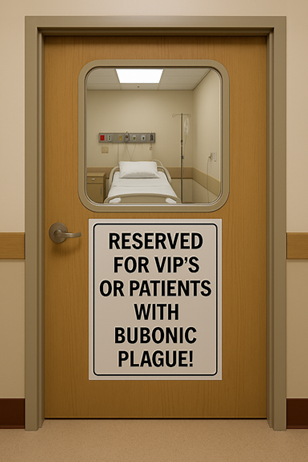
Room 33 was, as expected, semi-private. “Private rooms,” said our daughter, “are reserved for patients in bidud, quarantine.” After I had been in our semi-private room for a couple of hours, alone for the moment, a nurse came in and asked, “Would you like a private room?”
Perplexed, I guessed so. “So take your things and let’s go,” she said.
We gathered my belongings and crossed the hall into an alcove, within which was a large, empty room. As the nurse got things organized, she said to me, in a tone of surprise, “How do you know the surgeon, Dr T?”
“I don’t know him,” I said. “I just made an appointment, and he scheduled surgery.”
“Because he called me,” she went on, “and said I should put you in a VIP room. We usually use this room for patients in bidud, but since there’s no one here, it’s no problem for us.”
I was completely befuddled. Only later did I piece together what happened.
There is another doctor at the hospital whom I knew when he was two years old and his family lived in our town in the Old Country. We went to his Bar Mitzvah in another state. I saw him again, years ago, when he was a medical student. Since aliyahI I have run into him a couple of times, once in this hospital.
When he got wind of my admission—Jerusalem is a very small town–he called up my surgeon and identified me as a VIP, to be placed in an appropriate room.
I confess to two things. First, I felt funny getting special treatment when I have made a lifetime habit of not seeking any. Second, I really did enjoy the space of my large room and the privacy of being alone with my wife, daughter, and son. Having family present during hospital admissions is said to be essential in Israeli hospitals to supplement the efforts of overworked nurses. The night after surgery, without my daughter’s help, I would never have been able to disentangle myself from tubes and gowns.
As for VIP accommodations, more than one Israeli has told me, “You don’t need protektzia when you know people.”
When I later saw my benefactor in person, I thanked him warmly.
***
New vistas, new vocabulary
There are always new chances to learn specialized vocabulary. In the hospital you can learn: semicha, blanket, chaluk, robe, bechilah, nausea, lehisha’el, to cough, and irui, the IV thingy they leave in your arm in case you need an infusion, of fluids or medicine. And then there was the physiotherapist, who spoke to me in Hebrew which included the phrase teyk it izi. An Israeli friend assures me this is, in his words, “perfect Hebrew.”
Another interesting word I learned is matosh, applicator. You can put a matosh in a throat, or a nose, or an ear. Its etymology has nothing to do with the fact that you can also put it in a tush.
***
High-tech staff
***
How many cubic centimeters?
It has taken work to be able to answer sample questions like “How tall are you?” or “How much do you weigh?” because the answers my brain comes up with are in inches and pounds. Being asked them repeatedly during pre-op allowed me to say, with alacrity, “180 centimeters and 82 kilos!”
But when the nurse asked if I wanted some tea, I said yes. “Sugar?” Again yes. But then she asked, “How much?”
At once I thought: an eight-ounce glass is 240 cc. How do I say that? Until she said, “Capit?”—one teaspoon?
Right: How much sugar, not how much tea. So much to learn, so little time.
***
Off to the OR in two dimensions
The speedy trip to the operating room took me back to high school geometry, when we read the satire, Flatland, about a two-dimensional world.
Flat on your back on a speeding gurney, you can see nothing behind or beneath, and get just a blurry glimpse at what is ahead or on either side. All you can see clearly is a succession of ceilings that are either flat planes or arrays of rectangles.
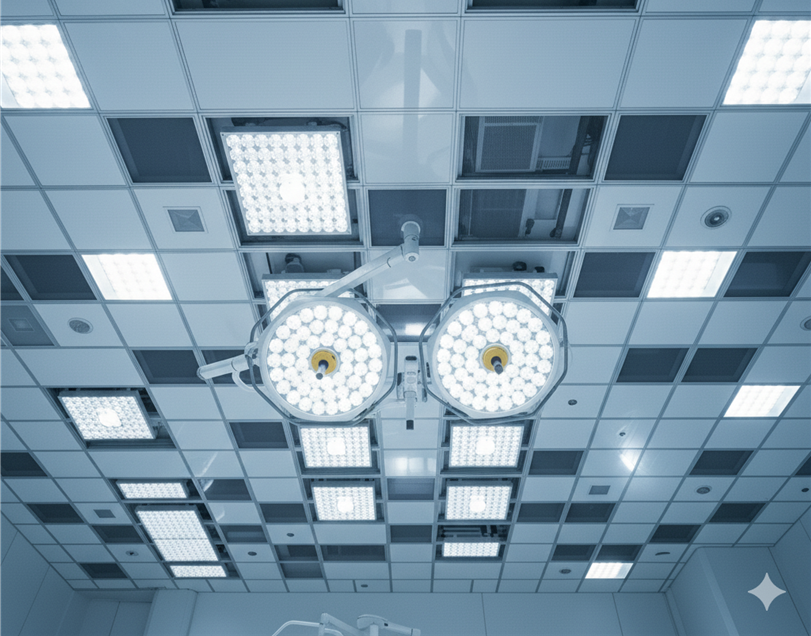
In the operating room itself, some of the rectangles are of ceiling tile, while others contain lights of different kinds. In the center of the room are two large, round lights—presumably spotlights for the surgical field. These are made of a kind of crystal glass. Their metal rims are decorated with light-yellow curlicues.
Ornamentation serves no functional purpose, and may be noticed at all by no one but a flattened rectangle with nowhere to look but up.
Meantime, you lie on your back, enveloped by furious activity. The anesthesiologist to your right pins down your right arm and inserts an intravenous line. Someone to your left does something on that side. People you can sense but not see press things that feel like pieces of moist gauze on your arms, on your forehead, for some unknown but crucial purpose. The surgical fellow, unrecognizable in her scrubs, comes over and asks—yet again—whether you have any allergies. Someone from behind presses an oxygen mask onto your face.
The rest was silence.
***
When I awoke, my daughter told me that the surgeon had indeed spoken with me when he was done. He described me to her as k‘tzat me’urpal, a bit foggy, which accounts for the fact that I have no memory of speaking to him then.
My daughter said I insisted on speaking with her in Hebrew, even when she asked me to speak English. “Your Hebrew was actually very good,” she said.
Great news. The next time Hebrew fluency escapes me, I’ll arrange for general anesthesia.
***
Crowds and celebrations
Shabbat was one day after my procedure. I was in no position to go anywhere, but my son went up two floors to the Bet Knesset, choosing one of five minyanim.
At first he was astonished by how many men had come, unable to grasp how so many could be connected with the hospital. Only when the Torah was taken out did he understand.
Reading the Torah involves honors: opening the Aron Kodesh, handing out seven aliyot, followed by maftir, then hagbahah and gelila. Every one of the eleven men so honored announced the birth of a baby. But after that, 14 more men lined up to make a Mi Sheberach prayer for their wives who had given birth.
In total: 7 girls were named. 18 boys had their upcoming brit milah announced. 25 new babies at one minyan!
Our hospital vies with Soroka in Beersheva for pride of place for number of deliveries per year, each with about 20,000.
This takes place against the background of demographic decline throughout the developed world. Break-even fertility is 2.1 children per woman. The UK has just dropped to 1.4, Finland has 1.3, Italy has been at 1.2 for a generation.
Explaining why people have children is above my pay grade. But I cannot think of a more emphatic way to express elemental faith in the future than by choosing to populate that future with your progeny.
What passes for normal life in Israel involves appalling personal risk at home, disapproval and disgust abroad. And so, then: Mazal Tov! Mazal Tov! And again, and more! And let the world go hang.
It is possible to esteem what you cannot explain. In Israel, there is often no choice.
***
Loud Visitors
Visiting hours end at 9:00 PM. On Motza’ei Shabbat, the mood on the was festive. In the private room next door to mine, the patient was a frail young teenager. Many visitors joined his family. They spoke with energy, in full voice.
They were still speaking that way at 11:30 PM. No staff member objected. My wife went out and gestured and was told, “They are just leaving.” Twenty minutes later they were still just leaving. The ward was not quiet till after midnight.
In Israel, many rules are barely polite suggestions. It is easy to admire the clamorous energy of Israeli life. It is hard to sleep next door to it.
***
A Heymish Shabbat
Friday afternoon there was a lovely sound of singing outside coming in from the hall. A few musicians went from room to room playing and singing nigunim. The feeling was soothing and warm.
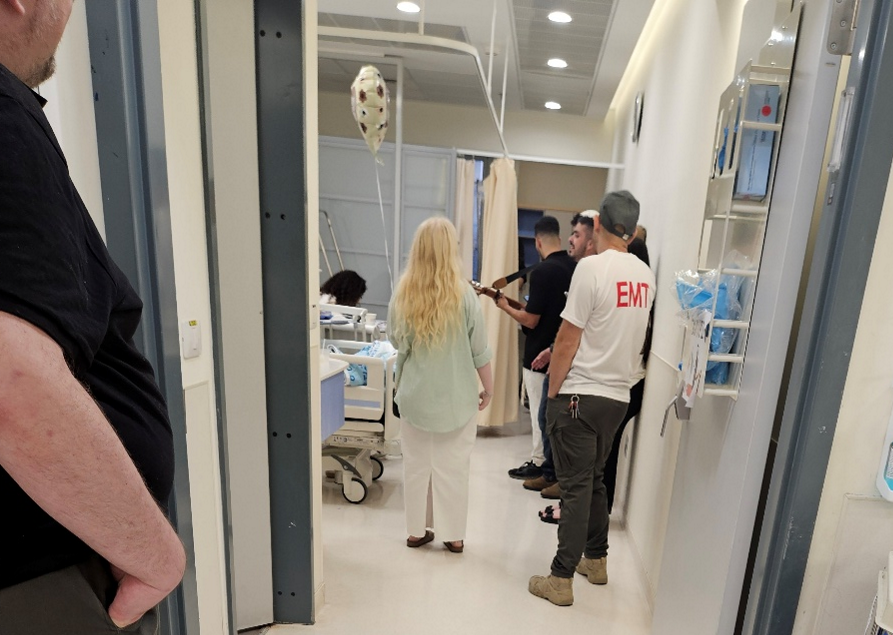
On Shabbat a caterer prepared boxed meals at no charge for those visiting hospital patients. These were filling, if not elegant. And you can’t argue with gefilte fish and cholent.
A short walk from the hospital, Yad Sarah, the redoubtable lender of medical equipment, offers rooms, small and spare but quite comfortable, for family visitors. At no charge.
After Shabbat a piping voice in the hall called out “Havdalah.” As we all gathered in the hall, a teenager with flowing peyot set up wine and a candle and small cups of cloves which were handed out. In this way the whole ward ushered Shabbat out.
Mi k’amcha Yisrael.
***
Hakarat HaTov
In English you “have surgery.” In Hebrew it is la’avor nituach—you pass through it. The passage can be a fearful one: the anticipation, the preparation, the procedure, the recovery. No one would want to undergo any part of it alone.
Words are not sufficient to express my gratitude: to the surgeon and the surgical staff, to the nurses and technicians and aides; to the caterers and the musicians who propped up flagging spirits; to my wife and children for being by my side; to the society that has produced an institution able to provide such cutting-edge competence, accompanied by care that revives the body and nourishes the soul. These are words, but there really are no words.
***
Innocence and Experience
Our Israeli grandsons came by, aged 8 and 11. The little one had taken me aside a few days before my admission. “Mommy said you’re going into the hospital,” he whispered. Then he made a frowny face. We hugged.
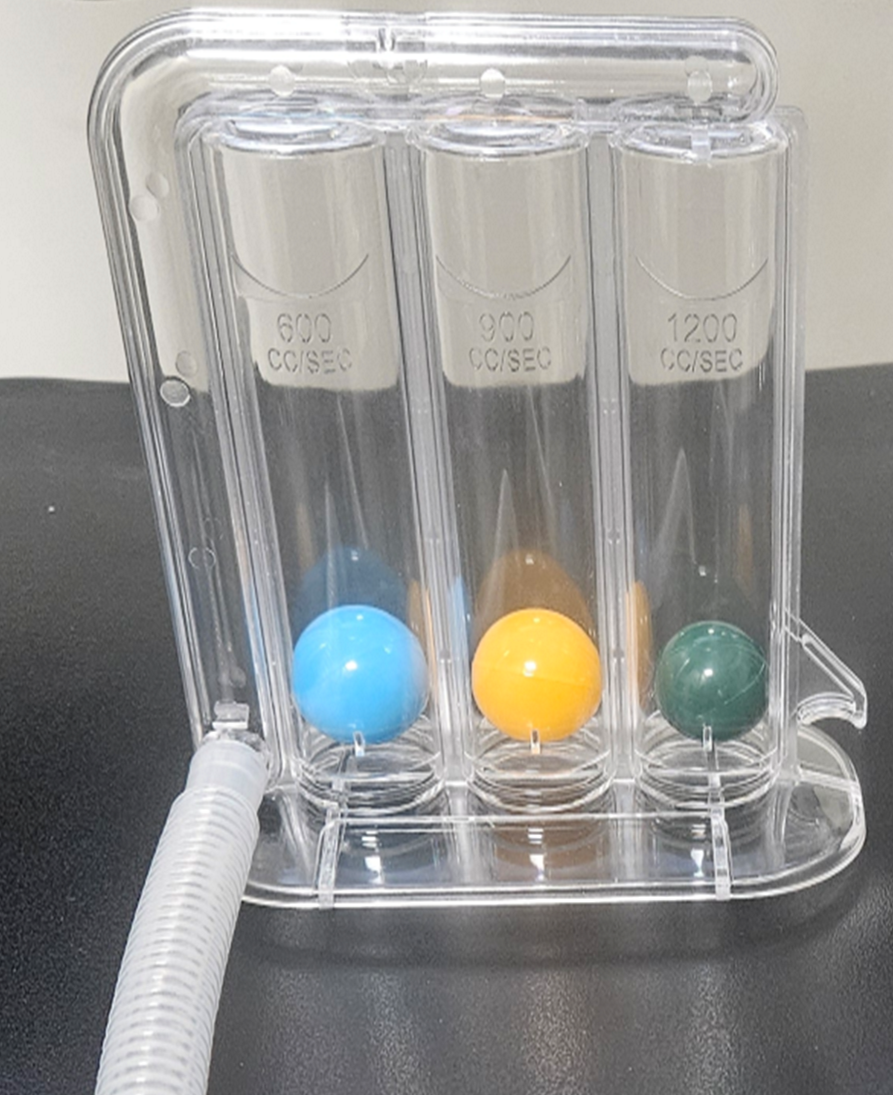
When they arrived, the little one was unhappy. He asked his mother if they could leave. Then he was distracted by the breathing apparatus next to my bed. He was delighted that he beat his big brother by inhaling hard enough to levitate all 3 colored balls.
His clear, bright eyes usually twinkle with delight or mischief. Now, for perhaps one of the first times, they were clouded by fear and sadness. I will remember his face from when our gazes met. He may, perhaps, remember mine.
I would like to think that he will.