In Bangladesh, Islamists Can Lose the Election—and Still Capture the State
Jamaat did not form the government, but the wider Islamist ecosystem may be reshaping the state from inside.
Bangladesh’s February election did not end the struggle over the soul of the state. It only changed the form of that struggle.
The Bangladesh Nationalist Party won power. Jamaat-e-Islami did not take the prime minister’s office. But Jamaat’s rise as a major parliamentary force has exposed a deeper question: does an Islamist movement need to formally rule a country if its ideology is already entering the institutions that govern it?
This is the question international readers should watch carefully. Bangladesh’s crisis is not only a rivalry between the Awami League, BNP, and Jamaat-e-Islami. That frame is too narrow.
The deeper concern is the rise of a wider Islamist ecosystem. This ecosystem includes Jamaat, other Islamic parties, madrasa-based networks, clerics, pressure groups, online activists, street movements, and institutional sympathizers.
By “Islamist ecosystem,” I do not mean Islam as a faith. I do not mean ordinary Muslims who pray, work, raise families, and want peace. I mean organized political, clerical, and street-based forces that use religion to define citizenship, pressure public culture, and narrow equal rights.
That distinction matters. Islam is a religion. Islamism is a political project.
Jamaat matters because of its history, discipline, and organization. But the danger today is larger than Jamaat alone. Political Islam can work through many channels at once.
One group contests elections. Another mobilizes the street. Another influences religious education. Another shapes online anger. Another pressures politicians, judges, police, or administrators. Together, they can change the mood of the state without formally controlling every office of power.
That is why the question is no longer only, “Did Jamaat win?”
The better question is, “Has Islamist ideology already entered the institutions that govern Bangladesh?”
A simple image may help. In politics, the election is the front door of the house. But a house also has windows, corridors, guards, keys, and hidden rooms.
A movement may fail to enter through the front door, yet still influence the house through the windows. In Bangladesh, those windows are the bureaucracy, courts, police, schools, border forces, military culture, religious networks, online movements, and street pressure.
That is how a state can be captured without one dramatic takeover.
Bangladesh was born in 1971 through a war of independence from Pakistan. Its founding identity was not Islamist. It was built on Bengali nationalism, secular citizenship, cultural identity, and resistance to Pakistani military domination.
That founding memory matters.
Jamaat-e-Islami historically stood against Bangladesh’s liberation struggle. But today the fear is not only that Jamaat may return through parliament. The deeper fear is that the anti-1971 mindset may return through institutions, public symbols, religious pressure, and the gradual rewriting of national memory.
Minorities understand this danger first.
Hindus, Buddhists, Christians, Indigenous peoples, secular voices, women, and the people of the Chittagong Hill Tracts do not experience Islamism as an abstract theory. They experience it as pressure in daily life.
They see it when a temple becomes controversial. They see it when a Buddhist monastery feels unsafe. They see it when a church is viewed with suspicion. They see it when Indigenous festivals are treated as foreign, tribal, or anti-state.
They also see it when public spaces are filled with majority religious symbols, while minority symbols are questioned.
The Palashbari Ram statue controversy is a clear example.
To someone outside Bangladesh, it may look like a local dispute over one Hindu statue. But to Bangladesh’s minorities, it raises a much larger question: do Hindus have the same public religious rights that the Muslim majority takes for granted?
If Muslims can build mosques, hold religious processions, raise Islamic religious flags, and fill public space with religious symbols, why should a Hindu statue become unacceptable?
The issue is not one statue. The issue is equal citizenship.
Minorities do not see Palashbari as an isolated dispute. They see it as a warning. Today it is a Ram statue. Tomorrow it may be a Buddhist monastery, a Christian church, a Sufi shrine, an Indigenous festival, a sculpture, or a cultural monument in the Chittagong Hill Tracts.
This is how a republic begins to shrink. Not always through law at first, but through pressure. Not always through violence, but through fear. Not always through official bans, but through the message that some citizens must keep their identity quiet.
The question is simple: does Bangladesh belong equally to all citizens, or only to the religious majority?
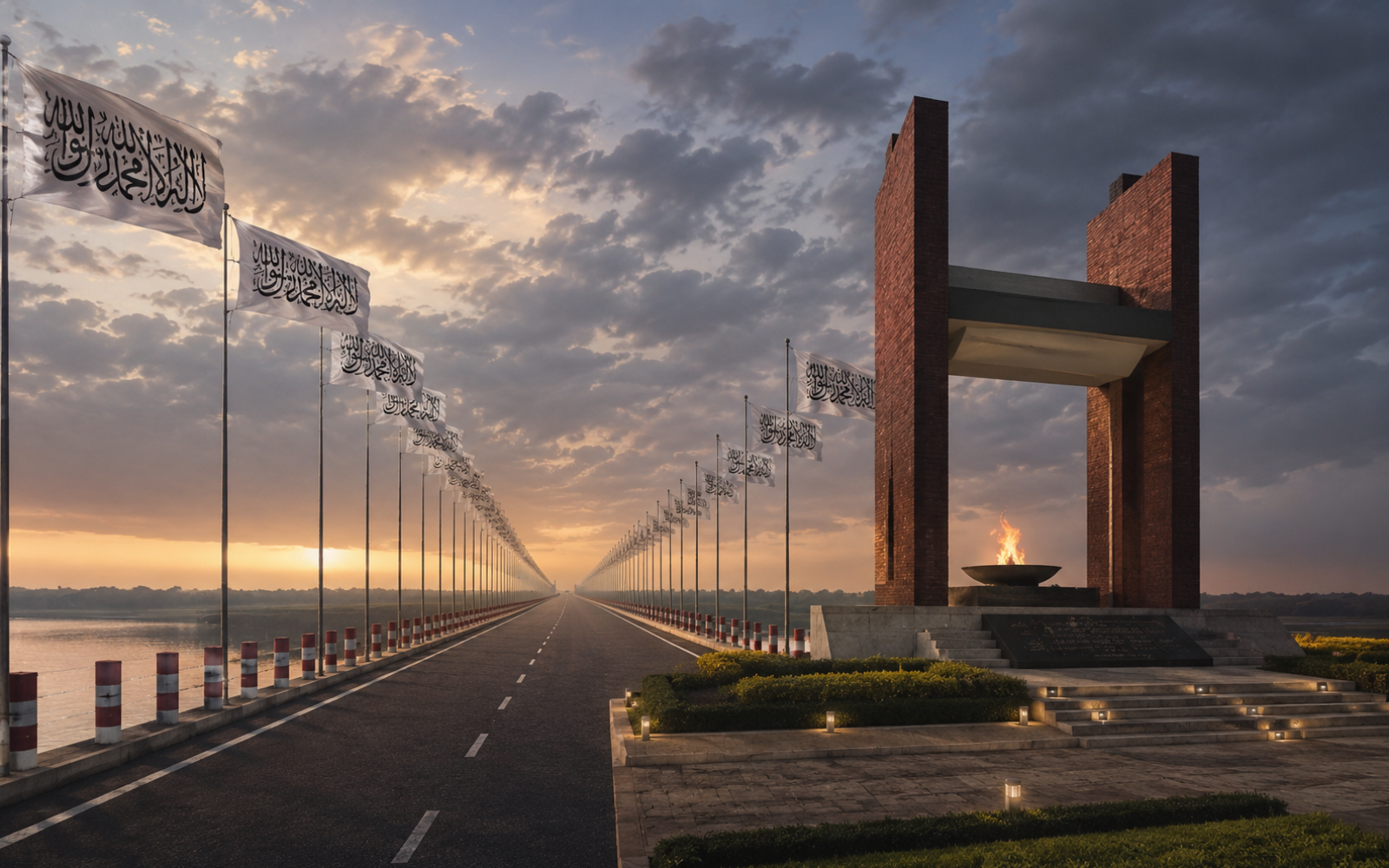
This is also why recent images of roads lined with white flags bearing Islamic scripture matter politically. The issue is not faith itself. The issue is what happens when public space begins to look like the territory of one religious-political identity.
When a football flag becomes a religious issue, when a cultural festival becomes suspicious, when a sculpture becomes offensive, when a temple becomes controversial, and when a national memorial becomes uncomfortable, the country has already begun to move.
By the time the wider public notices, minorities have usually felt the pressure for years.
This is why Shikha Anirban matters.
To outsiders, Shikha Anirban may look like only a small eternal flame inside Dhaka Cantonment. But for Bangladesh, it is not ordinary fire. It represents the memory of the Armed Forces martyrs of the 1971 Liberation War.
It is a military symbol, a national symbol, and a memory of sacrifice.
Claims and debates around Shikha Anirban must be handled carefully. Not every allegation can be treated as proven without independent verification. But even the controversy is politically revealing.
If a national military memorial becomes religiously uncomfortable to some actors, the issue is no longer ceremonial. It becomes a question of national memory.
Imagine a country’s eternal flame for its war dead being questioned because it does not fit a religious ideology. Every international reader would understand the danger.
The question would no longer be about fire. The question would be: who owns the memory of the state?
This is why the military question is so serious.
A military does not become ideologically captured only when it announces a coup or declares a religious state. It can change slowly through internal culture, promotions, rituals, silence, religious pressure, and unofficial tolerance of certain ideas.
If soldiers and officers begin to see national symbols through a religious lens, loyalty can gradually shift from constitutional duty to ideological loyalty.
That is dangerous for any country.
It is especially dangerous for Bangladesh because the military is deeply tied to the memory of 1971. If that memory is weakened, religiously filtered, or replaced by a new ideological language, the state begins to forget why it was born.
A republic needs a military that protects the constitution, not a military culture that judges national symbols through religious politics. It needs institutions that defend all citizens, not institutions that quietly absorb the worldview of one ideological camp.
The Chittagong Hill Tracts show what this means on the ground.
Indigenous peoples there have long faced suspicion when they defend their land, language, festivals, and identity. Their cultural expression is often treated as a security problem. Their political demands are often read not as citizenship claims, but as threats.
If Bangladesh becomes more religiously majoritarian, the pressure on Indigenous peoples will deepen.
Their festivals will be seen as strange. Their land rights will be seen as political threats. Their non-Muslim identity will be seen as weakness. Their culture will be pushed further to the margins.
That is why Islamist influence is not only a Dhaka problem. It is a hill problem, a minority problem, and a national survival problem.
The danger is not only that one Islamist party may control the state. The greater danger is that many Islamist forces may together reshape the state without formally taking full power.
This can happen through laws, schoolbooks, appointments, court culture, police behavior, military silence, street intimidation, online religious anger, and the constant accusation that secularism, minority rights, Indigenous identity, women’s freedom, or cultural pluralism are somehow anti-Islamic.
That is how a state changes.
Not in one day. Not through one speech. Not only through one party. But through a thousand small concessions.
Bangladesh’s secular promise is not anti-religious. It does not mean hostility toward Islam. It means the state belongs equally to all citizens.
A Muslim should be safe. A Hindu should be safe. A Buddhist should be safe. A Christian should be safe. An Indigenous person should be safe. A secular citizen should be safe.
The state must not ask which religion a citizen belongs to before deciding whether that citizen deserves protection.
That is the difference between a republic and an ideological state.
For Israel and international readers, the lesson is clear. Radical movements should not be measured only by how many seats they win in parliament. They should also be measured by how deeply their ideas enter the institutions of the state.
Bangladesh may still have elections, political parties, and a constitution. But if the institutions that enforce law, protect citizens, educate children, guard borders, command soldiers, and remember national history become ideologically captured, then democracy becomes only a surface.
The real question is not whether Jamaat-e-Islami won the February election. It did not form the government.
The real question is whether Jamaat and the wider Islamist ecosystem have already entered power through other doors.
A flame can be put out in one second. A statue can be stopped in one district. A festival can be questioned in one village. A minority can be silenced in one neighborhood.
But when these things happen together, they are no longer isolated incidents. They become a pattern.
Bangladesh must decide whether it will remain a republic of citizens or become a state quietly reshaped by ideological loyalty.
Because no country is lost only on election day. Sometimes a country is lost slowly, one institution at a time.
June 28, 2026
Tokyo, Japan