London based entrepreneur, cybersecurity analyst doing a PhD in AI
Abraham’s Question – Part 2.
Abraham’s Question — Part 2
The Prophet Who Asked for Evidence
Abraham عَلَيهِالسَّلام asked a question.
Not because he had abandoned faith.
Not because he had concluded that resurrection was impossible.
He asked because belief and demonstration are not the same thing.
The Qur’an records the conversation with unusual precision:
“My Lord! Show me how You give life to the dead.”
Allah responds:
“Do you not believe?”
Abraham answers:
“Yes, but so that my heart may be reassured.”
— Qur’an 2:260
That single exchange is important.
Abraham عَلَيهِالسَّلام does not say: I do not believe.
He عَلَيهِالسَّلام says:
Balā.
Yes.
Then comes the qualification:
Wa-lākin li-yaṭmaʾinna qalbī.
But so that my heart may be reassured.
Classical tafsir generally understood the request accordingly. Al-Qurtubi records the majority position that Abraham was not doubting Allah’s ability to resurrect the dead; he sought direct witnessing of what he already believed. Tafsir al-Jalalayn similarly distinguishes certainty reached through reasoning from the additional reassurance of direct observation. (Quran.com)
Then comes one of the Qur’an’s strangest demonstrations.
Allah does not merely give Abraham عَلَيهِالسَّلام another argument.
He gives him something to do. It almost looks like an experiment. There is a pedagogical point I am noting personally, which is not found in Tafsir – learning by doing is more powerful than simply observing.
“Take four birds…”
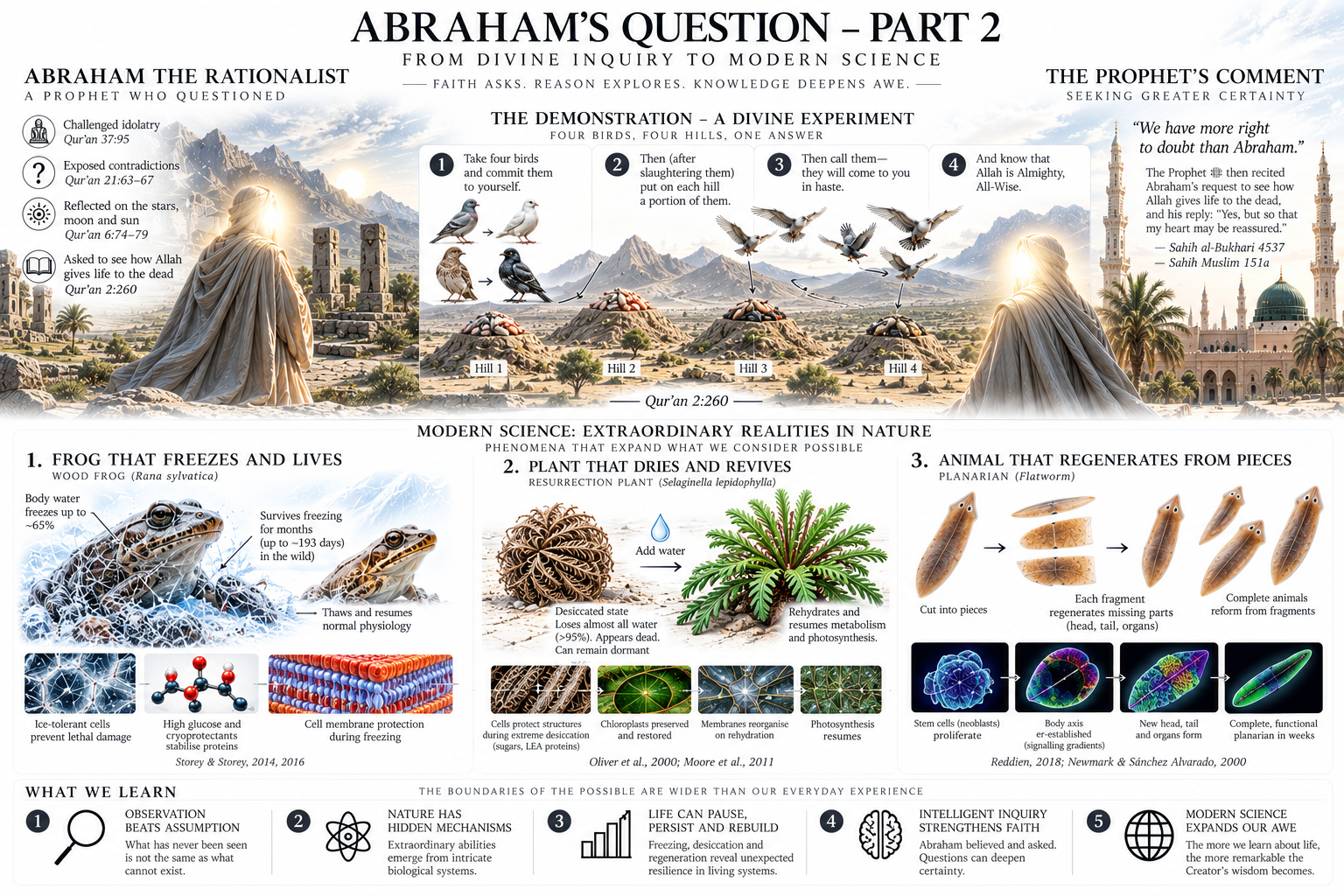
Abraham عَلَيهِالسَّلام is instructed to take the birds, and in the dominant classical interpretation, slaughter and divide them, place portions upon different hills, and then call them.
They return to him.
The verse concludes:
“And know that Allah is Almighty, All-Wise.”
— Qur’an 2:260 (Quranic Arabic Corpus)
Whatever else we call this episode, it has an intriguing structure.
There is a question.
There is a proposed demonstration.
There are physical objects.
There is an intervention.
There is an observation.
And there is a result.
It is not a scientific experiment in the modern methodological sense. Abraham عَلَيهِالسَّلام is not running controls, calculating confidence intervals or publishing a reproducible mechanism.
But it has something recognisably empirical about it.
Abraham عَلَيهِالسَّلام asks:
Show me.
And the answer includes:
Do something. Then Observe.
This should also apply to us. Pray for guidance, pray for the truth, pray for good character and work towards it in circumstances that demand it. And then expect improvement in yourself (and myself) – because I am as much in need as everyone else reading this.
“We Have More Claim to Doubt Than Abraham”
The Prophet Muhammad ﷺ later commented directly upon this passage.
Abu Hurayrah reported that the Messenger of Allah ﷺ said:
“We have more claim to doubt than Ibrahim…”
He then cited Abraham’s request to see how Allah gives life to the dead and Abraham’s answer that he believed but wanted his heart to be at rest.
— Sahih Muslim 151a (Sunnah.com)
The chapter heading under which Sahih Muslim places the narration is itself illuminating: “Increasing the heart’s tranquillity with the appearance of evidence.” (Sunnah.com)
The hadith should not be turned into the claim that Abraham عَلَيهِالسَّلام suffered a crisis of faith.
The Qur’an has already answered that question.
“Do you not believe?”
“Yes.”
Ibn Kathir explains the Prophetic statement in terms of seeking increased certainty. Al-Qurtubi likewise reports the majority view that Abraham never doubted Allah’s power to resurrect the dead. (Alim)
The interesting principle is therefore subtler.
Faith does not require the suppression of questions.
Abraham عَلَيهِالسَّلام believes and asks.
He possesses conviction and seeks observation.
He accepts the proposition and wants to understand its how.
That distinction makes Abraham عَلَيهِالسَّلام particularly interesting in an age of science.
Abraham the Rationalist
Calling Abraham عَلَيهِالسَّلام “the first rationalist” should be understood as a literary description, not a historical claim that he founded the later philosophical school called Rationalism.
But the Abraham presented by the Qur’an repeatedly reasons.
He asks questions.
He examines claims.
He constructs arguments.
He exposes contradictions.
Consider his confrontation with idolatry.
His people manufacture objects and then worship what they themselves have manufactured.
Abraham asks:
“How can you worship what you carve with your own hands?”
— Qur’an 37:95 (Quran.com)
It is a devastatingly economical argument.
You made the object.
The object did not make you.
So why have the causal roles been reversed?
In another episode Abraham destroys the smaller idols while leaving the largest.
When his people demand to know who destroyed their gods, Abraham replies:
“Rather, this—the largest of them—did it. So ask them, if they can speak.”
— Qur’an 21:63 (Quran)
Of course, that is precisely the problem.
They cannot answer.
The Qur’an says his opponents briefly “returned to themselves.” Then they protest that Abraham already knows the idols cannot speak.
And Abraham springs the argument:
“Then do you worship instead of Allah that which does not benefit you at all or harm you? … Will you not use reason?”
— Qur’an 21:66–67 (Quran)
The brilliance lies in forcing the premise to expose itself.
Abraham does not merely announce:
Your idols are false.
He constructs a situation in which his opponents must supply part of the argument themselves.
Ask your god.
It cannot speak.
Then why is it your god?
This resembles a thought experiment made physical.
The contradiction was always present.
Abraham simply made it impossible to avoid.
The Star, the Moon and the Sun
The same pattern appears in the Qur’an’s account of Abraham and the heavens.
The Qur’an first says:
“Thus We showed Abraham the realm of the heavens and the earth that he would be among those of certainty.”
— Qur’an 6:75 (Quran.com)
Then night comes.
Abraham sees a star.
“This is my Lord,” he says.
But the star sets.
“I do not love those that disappear.”
Then comes the moon.
It too disappears.
Then the sun—the greatest apparent candidate.
It too sets.
Abraham concludes by rejecting what his people associate with Allah. (Quranic Arabic Corpus)
Exegetes have discussed whether Abraham is being represented as progressing personally through this reasoning or, as many understand it, constructing an argument against his people’s celestial worship.
Either way, the Qur’anic argument works through observation and elimination.
Candidate.
Observation.
Failure.
Reject.
Candidate.
Observation.
Failure.
Reject.
The star disappears.
The moon disappears.
The sun disappears.
The Creator cannot simply be another transient object inside the system being explained.
Abraham’s intellectual character across these passages therefore has a striking consistency.
Test the claim.
Does the idol speak?
Does the celestial object remain?
Can resurrection be shown?
His faith is not portrayed as intellectual passivity.
It is relentlessly inquisitive.
And that brings us back to the birds.
The Four Birds as Demonstration
Abraham asks a question about something that appears impossible from ordinary human experience.
A living organism dies.
Its integrated biological processes cease.
Its body decomposes.
Its constituent matter disperses.
How could such a creature live again?
Allah could simply have replied:
Because I can do it.
Instead, Abraham is given a demonstration.
Four birds.
Physical separation.
A call.
Reassembly.
Life.
The theological claim is resurrection.
But the pedagogical method is striking:
what appears impossible from ordinary experience is demonstrated before the observer.
That matters because human beings routinely confuse two propositions:
I have never seen this happen.
and
This cannot happen.
They are not equivalent.
Science has repeatedly enlarged the space between them.
And modern biology contains examples that would sound almost absurd if we encountered them only as stories.
The Animal That Freezes
Consider the wood frog, Rana sylvatica.
Imagine finding a small vertebrate in winter whose body has frozen.
To ordinary intuition, freezing an animal should mean death.
Ice formation threatens cells mechanically and osmotically. Circulation cannot proceed normally. Normal physiological activity collapses.
Yet wood frogs possess remarkable adaptations to freezing.
Research on Alaskan populations found frogs surviving laboratory freezing down to approximately −16°C and enduring around two months frozen at −4°C. Field research subsequently documented wild frogs remaining frozen for an average of 193 consecutive days, with all 18 monitored animals in that study surviving. (PubMed)
Their biology deploys cryoprotective mechanisms, including enormous mobilisation of glucose and accumulation of other osmolytes, which limit cellular injury.
Then conditions change.
The frog thaws.
Physiology resumes.
It was not resurrected from biological death.
That distinction is essential.
But imagine describing the observation to someone who knew nothing of freeze-tolerant vertebrates:
The frog freezes for months. Then it thaws and continues living.
Without the mechanism, it sounds impossible.
With the mechanism, it becomes biology.
The Plant That “Resurrects”
Then consider Selaginella lepidophylla.
It is commonly called a resurrection plant.
The name is metaphorical, not theological.
The plant possesses extraordinary desiccation tolerance. It can lose almost all physiologically available water, curl into a dry-looking state and remain desiccated for extended periods.
Give it water and its tissues rehydrate.
Cellular structures reorganise.
Photosynthetic activity returns.
Research has examined how chloroplasts, membranes, enzymes and cellular organisation are preserved or restored during this process. (ScienceDirect)
A review describes S. lepidophylla as capable of surviving complete vegetative tissue dehydration and reviving when water becomes available. Other work reports that the plant can withstand complete desiccation for years before rehydration. (ScienceDirect)
Again:
this is not resurrection from death.
The biological machinery has entered an extreme survival state.
But without knowledge of desiccation tolerance, imagine encountering it.
A plant appears utterly dried.
No watering for months or perhaps years.
It looks dead.
Water arrives.
The structure opens.
Metabolism recovers.
Photosynthesis resumes.
What would once have sounded like folklore becomes plant physiology.
Cut the Animal Into Pieces
Now consider something closer to the visual intuition of Abraham’s birds.
The planarian.
Planarians are small flatworms possessing a remarkable population of adult stem cells called neoblasts.
Cut some species of planarian into pieces and the fragments can regenerate what is missing.
A fragment that lacks a head can produce a head.
A fragment lacking a tail can produce a tail.
Small pieces can restore an entire body plan, including nervous, digestive, sensory and excretory structures. (Springer Link)
This is not merely wound healing.
The remaining tissue must somehow determine:
What am I?
Where am I?
Which direction is head?
Which direction is tail?
What structures are missing?
How large should they become?
And when should growth stop?
Researchers describe planarian regeneration as involving stem-cell proliferation, restoration of body axes, organ scaling, tissue remodelling and bioelectric regulation. (ScienceDirect)
Some planarians can reconstruct an entire animal from remarkably small pieces, although regenerative capacity varies substantially among species. (Nature)
Again, this does not reproduce Abraham’s birds.
A planarian fragment contains living cells and regenerative machinery.
The Qur’anic demonstration concerns Allah showing Abraham عَلَيهِالسَّلام how He gives life to the dead.
They are categorically different claims.
But psychologically the comparison matters.
If someone had told a person unfamiliar with developmental biology:
I can cut this animal into pieces, and the pieces will reconstruct complete animals—
the claim might have sounded ridiculous.
Then came the experiment.
Cut it.
Wait.
Observe.
The impossible-looking event becomes a laboratory organism.
The Error of Calling the Unknown Impossible
This is where Abraham’s عَلَيهِالسَّلام question becomes surprisingly modern.
The point is not that science has “proved” Qur’an 2:260.
It has not.
Nor should freeze tolerance, regeneration or desiccation survival be described as miniature resurrections.
They are natural biological phenomena with physical mechanisms.
The point is epistemological.
Human intuition is a poor judge of the boundaries of nature.
We evolved to understand a narrow band of ordinary experience.
Objects fall.
Animals move.
Water flows.
Organisms die.
But venture beyond ordinary scales and conditions and nature becomes deeply counter-intuitive.
A frog can spend months frozen.
A plant can survive extraordinary desiccation.
A flatworm fragment can reconstruct missing organs and recover an entire body plan.
None violates natural law.
They reveal how little of nature ordinary intuition contains.
This changes the philosophical framing of Abraham’s question.
Abraham عَلَيهِالسَّلام does not say:
Resurrection is impossible.
He says:
Show me how.
That is an enormous difference.
Faith and the Experimental Temperament
There is a crude caricature in which religion begins where questions stop.
Abraham is an awkward figure for that caricature.
He interrogates idols.
He interrogates celestial objects.
He interrogates resurrection.
Not because everything is doubtful in exactly the same way, but because Abraham repeatedly moves from assertion towards examination.
The idol is tested by its inability to answer.
The star, moon and sun are tested by their transience.
Resurrection is answered with a demonstration involving four birds.
Abraham’s method might be compressed into three words:
Ask. Test. Observe.
Modern science formalised those instincts into something vastly more systematic: hypotheses, controlled experiments, measurement, reproducibility, statistical inference, peer review and revision.
Abraham was not conducting modern science.
But the intellectual disposition is recognisable.
Do not worship an object merely because everyone around you worships it.
Do not confuse inherited convention with truth.
Do not be embarrassed to ask how.
And do not confuse what you have never witnessed with what cannot exist.
From Knowledge to Reassurance
This may be why the wording of Qur’an 2:260 matters so much.
Allah does not condemn Abraham عَلَيهِالسَّلام for asking.
He clarifies the premise:
“Do you not believe?”
Abraham عَلَيهِالسَّلام answers:
“Yes.”
Then he explains the purpose:
“So that my heart may be reassured.”
Knowledge can have layers.
There is hearing a proposition.
There is understanding its logic.
There is seeing evidence.
And there is witnessing.
The Qur’an itself moves Abraham عَلَيهِالسَّلام through those layers.
Perhaps that is why the Prophet ﷺ could say:
“We have more claim to doubt than Ibrahim…”
The statement protects Abraham عَلَيهِالسَّلام rather than diminishing him. If Abraham were really suffering the kind of fundamental doubt attributed to him by a superficial reading, the Prophet’s rhetorical response would implicate everyone more strongly. Classical commentary instead treats Abraham as seeking greater certainty or direct witnessing. (Sunnah.com)
There is humility in that.
Human beings know very little.
The history of science is partly the history of things sensible people once considered impossible becoming measurable.
Not because everything imaginable is therefore possible.
That would be equally irrational.
Evidence cuts both ways.
But absence from ordinary experience is not proof of impossibility.
Abraham seems to understand the distinction.
He does not demand that reality conform to his intuition.
He asks to see more of reality.
Abraham’s Question
Perhaps, then, Abraham’s great question is not:
Can the dead live again?
The verse begins from his belief that Allah can give life.
His question is:
How?
“My Lord, show me how You give life to the dead.”
That may be one of the most intellectually consequential words in the passage:
kayfa.
How?
The question of mechanism.
The question behind much of science.
How does the frog survive freezing?
How does the resurrection plant preserve itself through desiccation?
How does a planarian fragment know what anatomy to rebuild?
How does an embryo construct a body?
How does consciousness emerge from biological tissue?
How did the universe acquire its present structure?
The answer “we do not yet know” is not a failure.
It is often the beginning of investigation.
Abraham’s عَلَيهِالسَّلام question therefore need not be read as the embarrassment in the story.
It may be the lesson.
He believes.
Then he asks.
Then he is shown.
And thousands of years later, standing in laboratories surrounded by phenomena that earlier generations could scarcely have imagined, human beings continue asking essentially the same question:
Show me how.
Author’s note :-
The natural phenomena discussed here are not presented as scientific explanations or naturalistic equivalents of the event described in Qur’an 2:260. Freeze tolerance, desiccation tolerance and planarian regeneration occur through biological mechanisms in organisms that retain living structures; the Qur’anic passage explicitly concerns Allah showing Abraham how He gives life to the dead. The comparison is epistemological: advances in knowledge repeatedly reveal that events which appear extraordinary or impossible to unaided human intuition can have realities and mechanisms we previously did not understand. The article therefore argues for intellectual humility, not for reducing a Qur’anic sign to a biological process.
Secondly, there are many more commercially “important” things like AI Safety, Public Policy I could write about – which would be of “material” benefit to my career. However, I write about religious understanding as I consider this the “core” purpose and need of a human being, and I write them wishing for everyone guidance to Islam which I firmly believe is the truth and the light, and anything apart from that is misguidance. Why don’t I just simply write about topics which I can “showcase” to potential clients or increase my public footprint – very simply – I do it seeking the pleasure of the one who controls every aspect of my life and I have to stand in front of – on the day of judgement when nobody will be able to “help” – no money, no children, or anything else. I am sure many of you, if not all of you, can relate to this from your personal experience – there are times in life – nobody or nothing can help – and the “hubris” of “modern life” – that we are in control of our “destiny” – goes firmly out of the window.
“And fear a Day when no soul will suffice for another soul at all, nor will intercession be accepted from it, nor will compensation be taken from it, nor will they be aided.” (Quran 2:48).
Third, I am not any religious scholar – this is just one person talking to another person(s) and written in that style. There is no “eloquent prose” or trying to write the next “Harry Potter”. If you want to convert to Islam – go to a Mosque – speak to an Imam, or seek out a Hafiz (who memorised the Quran) or an Alim (someone who understands Fiqh, and Hadith) or someone who you see going to a Mosque regularly.
And finally, a request to the Israeli leadership – let people pray at Al Aqsa. Keep politics out of religious worship. If you are confident in your theology – you are more than happy to create an open forum for Muslim Jewish public debate – one notable thing I found in my study of Judaism and Islam – The 99 names of God – is far more developed in Islam than in Judaism. These are things for Rabbis and Imams to discuss.
Related Topics
Related Posts