
In Golda’s Kitchen
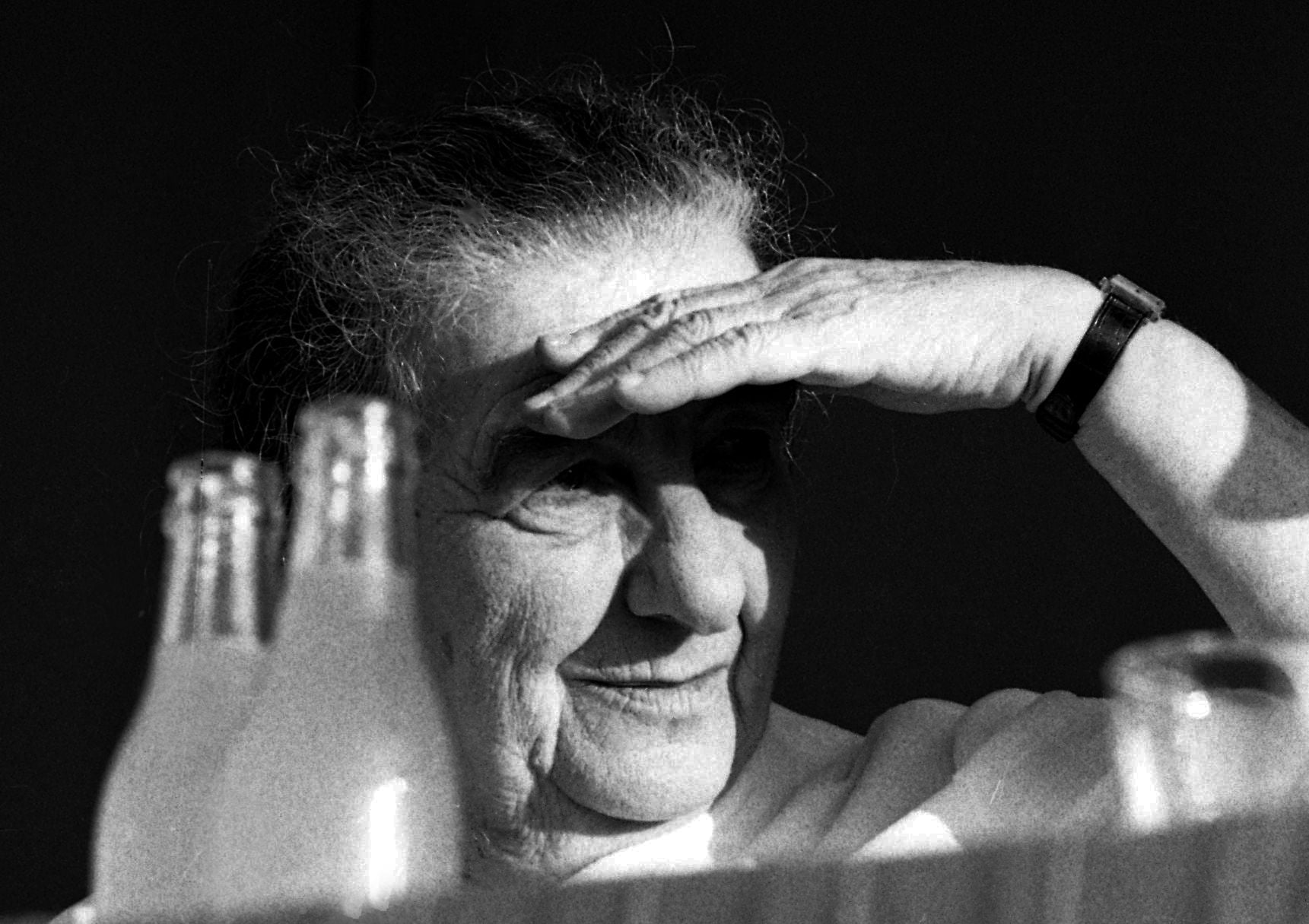
From the bathroom of a Moscow hotel to her green Formica table, Golda Meir never really left the kitchen. She turned it into an instrument of government: in Israel, the innermost circle of power is still called “the kitchenette.”
The room that matters
In many Jewish families, the essential room is not the living room. It is the kitchen. That is where mothers hand down a piece of family history: a gesture, a flavor, a habit inherited from another woman in another country. The kitchen tells the story of exile and keeps the taste of the place left behind, sometimes for good. When religious practice has all but faded, tradition tends to survive on the plate: Shabbat has been given up, the Friday-night meatballs have not.
Recipes, meanwhile, are jealously guarded. Some mothers are reluctant to hand over their technique in full, as if a complete handover might make them replaceable at the family table; what survives often fits into a handwritten notebook, warped and stained on the pages that count. Golda Meir, a global icon often cast as Israel’s matriarch, made the kitchen into something else: an instrument of government.
Moscow, 1948: A kitchen in the bathroom
In 1948, Golda was posted to Moscow to head Israel’s legation. Some twenty people went with her, unpaid, in exchange for room and board, and all of them moved into the Metropol, the hotel reserved for foreigners. A week later the hotel bill arrived and the diplomat nearly fell off her chair: the legation’s budget was thin, Moscow’s prices were not. Golda gathered the staff to announce, without debate, that from now on everyone would take a single meal a day in the hotel dining room; she would supply breakfast and dinner herself, and on Friday nights the whole team would dine together.
The logistics followed the very next day. With her secretary, Lou Kaddar, Golda bought electric hot plates and handed them out room by room, along with plates and cutlery borrowed from the hotel: there was nothing to be had in the shops of postwar Moscow. Once or twice a week the two women went to a market slightly cheaper than the city stores and filled their baskets with cheese, sausage, bread, butter and eggs, which they kept cold between the double windows. Those freezing mornings at the market were perhaps, she would write, the only truly pleasant thing in her seven months in the Soviet Union.
On Friday nights, Golda entertained the way Israelis do, without invitations: an open table, where she served her guests a slice of cake and a cup of tea. Through her hotel apartment came journalists, diplomats from other embassies, Jewish and otherwise, American businessmen passing through. In Moscow, Israeli diplomacy began around a teapot.
The next morning, Israel’s envoy cooked on her hot plate, in the bathroom of her “suite,” a hearty breakfast that doubled as lunch for her family and the legation’s “bachelors.”
Scratch the diplomat and you find a Jewish mother.
The right to a kitchen
Recalled in 1949, Golda became labor minister. Her ministry was in charge of the “Great Aliyah,” the mass immigration that began in late 1948 and lasted until 1952, bringing some 730,000 immigrants to Israel. The state had promised to take in everyone who came, without restriction. With no roofs to put over their heads, the newcomers ended up in the ma’abarot, transit camps of tents and huts where several families shared the same cramped quarters.
Her ministry launched vast housing and road-building programs, and Golda inspected the building sites relentlessly. Her visits, she concedes in her memoirs, were not always to the liking of the engineers and architects. In those tiny houses she found the kitchen so badly designed that it could not even be kept clean, and she demanded changes. To her mind, the bare minimum of a dignified life was a kitchen where one could actually cook for one’s family. The story goes that contractors dreaded her visits: each one, they said, cost them an extra million dollars.
The kitchenette of power
In Israel, the innermost circle of power is named after the room where onions are peeled: hamitbahon, literally “the kitchenette” – Golda’s “kitchen cabinet” – the small group with no official status with which a prime minister prepares decisions before putting them to the cabinet. And it is no figure of speech: the word comes from Golda’s kitchen. Having become prime minister in March 1969, after the death of Levi Eshkol, she made a habit of gathering a few loyalists on Saturday night, the eve of the cabinet meeting held on Sunday, the first day of the Israeli week. No protocol, just her green Formica table, which soon became famous.
An invitation to Golda’s kitchen was an honor, one of the regulars would recall. She served the coffee and the cheesecake or apple strudel herself, and took any offer of help as an insult. The coffee, black and strong, never ran out: two percolators, it is said, were always going on the stove.
The practice irritated those who were left out. In 1972, coalition partners demanded to be included, right down to the kitchen consultations. Golda replied with a smile that her kitchen had limited seating.
Then there is Kissinger. Legend, popularized by the 2023 film “Golda,” seats him in that kitchen in front of a bowl of homemade borscht; according to Golda’s son, he got tea and cookies instead, in the living room. The borscht belongs to the movies; the tea, to history. Golda is also credited with a famous retort: to Kissinger, who described himself as an American first, secretary of state second and a Jew third, she supposedly replied that in Israel we read from right to left.
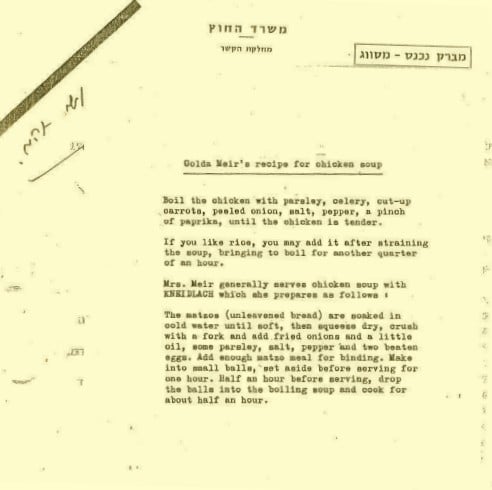
The kitchen followed her even into press conferences. On a state visit to the United States, she recounts in her memoirs, an American journalist asked her for the recipe for the gefilte fish her grandson raved about, and then whether she made a good chicken soup. She agreed to share it; within a week, the journalist had received some 40,000 requests from readers. It is hard to imagine the question being put to a male prime minister, and the anecdote says a great deal about the place assigned to women in politics at the time. The recipe held by the Israel State Archives, released in 2012, is typed in English on Foreign Ministry letterhead and refers to her in the third person, like a ready-made reply for the letters page. Here it is.
Golda’s chicken soup — Israel State Archives
One room
From the Moscow canteen to her table as prime minister, Golda never really changed rooms. If she wanted a kitchen for every immigrant family, it was because she knew what a table makes possible: bringing people together, and often winning them over. Legend credits her with dishes she never served; history remembers a woman who governed the way one hosts.
Her successors kept the word hamitbahon; none of them put on the apron.
Translated from the French. The original version appeared on Tel-Aviv | beyondthecitymag.com