
In Netanyahu’s Israel, Everyone Else Is the Left
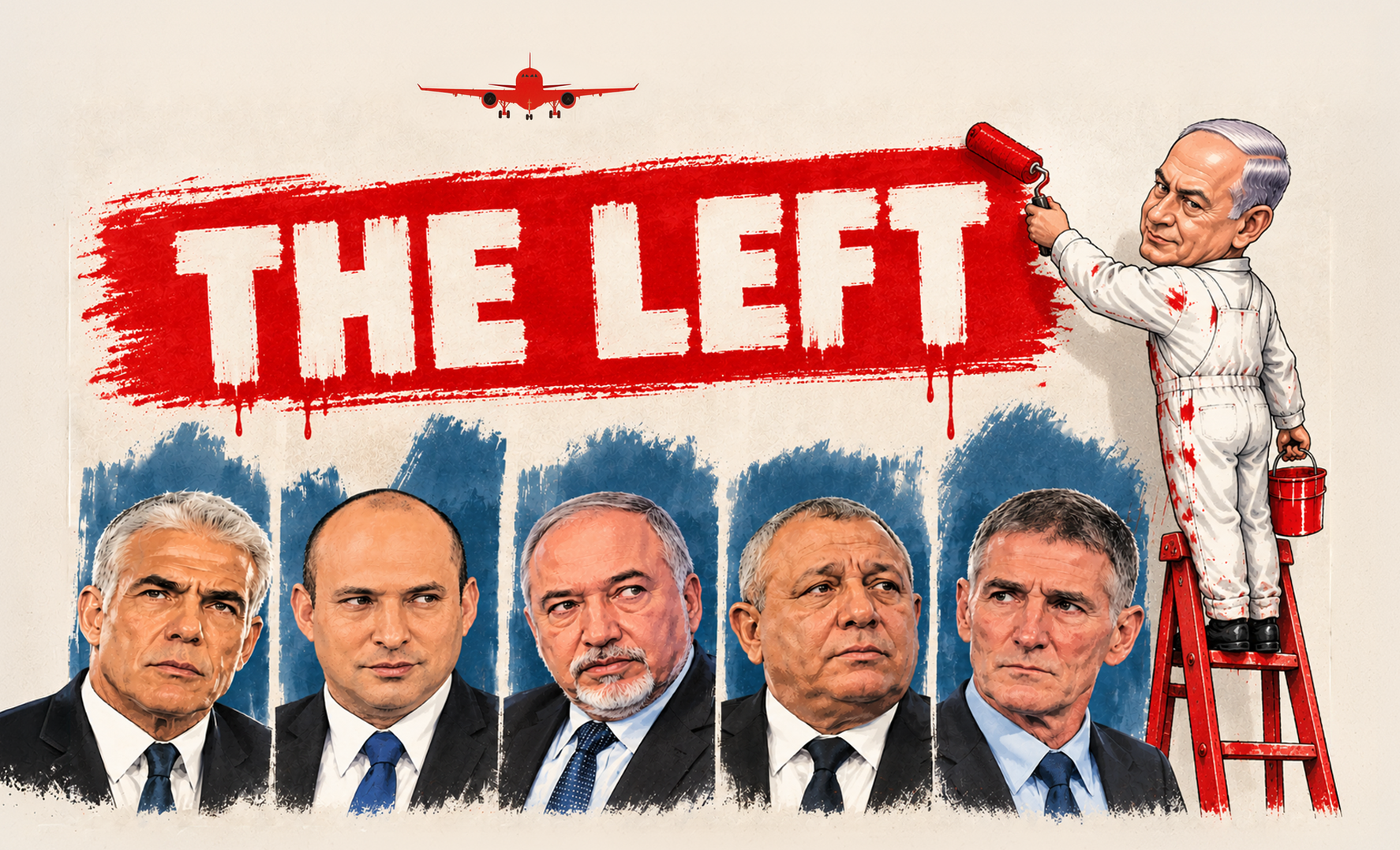
Less than 24 hours before the polls opened, Prime Minister Benjamin Netanyahu released a last-minute panic video aimed at residents of Judea and Samaria: “We are in danger, because the left is flying in its thousands from thousands of kilometers away to vote.” Election-day panic is an old tool, and Netanyahu is its master. In 2015 it was “the rule of the right is in danger. Arab voters are moving in droves to the polling stations. Left-wing organizations are busing them in.” Then it was buses; now it’s planes. It’s easy to laugh. But this sentence is not just another trick. It is a confession.
Look at who is running against him. Naftali Bennett, former director-general of the Yesha Council, the umbrella body of the settlements, who built his career in the very community Netanyahu is now addressing. Avigdor Lieberman, who lives in the settlement of Nokdim and once served as Netanyahu’s own defense minister. And Gadi Eisenkot, leader of the Yashar party and a candidate for prime minister: a centrist and former IDF chief of staff. In summer polls, opposition voters preferred Eisenkot over Bennett to lead the bloc. If Eisenkot is the left, one has to ask what is left of the right. None of the three is left-wing by any definition accepted in Israel a decade ago.
And that is exactly Netanyahu’s problem. A panic campaign needs a clear enemy. “Go vote, because Bennett or Eisenkot might win” won’t frighten a voter in the settlements of Eli or Kedumim. Many of them voted for Bennett in the past, and many served under Eisenkot. So Netanyahu has to turn them into “the left.” Not because it’s true, but because without it, he has no campaign.
The label has nothing to do with positions. It has everything to do with Netanyahu. Bennett was his chief of staff. Lieberman was director-general of his Prime Minister’s Office. Gideon Sa’ar was his cabinet secretary, became “left” when he founded a party against him, and became right-wing again when he returned to Likud. The label switches on when someone leaves him, and switches off when he comes back.
There is another side to this. The Israeli left, which once led governments, is now a junior partner. There is a left: its name is Yair Golan, and he is not running for prime minister. If the left were leading the bloc, Netanyahu would run against it. But when the bloc is led by figures from the right and the center, he has to pin the label on them. The word “left” has become empty enough for anyone to fill.
The pattern continues. Just days ago, Netanyahu claimed the left was embracing Ofer Winter, a reserve brigadier general identified with religious Zionism, so that Likud would lose. Winter, too, is now a problem of “the left.” The right is no longer defined by positions on security, settlement or the economy. It is defined by loyalty to one man.
The story of the flights fits the same pattern. Yes, Israelis are flying home to vote, and many of them presumably want change. Some 810,000 eligible Israeli voters live abroad, and Israel does not allow them to vote from there. For most Israelis living abroad, voting means making the journey home. Ultra-Orthodox voters have traditionally flown in en masse, mostly from New York. So what changed? Not the flights. For the first time in years, there is an alternative on the right, and Netanyahu knows that some voters, at home and abroad, simply want a different leader.
And notice the language. “We are in danger” is the phrasing of a storm warning or an earthquake alert, something coming from outside that must be defended against. That is how the prime minister talks about citizens coming to vote. In a democracy, an Israeli who travels all the way home to stand in line at a polling station is a reason for pride, not alarm. A prime minister should welcome it, even when he fears the vote won’t go to him.
His supporters will say the question is not who leads the bloc, but with whom he will form a government; that Bennett once sat with Yair Lapid and with the Islamist Ra’am party, that this time Yair Golan will be there too, so “left” is a fair description of the outcome. That is a legitimate argument, and it deserves a debate. But that is not what Netanyahu said. He did not say, “I fear their coalition.” He said the left is flying in its people. He is not arguing with his rivals. He is erasing them.
Why does it matter? Because the price is paid by the right-wing camp itself. A healthy political camp knows how to replace its leaders. It can say, “Thank you, now it’s someone else’s turn,” without betraying itself. When Netanyahu defines every right-wing rival as a leftist, he cancels that option. He tells right-wing voters they have no choice: him, or the enemy.
But the residents of Judea and Samaria, like every voter, do have a choice. They know Bennett, Lieberman and Eisenkot. Some have worked with them, some live next to them, some served under them. They know the left when they see it. And they know a frightened leader when they see one.