
In Sweden, hatred disguised as justice
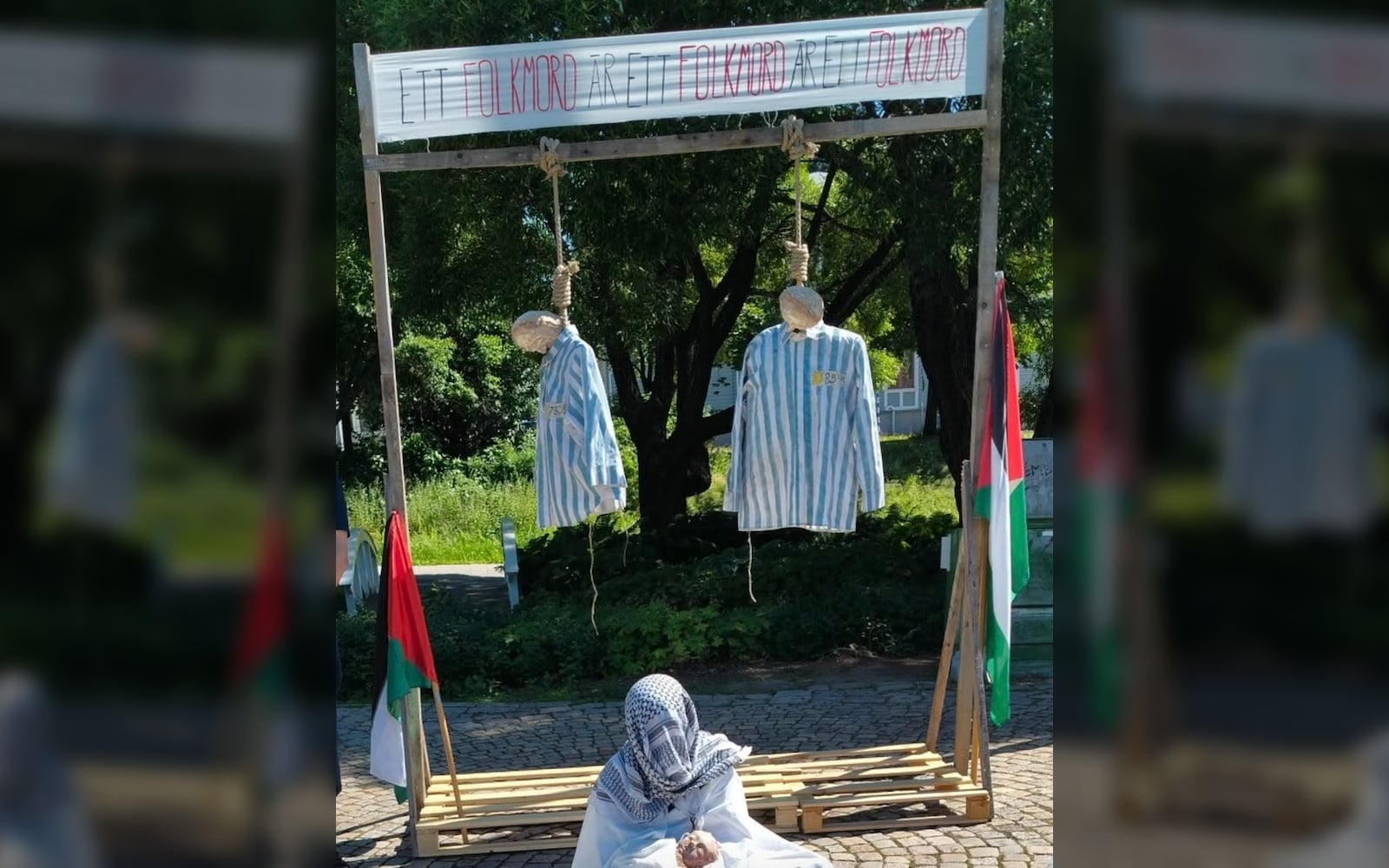
In the northern Swedish city of Umeå, a public display recently went up showing two striped Holocaust uniforms hanging from nooses under a banner that read: “A genocide is a genocide.” Below them sat a mannequin dressed in Palestinian attire, flanked by Palestinian flags.
It was not a plea for peace. It was not a cry for dignity. It was a chilling spectacle designed to provoke, inflame, humiliate.
This was not an act of solidarity. It was a grotesque inversion of history – one that dehumanizes Jews, appropriates the Holocaust, and fuels antisemitic violence under the hollow pretense of human rights advocacy. The message was clear: not just that Israel is akin to Nazi Germany – a vile distortion of history – but that Jews today are the moral inheritors of their murderers. That they deserve the same fate.
This is what happens when moral outrage collapses into moral perversion.
Whatever one’s view of the Israeli-Palestinian conflict, and there is no shortage of grief on all sides, displays like this do not serve justice. They erase nuance and history, replacing both with theatrical cruelty. They are not expressions of conscience but of vengeance. The suffering of Palestinians is desperate, but it is not honored by desecrating the memory of Jewish genocide.
Would we accept such tactics if they targeted other communities? Imagine a protest that used photographs of Bosnian genocide victims to condemn Muslim leaders – or dressed African refugees in Rwandan uniforms to shame Sudan. We would recoil in horror. We would call it what it is: an abuse of memory, a desecration of trauma, a politicization of pain. But when Holocaust symbols are twisted to indict Jews, the response is often silence, or worse, applause.
There is no moral equivalence between the industrial extermination of six million Jews and a tragic, asymmetrical war where civilians suffer horribly. Palestinian civilian deaths must be mourned – and, when necessary, investigated – but to call this a genocide is not just false. It is a calculated rhetorical weapon, meant to turn sympathy into hatred.
Such a display is not a criticism of Israeli policy. It is psychological warfare against the Jewish people.
And it is no coincidence that this rhetoric is rising alongside antisemitic violence across Europe. Jews are being harassed in the streets, synagogues vandalized, Holocaust survivors heckled. And now, in Umeå, Jews are once again hung in effigy, as if to say: Look what you’ve become. Look what you deserve.
Those responsible for this display may claim to be speaking for the oppressed. But justice does not hang Jews from nooses. Justice does not mock genocide. And justice is never served by reanimating the symbols of humanity’s darkest chapter to score points in today’s political theater.
What frightens me most is not just the act itself, but the context that enables it. We are living in an era where language has fractured – where speech has become an arms race of accusation, performative virtue, and dehumanization. To speak plainly, to mourn sincerely, to ask for perspective – these things are now suspect. In a climate thick with vulgar rhetoric and vengeful slogans, the space for shared moral understanding is vanishing.
And so I ask: where are the voices willing to say this is a step too far?
I urge Sweden’s leaders, artists, teachers, and citizens: do not let this pass in silence. You can support Palestinian rights without desecrating Jewish memory. You can call for peace without invoking lynch imagery. You can criticize Israeli policies without indulging in the psychological tropes of antisemitism.
Hatred disguised as justice leads to the same destination as open hatred. And silence, especially now, is not neutrality. It is complicity.