
Why Christians Must Reject ‘The Jews Killed Jesus’
Rome crucified Jesus, a few leaders in Jerusalem handed him over, and Jesus said he laid down his own life. Here’s what the New Testament says about who was responsible, and why “The Jews killed Jesus” is false and dangerous.
Imagine it’s Good Friday in Rome, in the spring of 1500.
You live in the Jewish quarter, a few crowded streets along the Tiber, the river that winds through the middle of the city. You know the smell of the fish market near the old Roman columns of the Portico of Octavia. When the Tiber floods, it floods your street first.
Maybe your family has lived here for centuries, or maybe you arrived eight years ago with whatever you could carry, after the king and queen of Spain gave every Jew in their kingdom a choice: be baptized or leave.
Either way, you know what today is.
By church law, you may not leave your house today. So you stay inside. You bolt the door. You pull the wooden shutters closed and latch them. Your children ask why, and you tell them what your parents told you: on this day, we stay home.
Then you hear them. First it’s only a murmur. Then the sound of feet, hundreds of them, on stone. The sound is accompanied by a vibration, and it grows until it rattles the bowls on your family’s table.
Through a crack in the shutters, you see them. Men in long white robes, their faces hidden under peaked hoods. At the front, someone carries a tall banner. These are the brothers of the Gonfalone, Roman laymen you may do business with the rest of the year.
They’re walking to the Colosseum, where thousands of Romans will watch Jesus betrayed, beaten, and crucified. The play tells them in gruesome detail who is to blame.
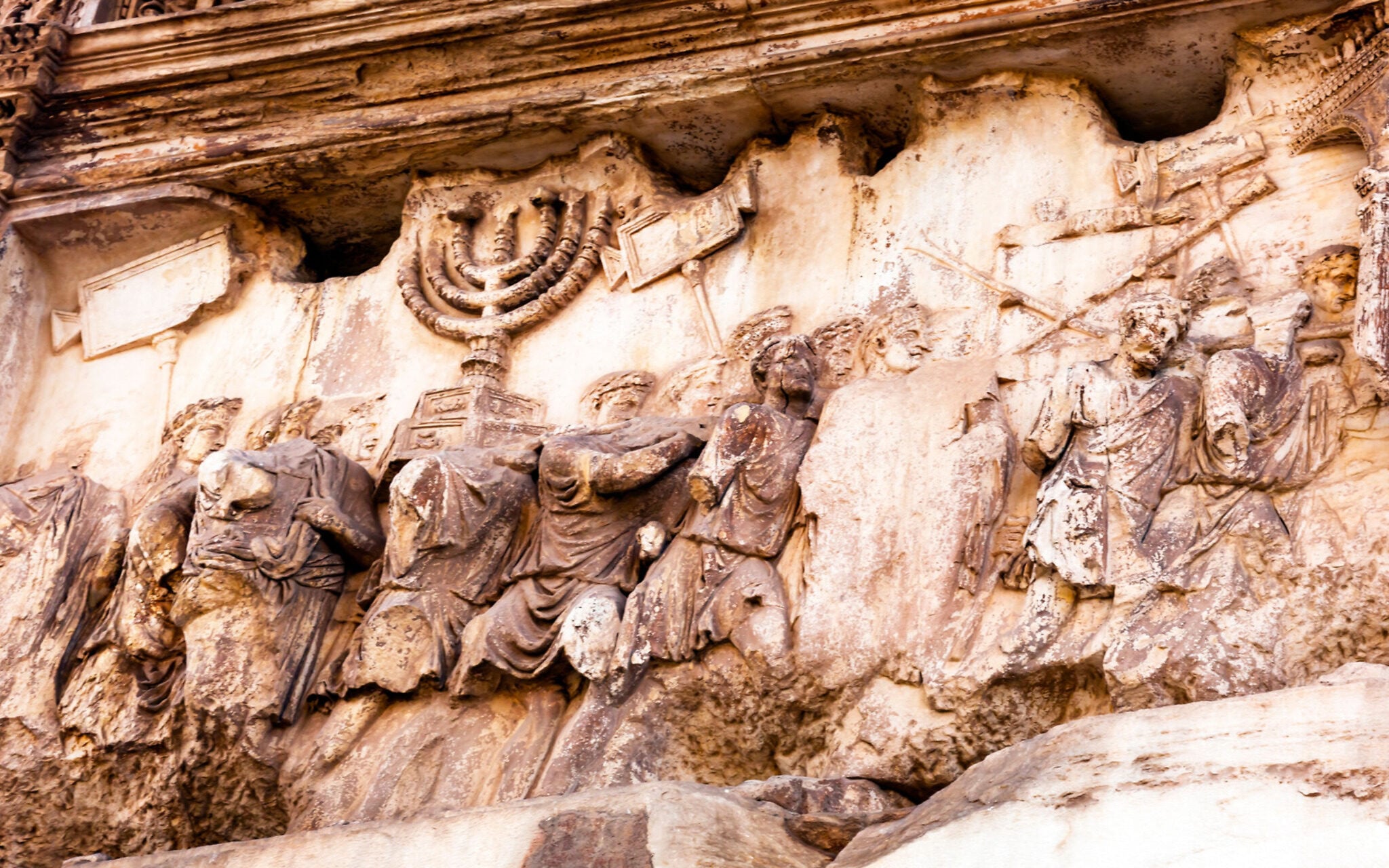
You know something about that arena that most of the crowd has forgotten. Rome built the Colosseum with treasure carried off from Jerusalem after its legions destroyed the city and the Temple in AD 70. A short walk away, at the edge of the Roman Forum, stands the Arch of Titus, which Rome built to celebrate that victory. Depicted on its inner wall are Roman soldiers parading the treasures of the Temple through the streets, the golden menorah carried high on their shoulders. Your people have a tradition: you don’t walk beneath it.
Toward evening, you hear them again. This time they’re singing hymns. Under the singing, there is another sound, sharp and steady: the crack of whips. The brothers are flogging their own backs as they walk. Among them, they carry a man playing the dead body of Jesus.
You sit in the dark with your children and wait. You don’t know whether this will be the year the crowd comes looking for you.
For almost forty years, the plays go on. In 1539, a riot breaks out as the procession passes through the Jewish quarter. Afterward, Pope Paul III ends the plays for good.
The shutters, the hoods, the whips, and the riot all grew from one accusation.
Almost five hundred years later, the same accusation shows up under my social media posts: “The Jews killed Jesus.”
If you’re a Christian, you may not know what to say back. If you’re Jewish, you’ve likely heard it more times than you can count. This essay answers it.
What Actually Happened at the Cross?
In Jesus’ time, Judea was under Roman rule. Crucifixion was Rome’s punishment to give, and in Jerusalem that power rested with the Roman governor, Pontius Pilate.
So Pilate gave the order, and Roman soldiers carried it out. They beat Jesus, mocked him, and crucified him (Mark 15:15–24). Above his head they posted the charge: “The King of the Jews” (Mark 15:26). It was a political charge, naming him a rival to Caesar.
The night before, Judas led an armed crowd, sent by the chief priests, scribes, and elders, to arrest Jesus in the dark (Mark 14:43). In the morning, the high priest Caiaphas, who held his office at Rome’s pleasure, and the chief priests handed him over to Pilate (Mark 15:1; John 18:28). As John tells it, they could not put him to death themselves (John 18:31).
These were specific men in a specific moment. They didn’t even speak for the whole council. Joseph of Arimathea was a member, and Luke says he “had not consented to their decision and action” (Luke 23:50–51). Nicodemus, another leader, defended Jesus (John 7:50–51). Together, those two men buried him (John 19:38–42).
A crowd stood in Pilate’s courtyard and shouted, “Crucify him” (Mark 15:13). That was one crowd, on one morning, in a city packed with Passover pilgrims.
Now look at who stood with Jesus. His mother was Jewish. His disciples were Jewish. The women at the cross were Jewish (John 19:25).
So “The Jews killed Jesus” takes the actions of a few men and assigns them to a whole people. That people includes Jesus himself, his mother, and every one of his apostles. Imagine blaming every American alive today, and their grandchildren, for a verdict handed down by a handful of officials in one courtroom. No one would accept that reasoning about any other people.
Who Does the New Testament Say Is Responsible for Killing Jesus?
The New Testament answers this question more than once, and its answer is much wider than “the Jews.” After Peter and John were arrested and released, the first believers in Jerusalem prayed together and named everyone who had stood against Jesus:
“[F]or truly in this city there were gathered together against your holy servant Jesus, whom you anointed, both Herod and Pontius Pilate, along with the Gentiles and the peoples of Israel…” (Acts 4:27)
Jews and Gentiles appear on the same list, and the believers who prayed it were Jewish themselves. They named their own people alongside Rome, and they did not give any one group the whole blame.
The next line says all of them did “whatever your hand and your plan had predestined to take place” (Acts 4:28). God planned it, and Jesus chose it. “No one takes it [my life] from me,” he said, “but I lay it down of my own accord” (John 10:18). In the end, no one took his life. He gave it.
From the cross, Jesus prayed, “Father, forgive them, for they know not what they do” (Luke 23:34). He did not curse them.
Paul gives the reason Christians believe Jesus died: “Christ died for our sins in accordance with the Scriptures” (1 Corinthians 15:3). For Christians, the cross is not first about what a few men did to Jesus. It is about what Jesus did for us. Christians have long read the suffering Servant in Isaiah as a portrait of Jesus:
“But he was pierced for our transgressions; he was crushed for our iniquities… and the LORD has laid on him the iniquity of us all.” (Isaiah 53:5–6)
Jewish tradition generally reads the Servant as Israel, and I don’t ask Jewish readers to read the passage my way. For Christians, the words that stand out are “our” and “us all.” A Christian who blames “the Jews” for the cross is pointing at someone else for what his own sins required.
What About the Verses That Are Used to Blame the Jews?
Three Bible passages are quoted most often to make this accusation.
“His Blood Be on Us and on Our Children”
In Matthew’s Gospel, Pilate washes his hands of Jesus’ blood. The crowd answers, “His blood be on us and on our children!” (Matthew 27:25). For centuries, preachers used that line to say the Jewish people had cursed themselves forever.
Read it slowly. These are the words of a crowd accepting responsibility for a verdict. Matthew records what they shouted. He doesn’t say God appointed them to speak for every Jew. Nor does the crowd’s reference to its children establish inherited guilt. The Tanakh is clear: “The son shall not suffer for the iniquity of the father” (Ezekiel 18:20).
Notice, too, what Matthew has already said about Jesus’ blood. At the Last Supper, only a chapter earlier, Jesus lifted the cup and said, “This is my blood of the covenant, which is poured out for many for the forgiveness of sins” (Matthew 26:28). The meaning Jesus gives his blood is forgiveness. A reading that turns it into a permanent curse on his own people must reckon with those words.
“The Jews” in John’s Gospel
When John writes “the Jews,” the Greek word he uses is Ioudaioi. It can mean “Jews,” but it can also mean “Judeans,” the people of the region around Jerusalem. John uses it in more than one way, and the context decides which. Sometimes it simply means Jewish people. Often it means one specific group: the Temple leaders who opposed Jesus, the way we might say “Washington decided” when we mean a few officials.
The story of the man born blind shows the difference. His parents were afraid to speak about Jesus “because they feared the Jews” (John 9:22). The parents were Jewish. They were afraid of the religious authorities who could put them out of the synagogue. The same Gospel has Jesus say that “salvation is from the Jews” (John 4:22).
“The Jews, Who Killed Both the Lord Jesus and the Prophets”
In one of his earliest letters, Paul writes that believers in Judea suffered from “the Jews, who killed both the Lord Jesus and the prophets, and drove us out” (1 Thessalonians 2:14–15). He is comforting Gentile believers in Greece whose own neighbors had turned on them. In Greece, Gentiles persecuted Gentile believers. In Judea, Jews persecuted Jewish believers. Paul himself was a Jew. When he writes that they “drove us out,” he counts himself among the Jews who were driven out. He is describing specific people, in the same harsh voice Israel’s prophets used to rebuke their own.
Paul’s longest teaching on the Jewish people, in Romans 9–11, points the other way. There he asks, “has God rejected his people?” and answers, “By no means!” (Romans 11:1). Christians cannot use his rebuke in Thessalonians to cancel his answer in Romans.
When the accusation appears, at church or online, you can answer it. You don’t have to win an argument. You need to know what the passages say. You need to refuse the leap from a few men’s actions to a whole people’s guilt. You need to remember what you yourself confess every time you pray: that your own sins needed the mercy of the cross.
If you need words, here is one way to answer:
The Romans crucified Jesus. A few leaders in Jerusalem handed him over. Jesus, his mother, and every one of his apostles were Jewish. Jesus said no one took his life from him. He laid it down for the sins of the whole world, mine included. That’s no reason to turn against Jewish people today. If anything, it’s a reason to stand with them.
If the New Testament does not blame the Jewish people, where did the accusation come from?
How Did the Accusation Spread?
One of the earliest clear statements of the accusation comes from Melito, a second-century bishop in Sardis. In a sermon for Passover, he said, “God has been murdered, the king of Israel has been put to death by an Israelite right hand” (On Pascha 96). Scholars still debate what Melito intended. The accusation that the Jewish people had killed God became known as deicide. Over the centuries that followed, the charge spread through sermons, plays, and church teaching, until the actions of a handful of men in Jerusalem were laid on every Jew who would ever live.
In medieval Europe, Passion plays brought the accusation before public audiences. In some places, as in Rome, the performances helped provoke attacks on Jewish neighbors during Holy Week.
In 1543, Martin Luther wrote On the Jews and Their Lies. At Nuremberg in 1946, the Nazi publisher Julius Streicher told the court that Luther “would very probably sit in my place in the defendants’ dock today.” The Passion play in Oberammergau, Germany, has been performed since 1634. Hitler attended it twice, and records of his wartime conversations show him praising the play’s usefulness in promoting hatred of Jews.
Nazi antisemitism treated Jews as a racial enemy, but it drew on prejudices that centuries of Christian teaching had helped establish. Christians cannot account honestly for the Holocaust while overlooking the hostility toward Jews taught in their own churches.
The accusation has not stayed in the past. The American Jewish Committee has documented how the old “Christ killer” charge is now recycled in attacks on Israel, with Palestinians described as being “crucified” by Israelis.
How Has the Church Answered the Accusation?
Even while the accusation spread, some in the church taught the opposite. In 1566, the catechism of the Council of Trent taught that “our crime in this case is greater in us than in the Jews,” and the Catholic Catechism still teaches it today (CCC 598). After the Holocaust, churches were forced to look at what their own teaching had done. In 1965, the Second Vatican Council’s declaration Nostra Aetate said that Jesus’ death cannot be charged against all the Jews of his day or against Jews today. It said Jews must not be presented as rejected or accursed by God, and it condemned antisemitism. In 1994, the Evangelical Lutheran Church in America rejected the “violent invective” of Luther’s writings against the Jews.
Rabbi Eugene Korn has written that no idea did more to bring humiliation, persecution, and murder on the Jews of Christian Europe than the charge of deicide. He also writes that Jews today have allies in faithful Catholics who reject it. Christians of every tradition can join them.
Why Is the Cross a Jewish Story?
The deepest problem with “The Jews killed Jesus” is that it pulls the cross out of the story it belongs to. Jesus was born a Jew. He died at Passover, the feast that remembers how God rescued Israel from Egypt. His Jewish mother stood near the cross with other Jewish women (John 19:25). The sign above his head, “The King of the Jews,” was written in Aramaic, Latin, and Greek for everyone to read (John 19:20). Rome meant it as mockery. The Gospel writers believed it was true.
The night before he died, Jesus took the cup and said, “This cup that is poured out for you is the new covenant in my blood” (Luke 22:20). Those words point to a promise God made through the prophet Jeremiah: “I will make a new covenant with the house of Israel and the house of Judah” (Jeremiah 31:31). God promised the new covenant to Israel. Christians believe the cross is God keeping his word to Israel.
Paul warned Gentile believers never to forget where their faith came from. He pictures them as wild branches grafted into Israel’s olive tree, drawing life from a root that was there before them: “remember it is not you who support the root, but the root that supports you” (Romans 11:18). He calls Israelites who have not accepted the gospel “beloved for the sake of their forefathers” (Romans 11:28). Paul also wrote that in Christ, God had broken down “the dividing wall of hostility” between Jews and Gentiles (Ephesians 2:14). A Christian who uses the cross to blame the Jews is trying to rebuild the very wall the cross tore down. Blaming the Jews for the cross means blaming the people God was keeping his promises to. God’s faithfulness to Israel calls for gratitude toward the Jewish people, and the courage to stand beside them.
Who Stopped on the Road?
During the Holocaust, many Christians looked away, and some took part. Still other Christians risked their lives to hide their Jewish neighbors.
In the village of Markowa, in southeastern Poland, lived a Catholic farmer named Józef Ulma, his wife, Wiktoria, and their six children. Late in 1942, as German police hunted the Jews of the region, the Ulmas took eight Jewish people into their home: Saul Goldman and his four sons, Baruch, Mechel, Joachim, and Moses; two sisters, Gołda Grünfeld and Lea Didner; and Lea’s little daughter, Reszla.
The Ulmas hid them for more than a year. Then, early on the morning of March 24, 1944, German gendarmes came to the farmhouse. They killed the eight people the Ulmas had sheltered first. Then they killed Józef and Wiktoria, who was late in her pregnancy with their seventh child. Then they killed the children: Stanisława, Barbara, Władysław, Franciszek, Antoni, and Maria. The oldest was seven. Seventeen people were murdered that morning, counting the child Wiktoria carried.
The Ulmas’ Bible survived. In 2023, when the Catholic Church beatified the whole family, the priest who led their cause described what was inside. In the Gospel of Luke, Jesus tells the parable of the Good Samaritan, who stops for a beaten stranger when others pass by (Luke 10:25–37). In the Ulmas’ Bible, the heading of that parable was underlined in red. Beside it, someone had written one word in Polish: tak. Yes.
Jesus ends the parable with a command: “You go, and do likewise” (Luke 10:37). When eight people came to their door, the Ulmas did.
Five hundred years ago, on Good Friday, Jewish families in Rome bolted their doors, latched their shutters, and waited to learn whether the crowd would come looking for them. The church owes their children more than silence. It owes them the truth, spoken out loud.
Scripture quotations are from the ESV® Bible (The Holy Bible, English Standard Version®), © 2001 by Crossway, a publishing ministry of Good News Publishers. ESV Text Edition: 2025. The ESV text may not be quoted in any publication made available to the public by a Creative Commons license. The ESV may not be translated in whole or in part into any other language. Used by permission. All rights reserved. Biblical references appear in the text.