"These fragments I have shored against my ruins"
In the Birch Meadow of Birkenau
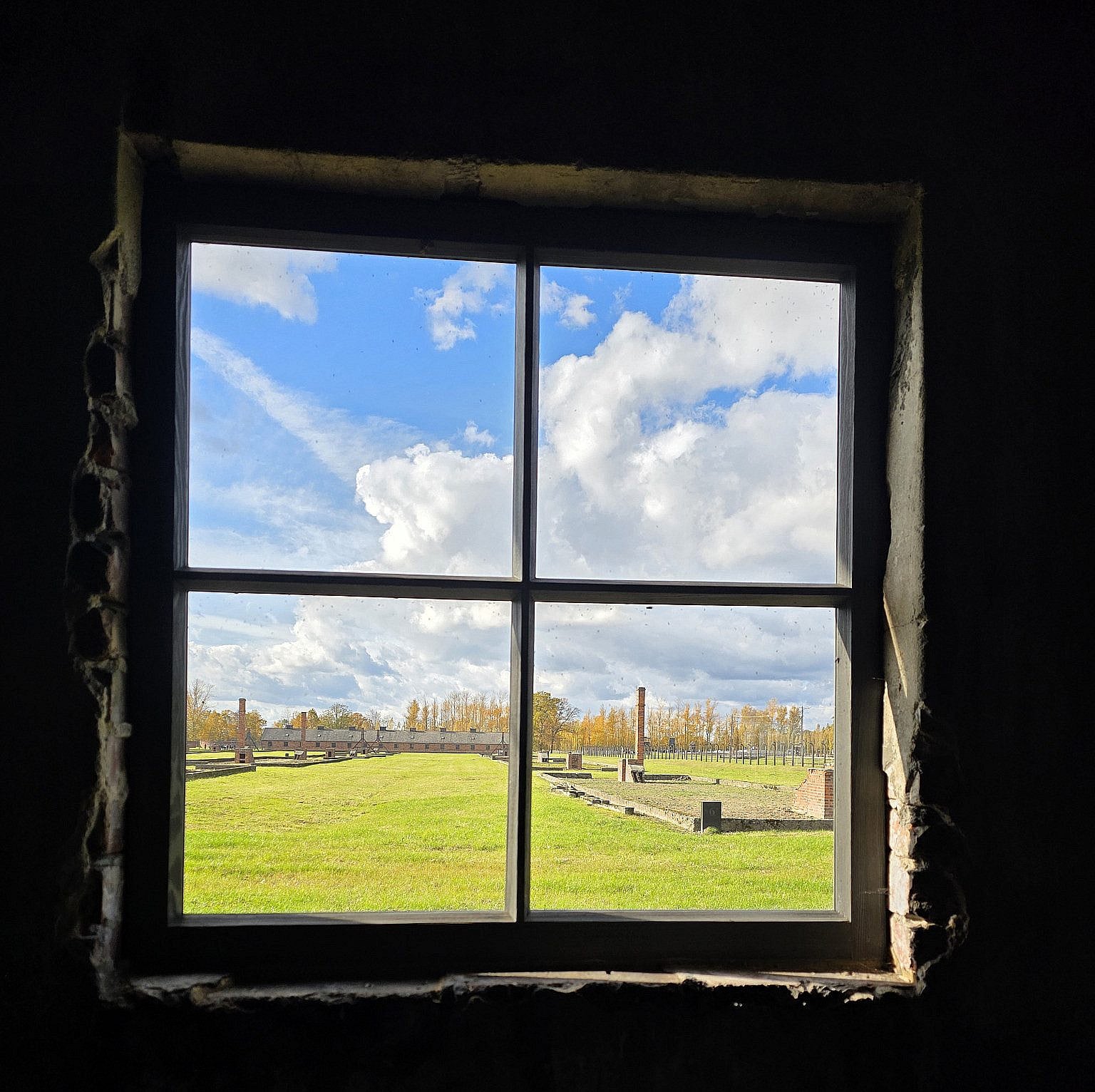
Birkenau through the window of a barrack
I had been to Auschwitz and Birkenau before. More than once, in fact. I knew their colours: the colour of the cold iron gates, the colour of the gravel, the colour of the brick soaked in rain. I knew the greyness that settles on your skin, the greyness that feels appropriate, even necessary. I had never expected anything else.
Beauty did not belong there; beauty was something the place actively resisted.
And on the first day of the media seminar, in Auschwitz I, everything behaved according to that rule: cold rain, low sky, mud, grey as a verdict. My coat and dress were just as grey as the weather, everything perfectly monochrome. Even the buildings seemed to withdraw into themselves, as if refusing the indecency of sunlight. I felt the familiar pressure behind my ribs; the same emotional gravity that pulls me downward every time I enter the camp. No surprises, no betrayal of expectation. The world outside might be full of accidents, but Auschwitz never is.
Auschwitz I, with its brick buildings and curated exhibits, often feels like a museum of horror. Birkenau, by contrast, is expansive, open, and less structured. The birch trees, the meadow, the deer; these elements aren’t curated. They’re part of the landscape’s ongoing life, which makes the dissonance sharper.
We were warned by the organisers that Birkenau is different: we were told that it’s colder, more exposed to the weather and so on, and asked to make sure that we are dressed appropriately, warm clothes, comfortable shoes – another well-meaning sentence that broke my heart. It became even harsher in retrospect, when in the afternoon I saw some of the footwear they were trying to conserve in the laboratories; footwear people arrived wearing, unprepared: summer sandals with broken straps, shoes insulated with papers featuring a solved Maths test, broken-off heels mended with whatever was at hand. I wasn’t prepared either. I didn’t even take clothes like that with me. I dressed as I would always do: knee-length dress, moderate heels. Everything else wouldn’t have felt right.
The next morning, I woke up to a cold grey sky, and expected Birkenau to be as I knew it, and as Daniel Kahn described it:
The day it is done and the twilight is nigh
The sun is replaced with a watchtower eye
And the clouds have been stained with an ominous dye
Like the butcher has wiped off his knife on the sky
But as we arrived in Birkenau, something ruptured. I still don’t understand why. The shift was instantaneous, the moment I got off the bus, as if a curtain had been pulled back without warning. Perhaps it was the season; autumn at its most extravagant, all gold and copper and impossible blue. Perhaps it was the open meadow, the vastness that doesn’t allow you to hide inside solemnity the way the narrow blocks of Auschwitz I do. Or perhaps it was the image of two groups of young Israeli students walking ahead of us, flags tied like capes to their backs, a small procession of defiance: Am Yisrael Chai against the backdrop of the largest Jewish cemetery in Europe.
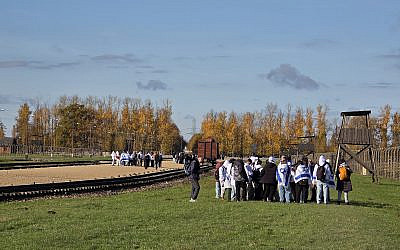 But none of these fully explains the moment when my senses betrayed me. Because that is what it felt like: betrayal.
The sky was the bluest I had seen in months. A kind of blue that doesn’t belong to October, let alone to Birkenau. The birch trees were so luminous, yellow, white, shimmering, that for a split second I felt as though I were in an ordinary birch meadow, somewhere in the countryside, somewhere where people have a picnic and feed ducks and fall in love. Deer were running at the edge of the clearing, moving with the kind of unselfconscious grace that should have been comforting. Instead, it made my throat close.
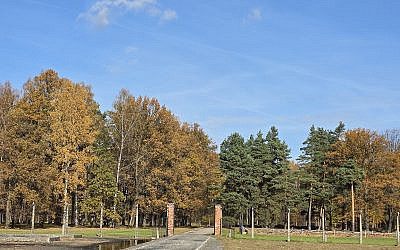 It was beautiful. And the beauty was intolerable.
I felt a physical discomfort, a kind of moral nausea. I didn’t want the sky to be blue. I didn’t want the trees to glow. I didn’t want my eyes to register anything but the historical weight of the place. And yet my body refused. It responded to colour, to openness, to animals moving freely in a landscape where human beings had not been free.
For the first time, Birkenau looked like a place instead of a symbol, and that felt like a betrayal too.
I stood there in that impossible meadow, caught between two realities that refused to merge: the world as it is, and the world as it was. The present unrolling in colour, and the past anchoring everything in ash. The contradiction was violent, not metaphorically, but viscerally, like a bruise blooming beneath the skin. And I couldn’t stop thinking: how dare this place look beautiful? How dare nature reclaim it so completely? How dare the same sun shine on everything?
But then another thought arrived, quiet but insistent: What if my shock isn’t about beauty at all? What if it’s about recognising that time has continued, even where I want it to stand still?
Because this is the part nobody prepares you for. Not the horror: that is documented everywhere. Not the grief: that is expected and felt. But the cognitive dissonance, the struggle with the surreal gentleness of the landscape when your senses detect something life-affirming in a place designed to destroy life.
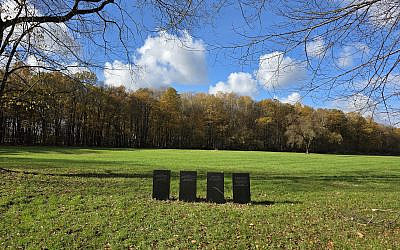 And maybe it is precisely because it was not my first visit that the shock was so sharp. The place had changed; or I had; or both.
Beauty felt like an intrusion, but also like a reminder that survival, in all its accidental, stubborn forms, is still happening, even here. As if beauty was the world’s refusal to freeze in horror.
Perhaps that is why the sight of the Israeli students moved me so deeply. Their presence created a different rupture, a deliberate one: the refusal to be erased. In that moment the natural beauty and the human defiance collided, almost painfully, in a way that made the landscape seem even more relentlessly alive.
Birkenau is not meant to be alive. Yet it was. And that, more than the colour of the trees, was what unsettled me.
As we walked further into the camp, our guide explained how the site would have been expanded; the plans for more barracks, more rails, more mechanisms of extermination. People listened. I watched the faces of the German men in our group, trying to read them. But even then, even in that context, even with the enormity of what was said, the meadow remained beautiful. And I hated that I could see it.
Maybe the unease is a sign of sanity. Maybe the contradiction is the only honest response.
Because if there is anything I took from that day, it is this: memory does not exist in pure form. It is always disturbed by the present. And sometimes the present shows up in colours that feel all wrong.
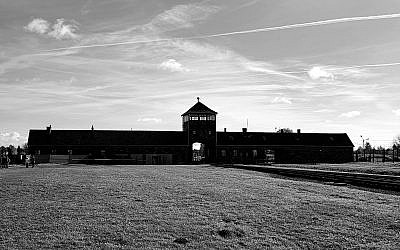
I still don’t know whether seeing beauty in Birkenau was a transgression or a revelation. I only know that I didn’t choose it, my senses did. And the discomfort, the rupture remains with me, long after I converted every photo to black and white, trying to restore the world to the way I believed it should look, and long after the colours have faded from memory.
Related Topics
Related Posts