


Author, America and the Indo-Pacific - Trump and Beyond (Routledge 2021)
India, UAE deepen tech ties during MBZ visit
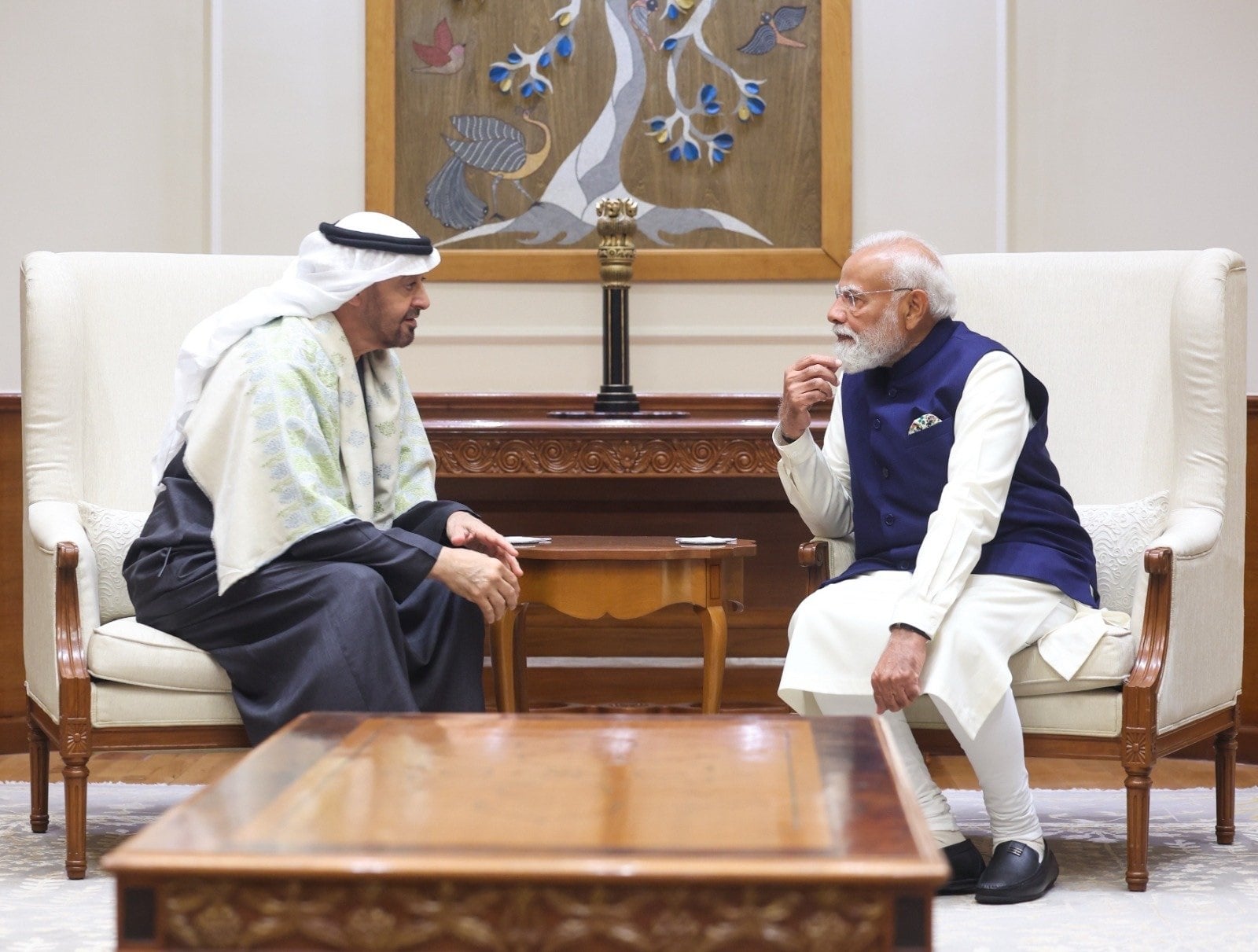
Prime Minister Narendra Modi hosted His Highness Sheikh Mohamed bin Zayed Al Nahyan, at 7 Lok Kalyan Marg in New Delhi. (Photo source: Government of India)
Beyond the announcement of a Strategic Defence Partnership, steps to deepen tech cooperation were the key outcomes of the UAE President’s visit to New Delhi.
KASHISH PARPIANI
This week, at the invitation of India’s Prime Minister Narendra Modi, UAE President Mohamed bin Zayed Al Nahyan (MBZ) visited India. This was his fifth visit of the last ten years and his third official visit as President of the UAE.
While the visit was short (about three hours), it was substantive with the comprehensive set of outcomes announced by the two sides. Of which, the most significant takeaway was the signing of the Letter of Intent towards the conclusion of the India-UAE Strategic Defence Partnership. As per an official readout, this will expand defence cooperation across a number of areas, “including defence industrial collaboration, defence innovation and advanced technology, training, education and doctrine, special operations and interoperability, cyber space, counter terrorism.”
Amid US-Iran tensions, rumoured expansion of the Saudi Arabia-Pakistan defence pact, and reports of a Saudi-Emirati rift over Yemen, the elevation of defence cooperation as “a core pillar” of the India-UAE partnership is a significant development.
However, the UAE President’s visit also yielded some notable agreements that are indicative of deepening India-UAE tech cooperation.
Beyond trade
India and the UAE share a comprehensive partnership, underpinned by strong people-to-people ties (Indians form the largest ethnic community in the UAE) and cooperation at multilateral fora (including through recent minilaterals like the I2U2, UAE-France-India trilateral). However, trade has been the partnership’s dominant theme in recent years. The economic realm of the partnership is supported by the India-UAE Comprehensive Economic Partnership Agreement (CEPA), the Local Currency Settlement (LCS) system, and the Bilateral Investment Treaty.
With CEPA for instance, India-UAE bilateral trade reached USD 100.06 billion in FY2024–25. Since CEPA came into force in May 2022, India-UAE bilateral merchandise trade has more than doubled (from USD 43.3 billion in FY2020-21). Whereas, non-oil trade has reached USD 57.8 billion (in FY2023-24) towards the bilateral goal of overseeing expansion of non-oil trade to USD 100 billion by 2030.
During the UAE President’s visit to India, the two sides pledged to double overall bilateral trade to USD 200 billion by 2032.
However, as noted in the Joint Statement released at the conclusion of the visit, the two sides are also looking to expand the ambit of India-UAE bilateral cooperation, by strengthening collaboration in science, technology and innovation, especially in the areas of AI and emerging technologies.
Tech and more
During the visit, India and the UAE announced the joint development of a supercomputing cluster. Under the AI India Mission, C-DAC India and G42 UAE will collaborate to set up a supercomputing cluster in India, and make it “available to private and public sector for research, application development and commercial use.” The two sides have also agreed to explore setting up Digital/Data Embassies under mutually recognised sovereignty arrangements.
These agreements stand in line with the UAE’s efforts to develop its own tech and AI propositions. Over the past few years, the UAE’s AI ambitions have included capacity-building efforts with tech giants (like Microsoft), strategic investments by its sovereign wealth funds, and comprehensive tech partnerships (chiefly, with the US). The UAE has also successfully navigated the ambiguities of US President Donald Trump’s decision to scrap his predecessor’s ‘AI Diffusion Policy’, and secured approvals for importing US semiconductors for its AI projects. Just this week, G42 UAE’s CEO announced that the first shipments of advanced chips (by Nvidia, AMD and Cerebras Systems) will arrive in the UAE within the next few months.
In addition, the two sides agreed to explore cooperation in advanced nuclear technologies, including “development and deployment of large nuclear reactors and Small Modular Reactors (SMRs), as well as cooperation in advanced reactor systems, nuclear power plant operations and maintenance and nuclear safety.”
This shortly follows India’s enactment of the Sustainable Harnessing and Advancement of Nuclear Energy for Transforming India (SHANTI) Bill, which aims to reduce India’s dependence on fossil fuels by gradually opening up the civil nuclear sector to private participation.
The UAE may have some pertinent takeaways for rapid expansion in this sector. For instance, a year into its full operationalisation, the Barakah Nuclear Energy Plant began providing 25% of the UAE’s total electricity needs and significantly advanced Abu Dhabi’s clean energy transition. This week, media reports suggested that the UAE is exploring export of components that it has produced to build its own nuclear energy infrastructure.
Ample synergies
Such varied projects deepening India-UAE tech cooperation also stand in line with India’s adaptive tech strategy, which has encompassed capacity building measures (like bolstering domestic production and refining capacities for critical minerals) and comprehensive tech partnerships with likeminded partners (like Japan and the UK).
Whereas, as the UAE seeks to develop its own tech and AI propositions, cooperation with India may yield crucial learnings on deploying digital services securely and at scale. This has been apparent with India’s successful deployment of numerous Digital Public Infrastructure (DPI) platforms for secure digital services and real-time administrative processes.
Moreover, India’s vibrant start up ecosystem, which registered 44,000 start ups in 2025 alone, offers avenues for early-stage collaboration in emergent sectors (fintech, healthtech and agritech) that present fertile ground for digitally-enabled and scalable solutions. Similarly, under the India AI Mission, New Delhi is prioritising next-gen innovation, with a focus on harnessing the power of AI through applications for agriculture, healthcare, education, and governance.
In this context of scale and innovation, one may also note the pertinence of the Letter of Intent finalised between the Indian National Space Promotion and Authorisation Centre (IN-SPACe) and the Space Agency of the United Arab Emirates (UAE) for space industry development and commercial collaboration. As per an official readout, this would encompass India and the UAE developing joint infrastructure for space and commercialization, including “launch complexes, manufacturing and technology zones, incubation centre and accelerator for space start-ups, training institute and exchange programmes.”
Finally, as seen in case of India’s deepening tech cooperation with Japan and the UK, India and the UAE are also focusing on cross-pollination between their innovation ecosystems. This includes the India-UAE announcement on encouraging linkages between Indian and Emirati universities and expanding student exchanges to serve as “knowledge bridges”, and overtime develop innovation labs in educational institutions.
Hence, beyond the focus on India-UAE trade and defence cooperation, deepening tech cooperation reflects the synergy between India’s adaptive tech strategy and the UAE’s capacity building on tech and AI propositions.