The views expressed herein are solely mine.
‘Indiana Trump’ Barks Again; No Bite Yet
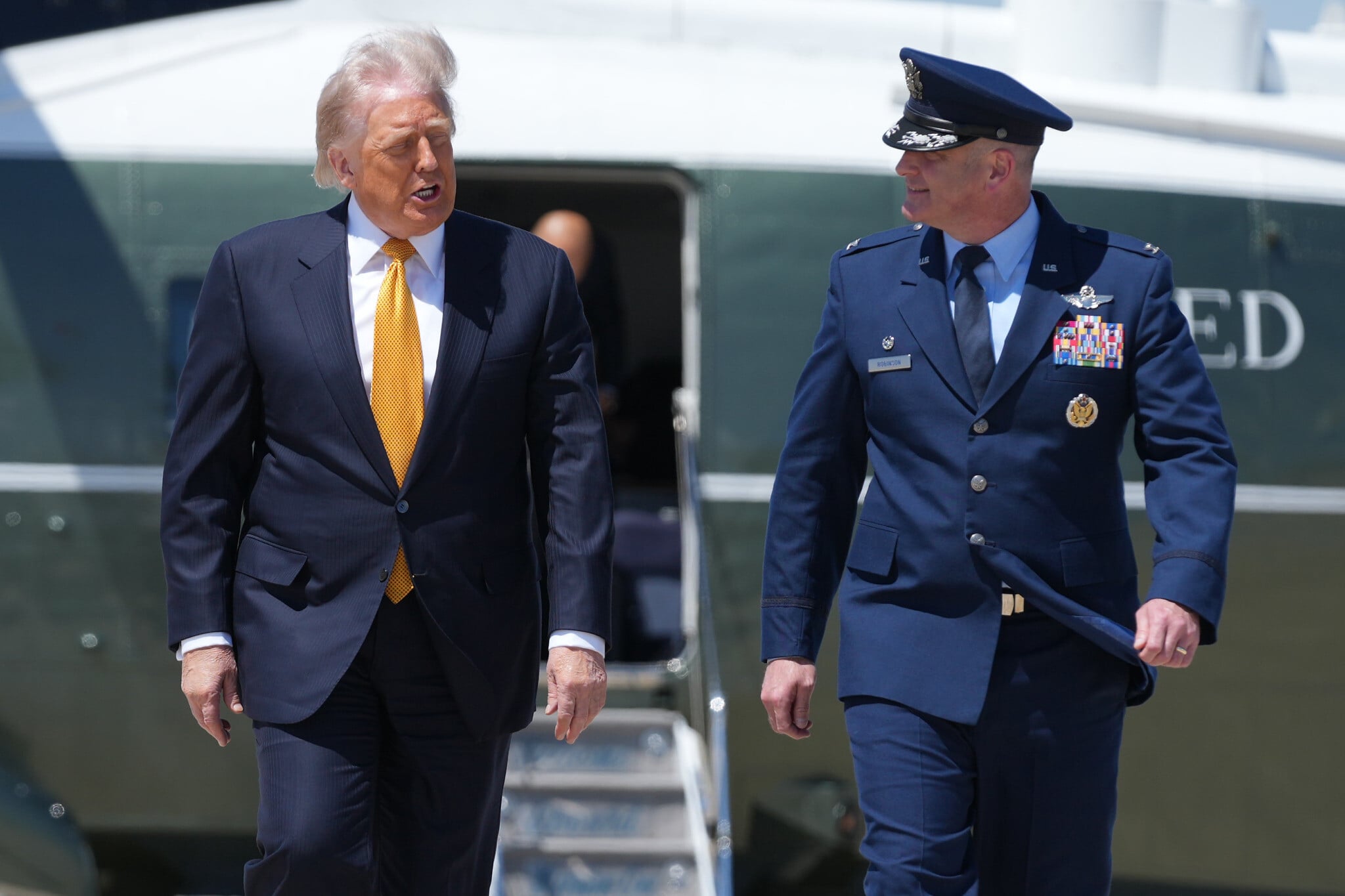
US President Donald Trump walks to board Air Force One with Air Force Col. Christopher M. Robinson, commander of the 89th Airlift Wing, Tuesday, May 12, 2026, at Joint Base Andrews, Maryland, for a trip to China. (AP Photo/Mark Schiefelbein).
In the brutal chessboard of Middle Eastern geopolitics, the Spanish proverb perro que ladra no muerde—a dog that barks does not bite—now defines President Donald Trump’s Iran strategy with merciless clarity.
Since the Pakistan-brokered ceasefire took effect on April 8, 2026, Trump has issued at least seven high-profile threats of renewed military action. He has delivered none. This pattern of serial bluffing has gutted American credibility, emboldened Tehran’s messianic survival narrative, and accelerated Gulf partners toward self-reliant defense architectures that may soon render American guarantees optional.
Operation Epic Fury opened on February 28, 2026, with coordinated American and Israeli strikes that destroyed key Iranian nuclear facilities, missile production sites, and eliminated more than 80 key regime figures, including former Supreme Leader Ali Khamenei. Tehran absorbed the blow, retaliated with more than 400 ballistic missiles and nearly 1,000 drones across Gulf targets, and forced a two-week truce—later extended indefinitely—on terms that left its core regime and 440.9 kilograms of 60 percent enriched uranium intact. The Strait of Hormuz, through which roughly 20 million barrels of oil flow daily, became hostage to Iran’s coercive strategy, allowing Tehran to blackmail global energy markets while its drone and ballistic missile programs remained fully operational under the sustained support of its regional allies.
In tandem, it remains particularly counterproductive for the United States to continue relying so heavily on Pakistan as the mediator and guarantor of this fragile truce. With credible indications that Islamabad permitted Iranian military and reconnaissance aircraft to shelter on its airfields—effectively shielding them from potential future strikes—this approach undercuts American leverage, confuses allies, and erodes the very credibility Washington seeks to restore.
Trump’s post-ceasefire barking has had no bite. On April 9, he vowed American troops would remain until Iran accepted a “real agreement,” warning otherwise of strikes “bigger, and better, and stronger than anyone has ever seen before.” On April 19 and 20, he threatened to “knock out every single power plant and every bridge in Iran.” Then, on April 21, public opposition to extending the truce emerged alongside explicit warnings of attacks on bridges, power plants, and water stations. Late April brought repeated ultimatums tied to reopening the Strait of Hormuz.
Eventually, on May 4, he threatened to blow Iran “off the face of the earth” if it interfered with American naval efforts. Then May 11 brought the latest dismissal of Tehran’s peace proposal as “totally unacceptable” and “a piece of garbage,” with the ceasefire declared “on life support.”Ironically, each deadline passed without American bombs. While the Iranians mine the Strait of Hormuz, U.S. naval enforcement in the area remains measured rather than decisive.
Tehran’s regime now sells its endurance narrative with renewed authority. Despite losing critical nuclear infrastructure during the 2025 strikes and enduring six weeks of 2026 bombardment, Tehran survived, preserved sovereignty, and forced Washington to the table. Its axis-of-resistance narrative—that great powers talk while the Islamic Republic outlasts them—now carries more geostrategic weight than White House red lines.
Accordingly, Gulf capitals absorbed the lesson differently. Saudi Arabia endured Iranian drone strikes on the Ras Tanura refinery on March 2, 2026, which slashed 550,000 barrels per day of production. Riyadh condemned the aggression and reserved the right to respond, yet issued no artificial deadlines or apocalyptic rhetoric. Its calculated restraint safeguarded both energy security and diplomatic flexibility.
The United Arab Emirates chose pragmatic boldness. Hit by 537 ballistic missiles, more than 2,200 drones, and 26 cruise missiles, Abu Dhabi activated seamless military integration under the Abraham Accords. Israel Defense Forces operators deployed an Iron Dome battery on Emirati soil for the first time outside Israel or the United States, pairing it with Iron Beam lasers and advanced detection systems. Joint crews intercepted dozens of projectiles.
This unapologetic cooperation has hardened the Accords into the embryo of a mutual defense pact linking Israel, the United Arab Emirates, Bahrain, and potentially Saudi Arabia: integrated air and missile defenses, shared early-warning systems, and rapid-response forces that Tehran dreads most.
Trump’s heightened focus on the 2026 congressional midterms compounded the damage. Prioritizing domestic political cycles over sustained pressure on Iran entrenched the isolationist faction around Vice President JD Vance and Tucker Carlson. Their manipulated “America First” approach increasingly views prolonged confrontation with Tehran as a ‘costly distraction’. The $8.6 billion in emergency arms sales to Israel and Gulf partners buys tactical breathing room but cannot substitute for strategic follow-through.
While any decision to finish the job more decisively could carry short-term political costs in the 2026 midterms, recent Electoral College and judicial adjustments may well limit Republican losses.
Longer term, a clearer victory could hand the next Republican presidential candidate a powerful legacy narrative: “Hey, it was a tough war, but we brought peace to the Middle East, eliminated the biggest and most entrenched element of the ‘Axis of Evil’ (Iran-Russia-China-North Korea-Venezuela), pulled Venezuela out of that orbit as well, and secured the world for generations.” That kind of muscular success story would also meaningfully weaken the Vance-Tucker isolationist faction (in Marco Rubio’s favor), which prefers a more cordial, accommodationist posture toward authoritarian regimes.
The cost is steep. American deterrence in the Gulf frays when threats evaporate, raising future expenses in blood and treasure. Israel confronts a resurgent proxy network and an unneutralized nuclear threshold without dependable United States backing. Western energy security and alliance cohesion weaken as Gulf states hedge toward self-reliance or deeper bilateral ties with Israel, while China and Russia move to fill the vacuum.
The 2026 Iran war tested whether the United States leadership could turn rhetoric into results. President Trump barked loudly. The region now knows he seldom bites.
Tomorrow, as part of one of his new adventures, ‘Indiana Trump’ will be in China. He will say—now that the ceasefire is supposedly “on life support,” and while the three competing factions shaping Iranian policy openly troll and mock him—that China’s Xi “is a great and true friend” despite persistent Chinese cyberattacks against the United States and other damning realities; that China “will stop selling drone materials to Iran”; that Beijing will “stop providing satellite information”; that “everything will get fixed”; and that “a deal is close.” But by now, the region and the world know the script and understand this is likely just another bark.
Meanwhile, the Iranian regime strengthens its propagandistic narrative, gains international support as a supposed “victim of the American-Israeli empire,” and Tucker Carlson pushes sections of the American right toward the abyss by portraying the Protocols of Zion as a “book that falls short of the horrible actions” Jews have supposedly committed against the world.
Only decisive action beyond midterm calendars can restore the balance—not barking.
Related Topics
- Abraham Accords
- Anti-Zionism
- Antisemitism
- Bahrain
- Benjamin Netanyahu
- China
- Donald Trump
- Hamas
- Hezbollah
- IDF
- Iran
- Iran Nuclear Deal
- Iron Dome
- Islam
- Israel At War
- Israel-China Relations
- Israel-Iran Conflict
- Israel-Saudi Normalization
- Israel-US Relations
- Israel: Jewish and Democratic
- Israeli Foreign Policy
- Israeli Politics
- Israeli society
- Knesset
- Latin America
- Lebanon
- Middle East
- Oman
- Pakistan
- Palestinians
- Qatar
- Russia
- Saudi Arabia
- Terrorism
- The Arab World
- Trump Peace Plan
- Tucker Carlson
- Turkey
- UAE - United Arab Emirates
- UAE-Israel Peace
- US Midterm Elections
- US Politics
- Venezuela
- Weapons
Related Posts