Geopolitical Analyst: Bridging Somaliland & Israel to the world
Trump Lost Congress. Somaliland Has Not Lost Washington
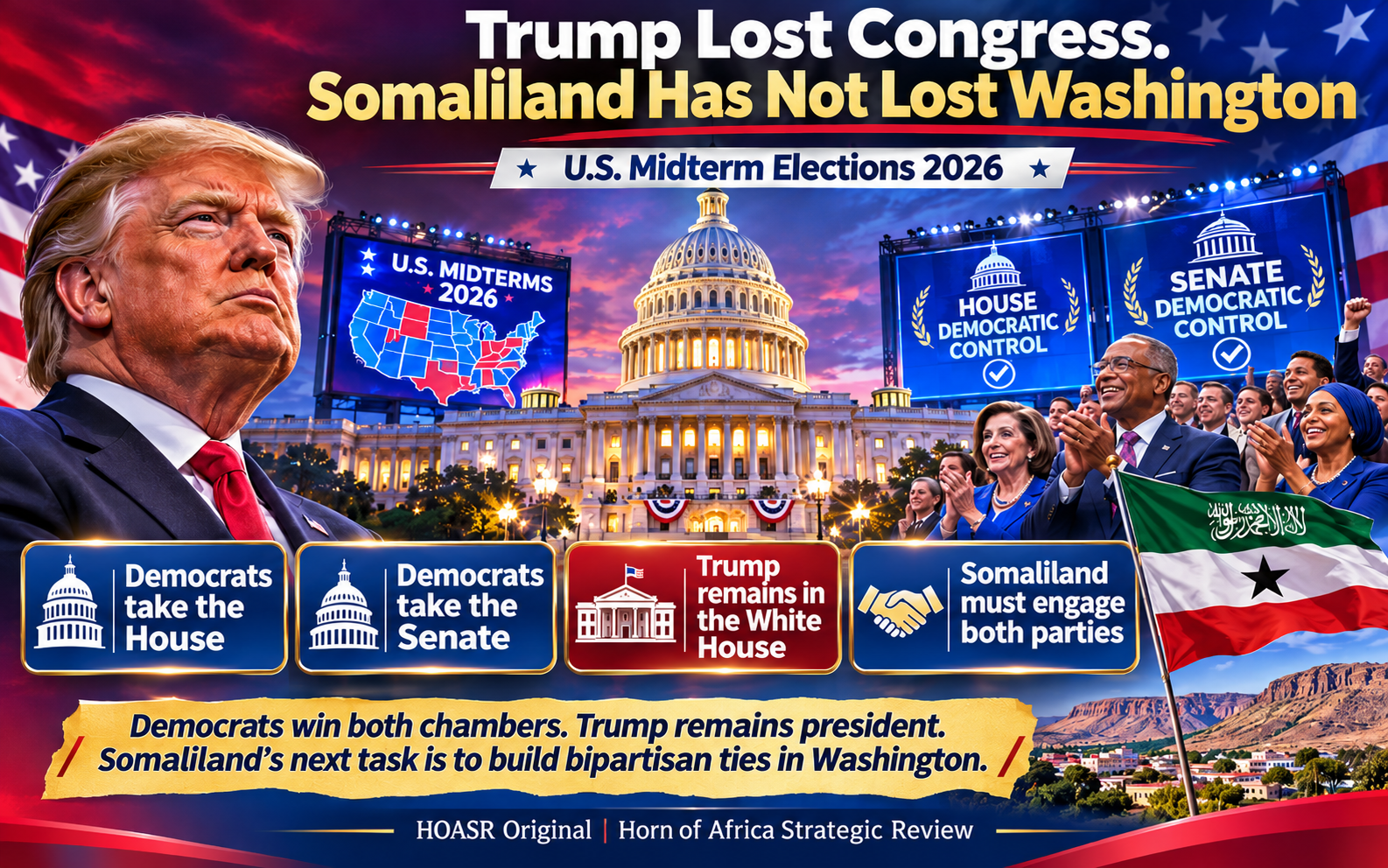
The 2026 U.S. midterms and Somaliland's next diplomatic challenge in Washington. HOASR Original Infographics
A Setback for Trump Is Not Necessarily a Setback for Somaliland.
Washington woke up Wednesday morning to a political earthquake that President Donald Trump and his Republican Party had hoped to avoid. The Democrats have captured both chambers of Congress in the November 3 midterm elections, delivering a sweeping rejection of the administration’s domestic agenda and its increasingly costly war with Iran.
From Republican strongholds in the South to closely contested congressional districts across the country, American voters have altered the balance of power in Washington. For governments around the world that had invested considerable diplomatic expectations in Trump’s presidency, the outcome demands a reassessment of their strategies.
For Somaliland, however, a setback for Trump need not become a setback for its pursuit of American recognition. The president remains in the White House, and the constitutional authority to recognize foreign states remains principally with the executive branch.
What has changed is the political environment in which that authority will be exercised, particularly once the newly elected Congress takes office in January 2027. Hargeisa now faces an important test of its diplomatic maturity: whether its relationship with Washington can extend beyond the Republican leaders who have championed its cause.
According to Reuters’ November 4 election report, the Democrats’ victories were driven by public dissatisfaction with rising living costs, tariffs, the Iran war and the conduct of the administration. These are overwhelmingly American domestic concerns, although their consequences will reach far beyond American borders.
The result gives Democrats control over congressional committees, investigations, legislative priorities and the Senate’s confirmation process. Trump will retain substantial presidential authority, but his administration will no longer enjoy the same degree of congressional support it possessed during its first two years.
The Republican Opening That Did Not Produce Recognition
For much of the past two years, Somaliland’s supporters had good reason to welcome growing Republican interest in their country’s strategic importance. Senator Ted Cruz emerged as one of the most prominent advocates, writing directly to President Trump in August 2025 to urge formal recognition of Somaliland’s independence.
He cited its location along the Gulf of Aden, security cooperation, relationship with Taiwan and potential contribution to American interests in the Horn of Africa. Republican members of the House also introduced the Republic of Somaliland Independence Act, H.R. 3992, placing recognition before Congress as a concrete legislative proposal.
These initiatives gave Somaliland unprecedented visibility in an important section of Washington’s political establishment. President Irro’s diplomatic engagements in the United States further strengthened the impression that Somaliland was receiving the kind of attention long denied to it.
Yet one essential fact remains: even with Republicans controlling the White House, Senate and House of Representatives, the United States did not formally recognize Somaliland. The State Department continued to uphold the established American position on Somalia’s territorial integrity, as documented in the Congressional Research Service’s July 2026 assessment.
That record deserves careful consideration. Republican sympathy, however valuable, was never equivalent to an official American decision, and the Democratic victory does not automatically mean the end of Somaliland’s recognition prospects.
It reveals the limitations of depending too heavily on one political coalition in a country where congressional majorities regularly change. A recognition strategy built around the expectations of one administration becomes vulnerable whenever American voters rearrange the political map.
Somaliland Has Friends Across the Political Divide
There is already a record of bipartisan congressional interest in Somaliland, although it has received considerably less attention than recent Republican initiatives. In March 2022, Democratic Senator Chris Van Hollen joined Republican Senators Jim Risch and Mike Rounds in introducing the Somaliland Partnership Act.
The proposed legislation called for closer American engagement with Somaliland and an assessment of a possible security partnership. It did not advocate immediate recognition, but it demonstrated that closer relations with Hargeisa could attract support from both parties.
Van Hollen’s position is particularly relevant because it came from a Democratic senator who viewed cooperation with functioning democratic institutions in the Horn of Africa as compatible with American interests.
His approach differed from the more explicit recognition campaign promoted by Cruz, but the two positions shared an interest in reassessing how Washington engages Somaliland. That history provides a basis for renewed congressional discussions after January. It also offers Hargeisa a useful reminder that Democratic engagement need not begin from zero.
The incoming Democratic leadership will naturally bring its own priorities to foreign policy. Human rights, accountable governance, the use of American military force, foreign assistance and congressional oversight are likely to receive greater attention.
Somaliland’s record of competitive elections, peaceful transfers of presidential power and locally maintained security offer material for serious engagement on these issues. Such a record should be presented with supporting evidence and a willingness to discuss shortcomings, rather than assuming that sympathetic legislators will accept every claim made on Somaliland’s behalf.
The Iran War Has Changed Washington’s Priorities
The most immediate international consequence of the elections concerns the war with Iran. The conflict has imposed significant financial and political costs on the United States, while disruption around the Strait of Hormuz has affected energy prices and international shipping. Trump himself acknowledged that the Iran war contributed to Republican electoral losses.
A Democratic-controlled Congress will have greater authority to investigate the administration’s military decisions, challenge further appropriations and press for a negotiated settlement.
For the Horn of Africa, these developments carry implications that extend well beyond Iran itself. The Strait of Hormuz and the Bab el-Mandeb have emerged as central concerns in the security of international maritime commerce, particularly as Houthi threats against shipping continue. The instability surrounding Yemen, the Gulf of Aden and the southern Red Sea has renewed attention to ports, naval logistics, coastal surveillance and dependable regional partnerships.
Somaliland occupies a strategically significant position within this wider maritime environment, whether Washington’s immediate priority is escalation or protecting commercial shipping. Berbera’s importance does not disappear because the Democrats have won Congress. Its commercial port, access to the Gulf of Aden and proximity to the approaches to the Bab el-Mandeb remain geographical and economic realities, regardless of which party controls Capitol Hill.
The challenge for Somaliland is to turn its geography into practical proposals involving maritime security, infrastructure, investment and cooperation that American policymakers can evaluate on their merits. Strategic location provides an opportunity, but durable partnerships require credible institutions and negotiated commitments.
Israel’s Recognition Has Already Changed Somaliland’s Diplomatic Position
Somaliland also enters this period of American political change from a different diplomatic position than it occupied a year ago. On December 26, 2025, Israel became the first United Nations member state to formally recognize the Republic of Somaliland.
That decision has since been followed by direct diplomatic engagement, including the presentation of credentials by Israel’s first ambassador to Somaliland and preparations for an embassy in Hargeisa. These developments have created an established bilateral relationship that exists independently of the American electoral outcome.
Nevertheless, Somaliland’s relationship with Israel should not become the sole foundation of its diplomatic campaign in Washington. American opinion on Israel, Gaza and the Iran war have become increasingly divided, including within the Democratic Party.
Presenting Somaliland exclusively through the lens of Israeli security interests could therefore narrow the audience for its recognition case. Somaliland has its own history, political institutions, economic ambitions and strategic interests, and those deserve consideration independently of its friendships and alliances.
The partnership with Israel can continue to develop alongside Somaliland’s longstanding relationship with Taiwan and its cooperation with Ethiopia, the United Arab Emirates and other regional actors. Each relationship serves different diplomatic, economic and security purposes.
A mature foreign policy preserves those relationships while avoiding unnecessary dependence on the political fortunes of any one foreign leader or part. For a country pursuing broader international recognition, diplomatic flexibility is an asset.
Somalia’s Washington Lobbying Will Not Disappear
Mogadishu will undoubtedly follow the changes in Congress with considerable interest. Somalia’s government has consistently opposed Somaliland’s recognition and will continue to invoke the African Union’s position, territorial integrity and the established international diplomatic framework.
Democratic control may offer additional opportunities for Somali officials to present those arguments to lawmakers whose priorities differ from those of Somaliland’s Republican advocates. Hargeisa should expect that debate and prepare to engage with it through documented evidence rather than political assumptions.
Somaliland’s strong historical case begins with its independence on June 26, 1960, its subsequent union with the former Italian-administered Somalia and its restoration of independence in May 1991. Somaliland maintains that its legal history and experience of self-government distinguish its situation from ordinary secessionist movements, while Somalia continues to contest that interpretation.
The African Union’s own 2005 fact-finding mission recognized the distinctive historical circumstances of the case, although the organization has not collectively recognized Somaliland. These are substantial legal and diplomatic questions that deserve direct examination rather than permanent avoidance.
There is also a practical dimension. The enormous international investment in Somalia’s political reconstruction, counterterrorism operations and security institutions has not eliminated its serious governance and security challenges.
Washington has legitimate reasons to examine the effectiveness of that engagement, just as it has reasons to maintain counterterrorism cooperation and humanitarian assistance. Somaliland can participate in that discussion by presenting its own experience and capabilities without assuming that criticism of Mogadishu will, by itself, produce American recognition.
Washington’s Political Map Has Changed. The Red Sea’s Has Not.
The American midterms have altered who will control congressional committees, shape legislation and investigate the executive branch during the final two years of Trump’s presidency. They have not altered the location of Berbera, the maritime significance of the Gulf of Aden or the competition among regional and international powers around the Red Sea.
China continues to pursue strategic interests in the region, Ethiopia remains concerned with maritime access, and Türkiye, Egypt, Israel and the Gulf states retain important stakes in its future. These interests will continue to influence American calculations under both Republican and Democratic leadership.
Existing Republican support remains valuable, including the work undertaken by Senator Cruz and the sponsors of congressional recognition initiatives.
The incoming Democratic majority presents a different set of political relationships, legislative procedures and policy priorities that Somaliland must understand. Engagement with both parties would give its diplomatic case a broader institutional foundation and reduce its exposure to electoral changes.
President Trump has lost the congressional majorities that supported much of his agenda, but he has not lost the presidency or his authority to make recognition decisions. Congress, meanwhile, will have a stronger voice in shaping the political environment surrounding those decisions.
Somaliland’s leadership now has an opportunity to demonstrate that its ambitions in Washington rest on more than personal relationships, temporary political alignments or expectations of a single presidential administration.
The Scoop
The November 3 election was a decision by American voters about the direction of their own country. For Somaliland, its significance lies in the diplomatic adjustments that follow. The campaign for American recognition has endured successive administrations and shifting congressional majorities; it will have to operate within another new balance of power.
Trump lost Congress. Somaliland has not lost Washington. Its future in Washington must extend beyond party lines.
Related Topics
Related Posts