
Gratitude | Purpose | Renewal
India’s Digital Revolution: How Jio Connected a Nation
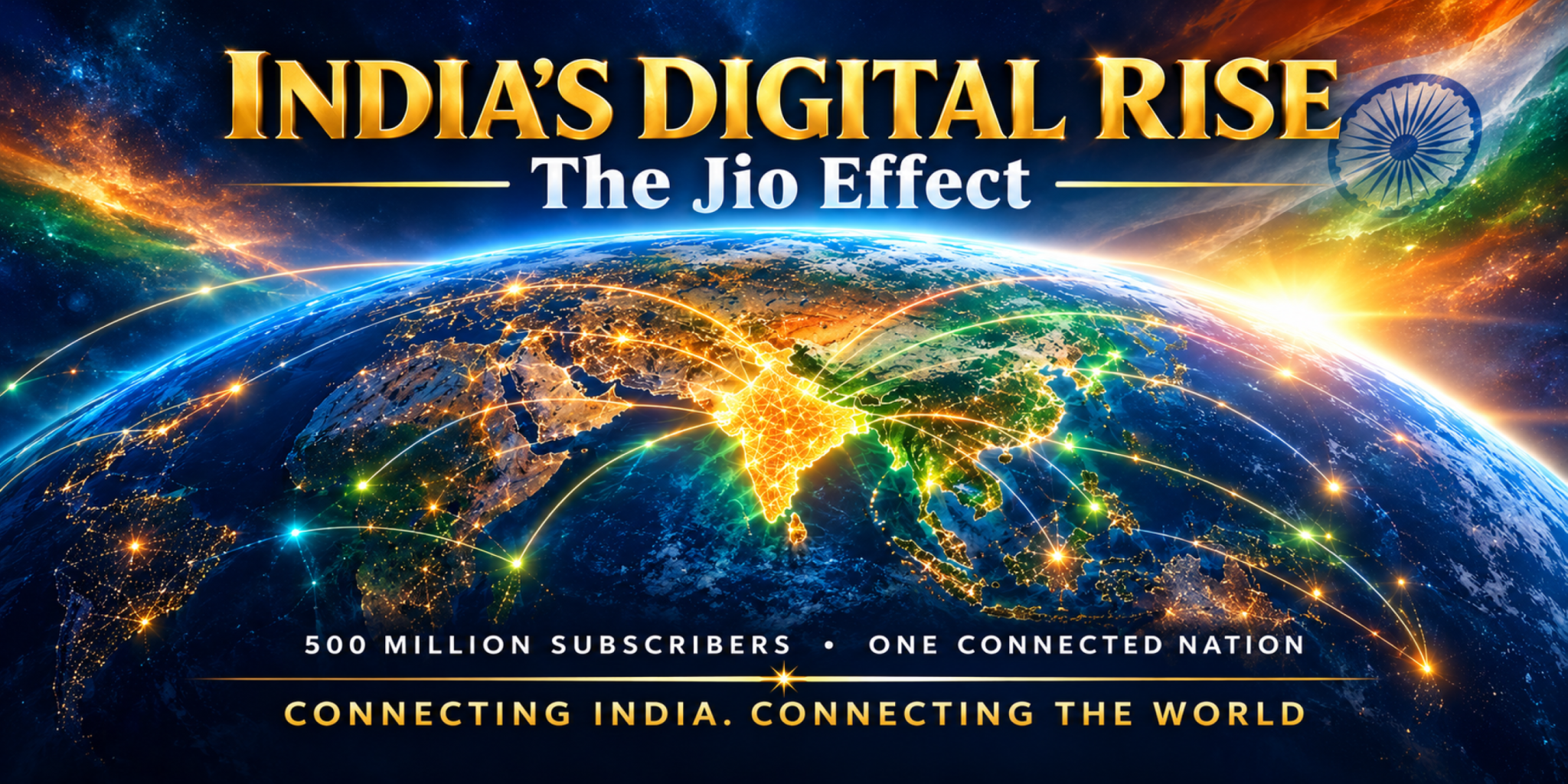
As billionaire Mukesh Ambani’s Jio prepares for India’s largest IPO by rupee value, its rise illuminates a broader transformation: how digital connectivity, public infrastructure and global investment are propelling India toward the forefront of global technology and economic power.
A Company, A Country, A Moment
Tomorrow, investors will focus on the anticipated IPO of Jio Platforms, the digital and telecommunications arm of Reliance Industries. Valued at roughly $108 billion and seeking to raise up to $3.2 billion, the company is coming to market amid extraordinary demand and global attention. Viewed through a narrow financial lens, it is a major IPO. Viewed through a wider one, it is something far more significant: a milestone in the story of India’s rise.
The scale alone helps explain why the world is paying attention. Jio’s more than 500 million subscribers exceed the population of the United States, while its parent company, Reliance Industries, is valued at roughly $170 billion and remains one of Asia’s most influential corporate groups. Mukesh Ambani, whose fortune exceeds $120 billion, built Jio as the centerpiece of Reliance’s digital strategy and, in the process, helped reshape India’s technological landscape. Yet the story is not ultimately about one company, one IPO or even one billionaire. Jio is the lens through which to view one of the most consequential economic transformations of the twenty-first century.
The Re-Emergence of India
For much of human history, India was not a peripheral economy. It was one of the world’s central economic engines, a center of trade, manufacturing and commerce whose influence stretched far beyond its borders. The story unfolding today is therefore not simply the emergence of a new power. In many respects, it is the return of one. The difference is that the engines of influence have changed. Where spices, textiles and maritime trade routes once powered growth, software, data, artificial intelligence and digital infrastructure increasingly do so now.
Home to more than 1.4 billion people, India possesses one of the world’s largest talent pools, one of its fastest-growing major economies and one of its most ambitious modernization projects. For decades, it was viewed primarily as a source of engineers, software developers and outsourced services. Those strengths remain important, but they no longer tell the full story. Increasingly, India is becoming a builder rather than merely a supplier, a creator rather than merely a participant. Investors who once saw India as a back office are beginning to view it as a global growth engine.
Wiring a Nation of 1.4 Billion
At the heart of India’s transformation lies one of the most ambitious digital infrastructure projects ever attempted. Through Aadhaar, the world’s largest digital identity system, more than 1.4 billion residents have been enrolled into a common identity framework. Through the Unified Payments Interface, or UPI, India created a real-time payments network that processes tens of billions of transactions each month, allowing consumers and businesses to move money with a simplicity that many advanced economies still struggle to match. The scale is extraordinary. What many countries built as separate systems, India increasingly integrated into a unified digital ecosystem.
Together, these platforms form the foundation of what policymakers call Digital Public Infrastructure, or DPI. Perhaps the most remarkable aspect of India’s digital transformation is that it was built at national scale. Countries around the world have digital identity systems. Others have advanced payments platforms. Few have successfully integrated both across a population of more than 1.4 billion people. Rather than leaving modernization entirely to private companies, India built public digital rails upon which entrepreneurs, banks, technology firms and consumers could innovate. The result is an operating system for a modern digital economy. Jio did not create India’s Digital Public Infrastructure. What it did was place that infrastructure into the hands of hundreds of millions of citizens at a speed and scale few believed possible.
Cheap Data, Massive Consequences
If Digital Public Infrastructure provided the rails, Jio became the locomotive. When the company launched nationwide services in 2016, it pursued a strategy that many considered radical: dramatically lowering the cost of mobile data while rapidly expanding network coverage. Millions of Indians who had previously rationed internet access suddenly found themselves connected. Data consumption surged, smartphone adoption accelerated and an entirely new generation of digital consumers emerged.
Internet access is often discussed as a convenience. In India, it became an economic multiplier. Affordable connectivity helped millions gain access to financial services, digital commerce, education platforms, healthcare resources, entertainment and government services. The smartphone became the gateway through which much of the country entered the digital economy. Today, Jio serves more than half a billion subscribers and has expanded beyond telecommunications into broadband, cloud infrastructure, enterprise technology and artificial intelligence initiatives. In much the same way railroads connected industrial economies, Jio helped connect digital India.
India’s emerging advantage lies in its ability to combine scale, talent, infrastructure and momentum in a way few countries can.
Why the World’s Smart Money Moved East
Global investors quickly recognized what was taking shape. In 2020, Jio completed one of the most remarkable fundraising rounds in modern technology history. More than $20 billion flowed into the company from an extraordinary collection of investors that included Meta, Google, KKR, Silver Lake, Vista Equity Partners, the UAE’s Mubadala Investment Company, the Abu Dhabi Investment Authority and Saudi Arabia’s Public Investment Fund. The investors came not only from California and New York, but from Abu Dhabi and Riyadh.
Together they represented three of the most powerful forces shaping twenty-first century capital flows: Silicon Valley’s technology giants, Wall Street’s financial institutions and the sovereign wealth funds of the Gulf. Meta invested approximately $5.7 billion. Google committed roughly $4.5 billion. It is rare to see technology companies, private equity firms and sovereign wealth institutions converge so decisively around the same opportunity. They did so because India offered something few countries can match; enormous scale, expanding digital infrastructure, rising incomes and a rapidly growing consumer economy. The investors were not simply betting on Jio. They were betting on India’s future.
The Rise of a Giant
Every major digital power possesses a defining strength. The United States dominates software innovation, venture capital and artificial intelligence. China built powerful consumer platforms at extraordinary scale. Israel established itself as a global leader in cybersecurity, entrepreneurship and deep technology. India’s emerging advantage lies in its ability to combine scale, talent, infrastructure and momentum in a way few countries can. Many nations possess one or two of these strengths. India increasingly possesses all four.
A decade ago, Jio set out to make internet access affordable. In doing so, it connected more than half a billion people to a digital revolution already underway. That revolution has transformed how Indians communicate, transact, learn, work and build businesses. It has also transformed how the world views India. Increasingly, India is no longer seen simply as a source of talent, a market for foreign products or a destination for outsourcing. It is becoming a builder of digital infrastructure, a generator of innovation and a destination for global capital. Jio’s IPO may mark the arrival of a corporate giant on public markets, but it also serves as a reminder that something much larger is taking shape. The world’s most populous nation is constructing one of the world’s most consequential digital economies. The IPO is not the destination. It is another milestone on a much longer journey. A giant is rising.
Related Topics
Related Posts