Inside HaOgen: Supporting 35,000 Israeli Families
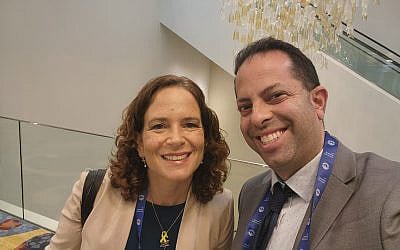
At the Jewish Federation of North America GA , you meet incredible people doing dynamic and important things for the people of Israel. This year, one conversation stood out. In the middle of the buzzing hallways, I sat down with Rachel Azaria, founder of HaOgen for Reservist Families — an organization that has become a national anchor during one of the most difficult periods in Israel’s history.
When 360,000 reservists were called up on October 7, Israel entered a new reality. Families were suddenly left without a spouse, a parent, and often their main source of emotional and logistical support. Azaria understood that chaos intimately.
“My husband did a lot of reserve duty,” she told me. “And it was always very, very hard for me. I’m very career-oriented… and when October 7 happened, I wondered what to do.”
What she did next transformed the lives of tens of thousands.
“I posted a post on Facebook, opened a WhatsApp group, and wrote: Come join.”
While the country was still in shock, Azaria acted.
“When I heard the numbers — 360,000 reservists — I posted a post on Facebook, opened a WhatsApp group and said, ‘Come join. We’re going to have reservist families throughout the country.’”
Within hours, the first volunteers arrived.
Within days, the system grew beyond anything she expected. Today, HaOgen is one of the largest volunteer organizations in Israel.
“We’re helping 35,000 families with 20,000 volunteers,” she said. “We help in 1,000 cities and towns throughout the country.”
What began as a late-night Facebook post is now a nationwide support network with structured divisions, training systems, and 24/7 availability.
“If you do the work — the boots-on-the-ground work — people will join.”
Azaria didn’t pitch the army. She didn’t pitch the government. She didn’t need to.
“Every time a woman posted, ‘I’m collapsing, my husband is in Gaza,’ her friends answered, ‘Go to HaOgen, they’ll help you.’”
The IDF took notice.
“The army said, ‘We hear about this HaOgen thing. Let’s do it.’”
This wasn’t slick marketing — it was effectiveness.
“It’s not about convincing,” she said. “It’s about doing it, proving there is a need, proving you know how to solve the problem. And then people join in.”
Today, the army has formally told HaOgen:
“We need you for the next three years.”
“I took 25 years of experience… and it crystallized into one moment.”
Azaria is humble, almost to a fault. When I asked if there was ever a moment she thought, This is going to work, she paused.
“With HaOgen, very quickly I realized that if we do the right work, it will work. I took 25 years of experience — social activism, community organizing, government, fundraising — and it crystallized for one moment.”
But she added something deeply Israeli and deeply human:
“I’m half a yekke — German. I don’t have those ‘Oh my God!’ moments. I’m like, okay, we got this done. What’s next? We have so much to do.”
That relentless drive built HaOgen into a movement.
Stories That Stay With You
When I asked for a moment that defined why she built HaOgen, she didn’t hesitate.
“There’s a woman who called us the day she submitted her PhD. She said it was because of our work. She was thinking of quitting. Now she’s doing research at the Weizmann Institute. She’s a future Israeli scientist — and she wouldn’t have done it without our help.”
Another story shook her deeply:
“A woman had just given birth. Her husband was in Gaza. He got only 48 hours for the birth and had to go back. Her mother lived far away. We were there the entire time. We prevented postpartum depression — something that affects families for years.”
Then she added, almost quietly:
“It’s not just helping in the moment. We made it possible for future Israeli scientists. We prevented trauma that could last a lifetime. We saved a family.”
A Hidden Crisis: “30% of reservist families are talking about divorce.”
There is another layer to HaOgen’s work — one few want to talk about.
“Thirty percent of reservist families are talking about divorce,” she told me. “Life has changed in such a significant way.”
HaOgen is now building new programs to support:
Couples under strain
Families facing trauma
Long-term emotional challenges
Community-based stability
“We’re here to save families,” she said simply.
“This is a crystallized moment for the Jewish people.”
Toward the end of our conversation, we spoke about community organizing and the broader global fight against antisemitism — something I work on through Minds and Hearts. Azaria said something that felt prophetic: “This is the golden moment. If you tried building this five years ago, people would have said, ‘Come on, what are you talking about?’ But today, people understand. This is a crystallized moment.”
HaOgen proves that when Israelis see a need, they respond — not with apathy, but with action.
“We’re doing this together.”
“This is really a joint initiative of everyone,” Azaria emphasized. “JFNA, federations, American foundations, Israelis… it’s everyone together.”
HaOgen’s volunteers — from students to retirees — have become Israel’s unsung home-front brigade. They don’t carry rifles. They carry strollers, groceries, meals, laundry, warmth, and stability.
And in wartime, that can be just as vital.
Learn More / Support HaOgen
You can join the movement:
Volunteer
Donate
Share their story
Support families in your community
Because in a time of war, an anchor can be the difference between sinking and surviving.