
Inside the World’s Largest Undeclared Military Zone: 79 Years Without Freedom
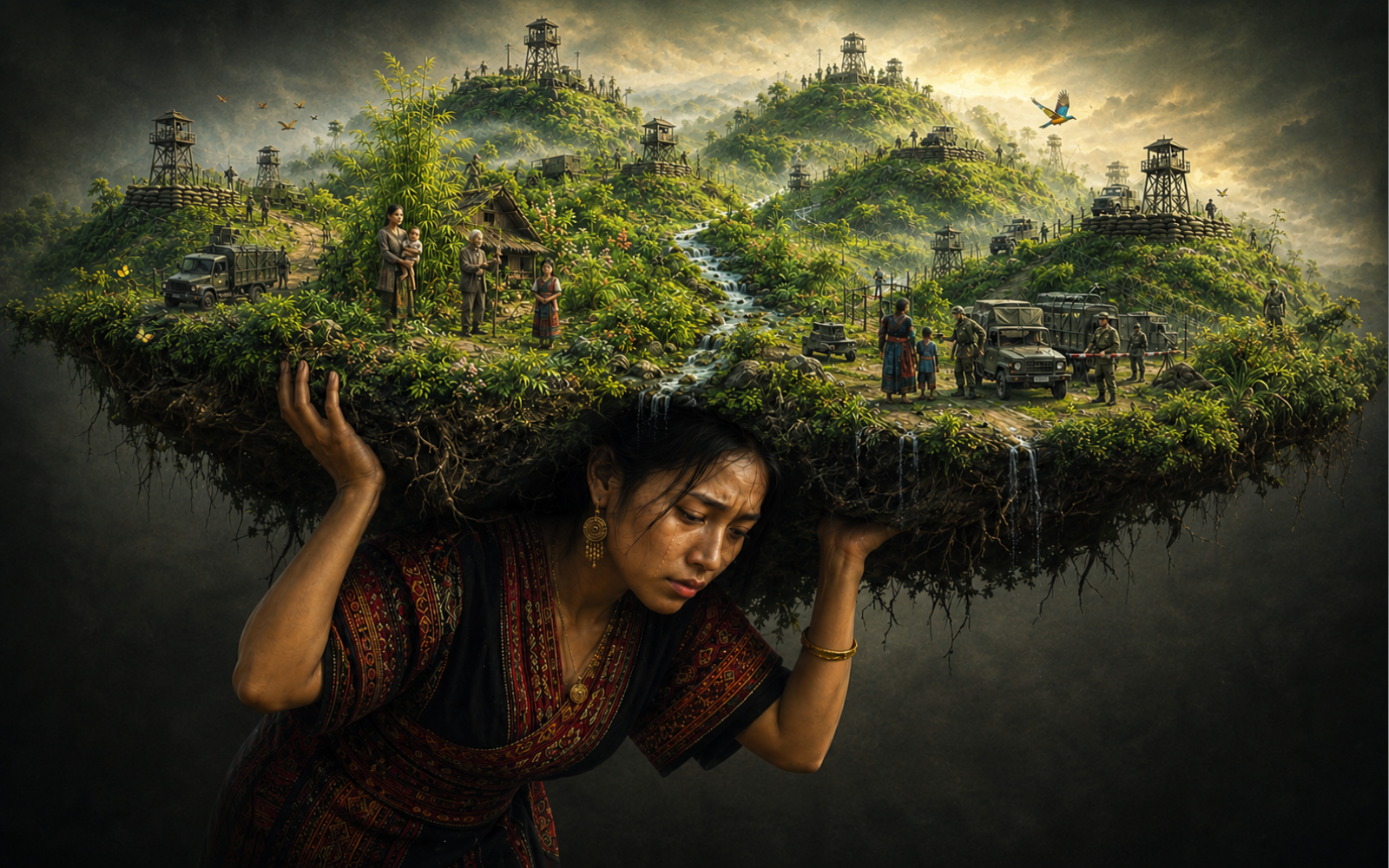
There was a time when the hills belonged to their people. Indigenous families cultivated jhum without wondering whether their fields would still be theirs after the next harvest. Men, women and children caught fish together in the streams, gathered food from the forests and walked freely between villages. During Biju, Sangrai, Baisu and other festivals, the hills filled with music and dance.
Life was not easy. Jhum cultivation required exhausting labour, and many villages had no electricity, hospitals or modern roads. Poverty and disease brought their own suffering. But Indigenous people were not strangers or suspects in their own homeland. Children did not grow up beside military checkpoints, and families did not have to explain their destination to armed men. They possessed something that cannot be measured by roads, income or electricity: freedom from fear.
Then, in 1979, the soldiers began bringing strangers into the Chittagong Hill Tracts.
I come from this Indigenous homeland. For people like me, this is not merely a forgotten chapter of South Asian history. It is the story that shaped our families, our identity and our continuing struggle to survive.
The Chittagong Hill Tracts, or CHT, lies in southeastern Bangladesh along the borders with India and Myanmar. It covers Rangamati, Khagrachhari and Bandarban and is home to the Chakma, Marma, Tripura, Mro, Tanchangya, Bawm and other Indigenous peoples.
Indigenous villagers watched unfamiliar military convoys arrive. Soldiers transported landless Bengali Muslim families from the plains and initially placed many of them in school playgrounds, marketplaces and newly established settlements. Villagers saw men wearing white prayer caps and women covered in burqas. They looked poor, homeless and unfamiliar with the land around them.
The Indigenous people did not immediately understand what was happening. These were not simply homeless families searching for somewhere to live. Their arrival marked the beginning of a state-sponsored transformation of an Indigenous homeland.
The newcomers reportedly received transportation, food, money and land. According to research cited by Forced Migration Review, more than 400,000 Bengali settlers were transferred to the CHT in the early 1980s. Many of those families were themselves victims of poverty, but their poverty was used by a powerful state. Poverty brought them to the military trucks; state policy turned their arrival into an instrument of demographic conquest.
Indigenous communities traditionally cultivated and protected land through customary ownership. A family might use the same field for generations without possessing a Bengali-style title deed. A village might collectively protect a forest or stream. Everyone living there knew whose land it was, but the state could describe it as empty or government-owned because its Indigenous custodians did not possess documents issued by that state.
Settlements appeared on Indigenous fields and around military camps and strategic roads. Markets and administrative centres gradually changed hands. Families sometimes returned to their jhum land and discovered strangers occupying it. When they protested, they did not face settlers alone. They faced soldiers, police and administrators who frequently protected the new settlements.
People defending ancestral fields were labelled separatists or terrorists. Villages were burned, civilians were killed and families were driven into forests or across the border into India. Indigenous women suffered sexual violence. Massacres and forced displacement scarred the CHT, while justice remained rare.
The conflict cannot honestly be described as an ancient quarrel between Indigenous people and Bengalis. One population was transported into the region through a state-supported program. The other was struggling to remain on the only homeland it had ever known.
To the villagers watching those convoys, 1979 may have appeared to be the beginning of the tragedy. It was not. The military trucks were travelling down a political road that had begun 32 years earlier, when an overwhelmingly non-Muslim Indigenous homeland was awarded to Pakistan without the consent of its people.
At the time of the Partition of British India in 1947, approximately 97 percent of the CHT population was non-Muslim. The 1941 census recorded only 7,270 Muslims—about 2.9 percent of a total population of 247,053. Most inhabitants were Indigenous Buddhists, Hindus and followers of traditional faiths.
They naturally expected their homeland to become part of India. On August 15, 1947, Indigenous leaders raised the Indian flag in Rangamati, while Indigenous leaders in Bandarban reportedly raised the flag of Burma.
The Radcliffe Award, published on August 17, placed the CHT inside Muslim-majority East Pakistan. Nobody asked the Indigenous inhabitants where they wanted to belong. Their homeland was transferred as though it were land without a people.
Jawaharlal Nehru protested that Sir Cyril Radcliffe had “no business to touch” the CHT. Archival records show that Indian leaders had assured CHT representatives that their region would not be included in Pakistan. Those assurances meant nothing. Pakistani troops entered Rangamati on August 21, removed the Indian flag and imposed a new political order upon the CHT.
August 17 is therefore remembered as CHT Black Day. It is also widely known as Chakma Black Day because Chakma organizations have played a leading role in preserving the memory of this historical injustice. On August 17, 2026, organizations again observed Black Day in India. Programmes in Kamalanagar, Mizoram, and Guwahati, Assam, remembered the moment when the people of the CHT discovered that freedom had passed them by.
The observance is not directed against India or any community. It remembers a political decision that placed an approximately 97-percent non-Muslim Indigenous region inside Pakistan against the expectations of its inhabitants. For India, August 1947 brought independence. For the Indigenous peoples of the CHT, it began 79 years of political control imposed from outside.
The next great wound arrived in the name of development. Pakistan constructed the Kaptai hydroelectric dam on the Karnaphuli River. When its reservoir filled in the early 1960s, approximately 40 percent of the CHT’s cultivable land disappeared beneath the water, displacing around 100,000 people, most of them Indigenous.
Homes, farms, orchards, Buddhist temples, cremation grounds and ancestral places vanished. Many families received inadequate compensation. Thousands crossed into India, while others were forced into more remote parts of the CHT, where cultivable land was already scarce. The electricity went to the cities, but the suffering remained in the CHT. First, development took Indigenous land; later, the state brought settlers to occupy what remained.
When Bangladesh became independent in 1971, Indigenous people hoped that a country born through oppression would understand their suffering. Indigenous leader Manabendra Narayan Larma sought constitutional recognition and regional autonomy. Instead, the 1972 Constitution imposed Bengali national identity upon citizens who were not ethnically Bengali.
Pakistan had denied them the right to choose their country. Bangladesh denied their distinct identity and political demands. The flag changed, but the relationship between the state and the CHT did not.
When Indigenous people resisted, the state treated their demands as a military problem. Counterinsurgency expanded, camps spread and the CHT was divided into military zones. Settlement and militarization supported each other: soldiers protected strategic settlements, while the new population permanently altered the demographic character of the Indigenous homeland.
The scale of this militarization is astonishing. The CHT covers approximately 13,295 square kilometers, roughly one-tenth of Bangladesh. Yet researchers and human-rights organizations have estimated that approximately one-third of the Bangladesh Army was deployed there during periods of intense militarization.
One-tenth of the country held approximately one-third of its army. Why did the state require such an extraordinary concentration of soldiers to govern its Indigenous population?
The CHT falls under the Bangladesh Army’s 24th Infantry Division. Four major brigade formations are based across the region: the 24th Artillery Brigade at Guimara, the 203rd Infantry Brigade at Khagrachhari, the 305th Infantry Brigade at Rangamati and the 69th Infantry Brigade at Bandarban. These formations were publicly identified in a 2016 report quoting the then-prime minister.
Alongside permanent cantonments, human-rights reports have documented approximately 500 military and security camps at different stages of the conflict. A Cultural Survival report described camps and checkpoints as an all-encompassing presence across the CHT.
No international organization maintains a ranking of the world’s military zones, and Bangladesh does not officially describe the CHT as one. Yet an entire Army division covers an Indigenous homeland larger than several independent countries. Brigade headquarters, cantonments, camps and checkpoints are distributed across its three districts, reaching far beyond the international border and deep into civilian life.
Vehicles may be stopped and passengers questioned or searched. Indigenous residents can be required to explain where they are going while traveling through their ancestral homeland. Even foreigners cannot visit the CHT as freely as they visit most of Bangladesh. Current British travel guidance requires visitors to notify Bangladeshi authorities in advance, while the United States travel advisory says prior government approval is required.
Bangladesh does not publish a transparent current inventory showing how many soldiers are deployed, how many camps remain or how many withdrawn camps have been restored, relocated or transferred to other security forces. Perhaps another territory contains more soldiers, but where else has an Indigenous homeland covering one-tenth of a country reportedly carried approximately one-third of that country’s army while remaining almost invisible to the world?
That is why I call the CHT the world’s largest undeclared military zone. It is not an official title or a claim based on an international ranking. It is the description of a lived reality. The military zone is not one enclosed compound; the military zone is the homeland itself.
On December 2, 1997, the Government of Bangladesh and the Parbatya Chattagram Jana Samhati Samiti signed the CHT Accord. Indigenous fighters surrendered their weapons, and families hoped military domination was finally ending. The CHT Accord promised the dismantling of temporary military camps, stronger regional institutions, rehabilitation of displaced people and mechanisms for resolving land disputes.
Nearly three decades later, many fundamental provisions of the CHT Accord remain unimplemented. Displaced families are still waiting for their land. Regional institutions have not received all the powers promised to them. Military influence remains embedded across the CHT. The government says many camps have been withdrawn, but Indigenous organizations dispute the extent of the withdrawal and report that some installations have remained, returned or reappeared under other security forces.
A CHT Accord that removes Indigenous weapons but leaves the structures of domination in place cannot deliver genuine peace. It produces silence under supervision.
In 1947, the CHT was overwhelmingly Indigenous and approximately 97 percent non-Muslim. According to the 2022 census, Indigenous peoples now constitute only around half of its population. This transformation did not happen naturally. It followed the disputed Partition award, the Kaptai Dam, state-sponsored settlement, military operations, land occupation and decades of pressure on Indigenous communities.
The state first took away their political choice. The dam took their homes. Settlement took their land. Militarization took their freedom. The failure to implement the CHT Accord took away their hope.
In August 2026, India celebrated its 80th Independence Day, marking 79 completed years since August 15, 1947. Across the border, the Indigenous peoples of the CHT remembered 79 years without the freedom they had expected.
They are not asking to return to a perfect past. That past was poor and difficult, but it was theirs. They could cultivate, fish, enter the forest and celebrate without living as suspects under armed supervision.
They have waited through Partition, a dam, settlement, war, military operations and a CHT Accord that never delivered full peace. They want their land restored, the CHT Accord fully implemented, their identity respected and the temporary military camps removed. Above all, they want their children to grow up without believing that checkpoints are a natural part of Indigenous life.
For 79 years, flags changed, governments changed and military operations changed their names. The checkpoints remained.
The Indigenous peoples of the CHT do not want to spend another generation waiting. They do not need another promise of peace. They need land, dignity, justice and freedom.
After 79 years without freedom, they are still waiting for the right to breathe in their own homeland.
August 18, 2026
Tokyo, Japan