
Urban Sociologist and Global Affairs Commentator
Where China’s Strategy Is Really Being Tested
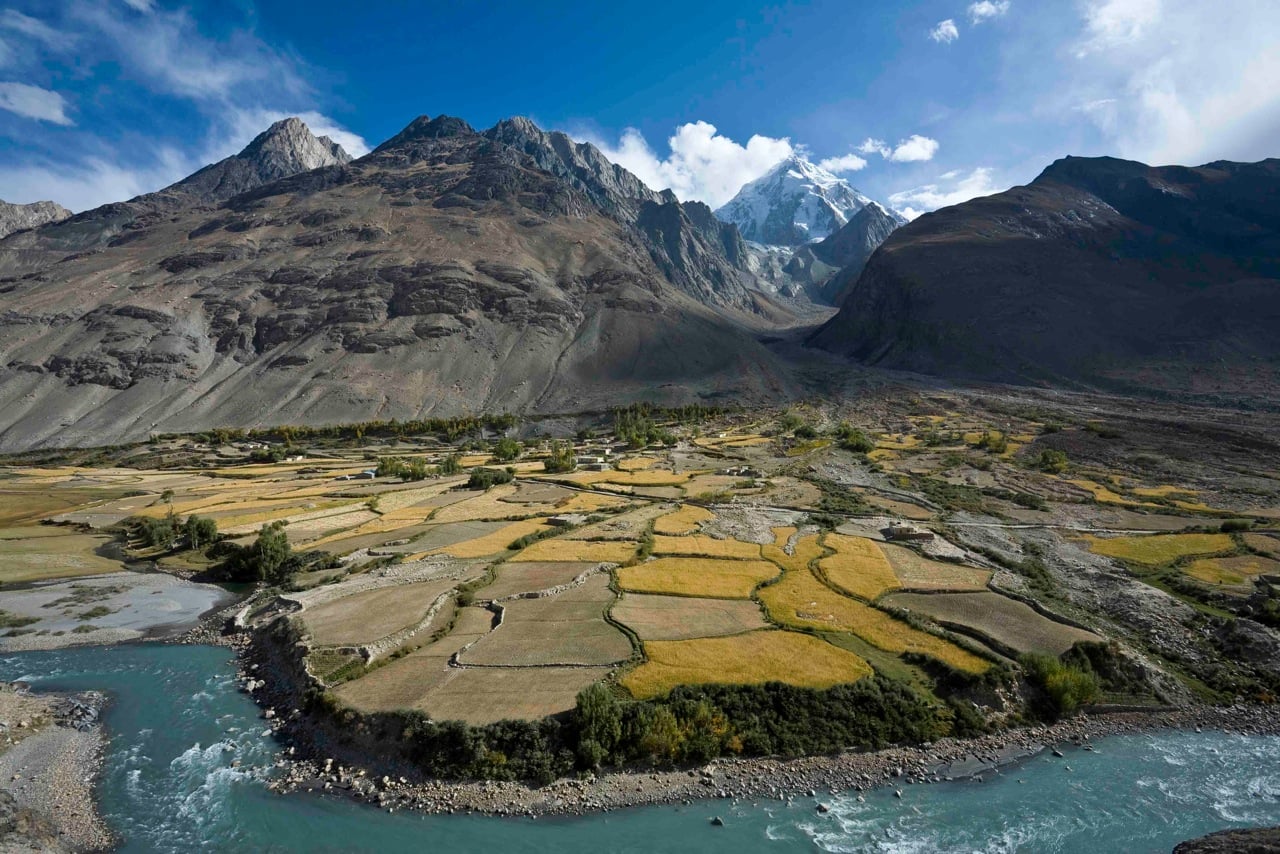
Village of Kret (Korut) with Wahkan River in the front and Koh-e Baba Tangi in the background. May 25, 2011. (Credit: John Winnie Jr., WCS-Afghanistan/Wikimedia Commons)
Analysts read China’s army exercises with Pakistan through two lenses: the routine counter-terrorism training and the India rivalry. The map points west, toward a war between Beijing’s closest partner and the Taliban regime where Chinese money, miners and engineers are increasingly exposed.
When the People’s Liberation Army and the Pakistan Army opened Karakoram 2026 at Korla on 14 October, commentary sorted itself into two camps. One treated the drill as a rehearsal for squeezing India between two fronts. The other dismissed it as routine counter-terrorism training. Both camps look east and south. Neither looks at the country that borders both participants: Afghanistan.
That omission is strange, because the drills came amid heightened tensions between Pakistan and Afghanistan, and Afghanistan borders both China and Pakistan. Pakistan and Afghanistan have been locked since February in the most sustained cross-border conflict between them since the Taliban’s 2021 return. This is not a footnote to China’s military diplomacy. It is the setting in which that diplomacy is now operating.
A war inside China’s address book
Consider what Beijing is holding. It has a treaty-grade partner in Islamabad, in which it has invested over $65 billion in road, rail and other projects. It has a commercial and diplomatic foothold in Kabul, built on mining contracts and an early embassy upgrade. And those two are shooting at each other.
The fighting has not subsided. Pakistan struck Afghan territory in February, and clashes continued into autumn: at least three border exchanges since 19 October, amid reports that Pakistani military and intelligence officials met Afghan anti-Taliban resistance groups. The same reporting records that bilateral trade fell 95% in fiscal 2026, and transit between Pakistan and Central Asia through Afghanistan has halted entirely. The UN mission in Afghanistan counts more than 1,100 civilians killed or injured by cross-border armed violence this year.
For China this is not abstract. In 2025 Wang Yi announced that CPEC would be extended into Afghanistan. A road to Central Asia through a war zone is not a road.
Beijing’s reluctant answer: be the referee
China’s first response has been mediation, and it has been substantial. Chinese diplomacy, including a message from Xi Jinping, helped ease the worst fighting in March. Beijing then hosted Pakistani and Taliban delegations in Urumqi from 1 to 7 April, though those talks ended without tangible outcome, like earlier rounds in Doha, Istanbul and Riyadh. By September, Islamabad was saying Beijing’s mediation cannot work unless the Taliban changes its relationship with Pakistani militants.
Notice the structure of the problem. Pakistan’s core grievance is the TTP; China’s is the East Turkistan Islamic Movement (ETIM). As one former Pakistani envoy put it, each capital’s core concern is a different group. Beijing is, therefore, mediating a dispute in which it holds interests of its own, not as a neutral party but as a stakeholder trying to make two aggrieved neighbours serve its security agenda.
Where Chinese blood is being shed
The reason this matters is a pattern that rarely makes strategic headlines. At least seven incidents targeted Chinese citizens in the Afghanistan-Tajikistan border area since November 2024, killing at least nine. In late November 2025, two drone and firearm attacks from Afghanistan killed five Chinese miners; the Chinese embassies told citizens to evacuate the border zone, and the strategically valuable Dushanbe-Xinjiang road project was disrupted. Responsibility remains murky: Tajik officials blamed criminal groups, analysts cite Islamic State-Khorasan Province (IS-K), ETIM or Tajik jihadists, and some local officials point to disputes over river water diverted by gold mining.
That murk is itself the point. China’s overseas assets are being exposed along a lawless frontier whose attackers are unidentified, whose host government cannot guarantee security, and whose neighbour is at war.
Reading Karakoram westward
Now reread the exercise. It was held in Xinjiang, a short distance from the Wakhan salient. Its theme was counter-terrorism clearing operations in high-altitude terrain, with drone operations, moving-target fire, sniping and a joint command. Its distinguishing feature, as one analysis notes, is the shift from specialised units to regular army forces. In September, Pakistan’s Khunjerab Security Force and Chinese units held a joint patrol at about 4,700 metres, and in July the two governments agreed to form a joint border working group on security.
Then listen to the Chinese commentators. One military analyst told Hong Kong’s Ming Pao that future joint or cross-border counter-terrorism operations were not ruled out. Another, in the Global Times, floated a joint intelligence analysis centre, joint law enforcement and precision strikes. These are speculative, semi-official trial balloons, not policy. But they sketch a plausible direction, and it points into the Afghan borderlands, not toward Ladakh.
My reading is this: Karakoram rehearses a western security role. It builds the staff habits, drone techniques and command procedures that a combined Chinese-Pakistani counter-terror effort on the Afghan frontier would require. India is a long shadow over the whole arrangement (China confirmed in May that it gave Pakistan technical support during Operation Sindoor), but the drill’s content, location and timing fit the western problem more tightly than the eastern one.
The inconvenient bandwidth problem
This reading unsettles the popular “two-front” narrative. A Pakistan with an active war on its western border is a poorer instrument for pressuring India. Every battalion in Khyber Pakhtunkhwa is one fewer on the eastern line. Chatham House observed in March that New Delhi may welcome the conflict as a diversion of Islamabad’s attention from the Indian border, and India has moved accordingly: it upgraded its Kabul mission to an embassy in October 2025, and was reported in July as the lone critic of Pakistan’s cross-border strikes. Islamabad, for its part, accuses the Taliban of acting at Indian behest, and India denies it.
Hence a three-cornered contest, with consequences that cut against easy assumptions. Pakistan’s reported outreach to anti-Taliban Afghan groups cuts against Beijing’s investments in dealing with the Taliban. India, long assumed to be the target of Chinese-Pakistani coordination, is quietly cultivating the regime Beijing most needs to stabilise (read as “Managed Instability”). China’s partner and China’s interests have begun to diverge.
Why the analysts’ community missed it
Three habits of mind explain the blind spot.
Taiwan’s gravity. Anything Chinese and military is pulled toward the Strait. A mountain exercise in Xinjiang, absent a Taiwan connection, is seen as secondary.
The post-American coding of Afghanistan. Since 2021 the country has been filed as a finished story, a graveyard of Western ambition. Chinese activity there is categorised as commerce, not security. The ledger of dead Chinese workers is read by mining analysts, not by strategists.
Institutional silos. China-watchers read the PLA; Afghanistan-watchers read the Taliban; South Asia hands read India-Pakistan. The three conversations meet only at conferences. The pattern, a Pakistani war, a Chinese mediation, a Tajik border massacre and a joint army drill, is visible only to someone reading all four.
The ratchet
China does not want a military role in Afghanistan, and analysts note that Beijing is reluctant to undertake direct military intervention that could worsen the situation. But reluctance is not a policy. Each step along the way is small and defensible: a special envoy, a mediation round, a training exercise, a border patrol, a working group. Taken one by one, none is an intervention. Taken together, they build the institutions and expectations from which an intervention could later be justified. Great powers seldom arrive in Afghanistan by decision; they arrive by defending something already there.
Limits, and what to watch
The evidence has gaps. No Chinese combat operation in Afghanistan has been reported. Karakoram is a drill. The Tajik attacks lack attribution. The Ming Pao and Global Times speculations are commentary.
Three indicators would shift the assessment. First, whether the Urumqi process revives or dies, and whether Beijing starts attaching consequences to Taliban inaction. Second, evidence of a Chinese-Pakistani intelligence-fusion mechanism or armed Chinese presence, state or private, along the Wakhan and Badakhshan approaches. Third, whether Karakoram becomes a recurring series that moves from skills exchange toward combined operations.
The other crossing
The world is waiting for China to cross a strait or the Himalayas. The more probable event is quieter and arguably more consequential: China walking, one defensible step at a time, into the security of a borderland that has defeated every outside power before it. The Taiwan clock tells us when a headline might arrive. The Korla training ground, the Urumqi table and the Tajik mining camps tell us where China’s strategy is actually being tested.
Related Topics
Related Posts