
Intelligent Autonomous Robots May Be the Solution to Hezbollah’s Drone Threat
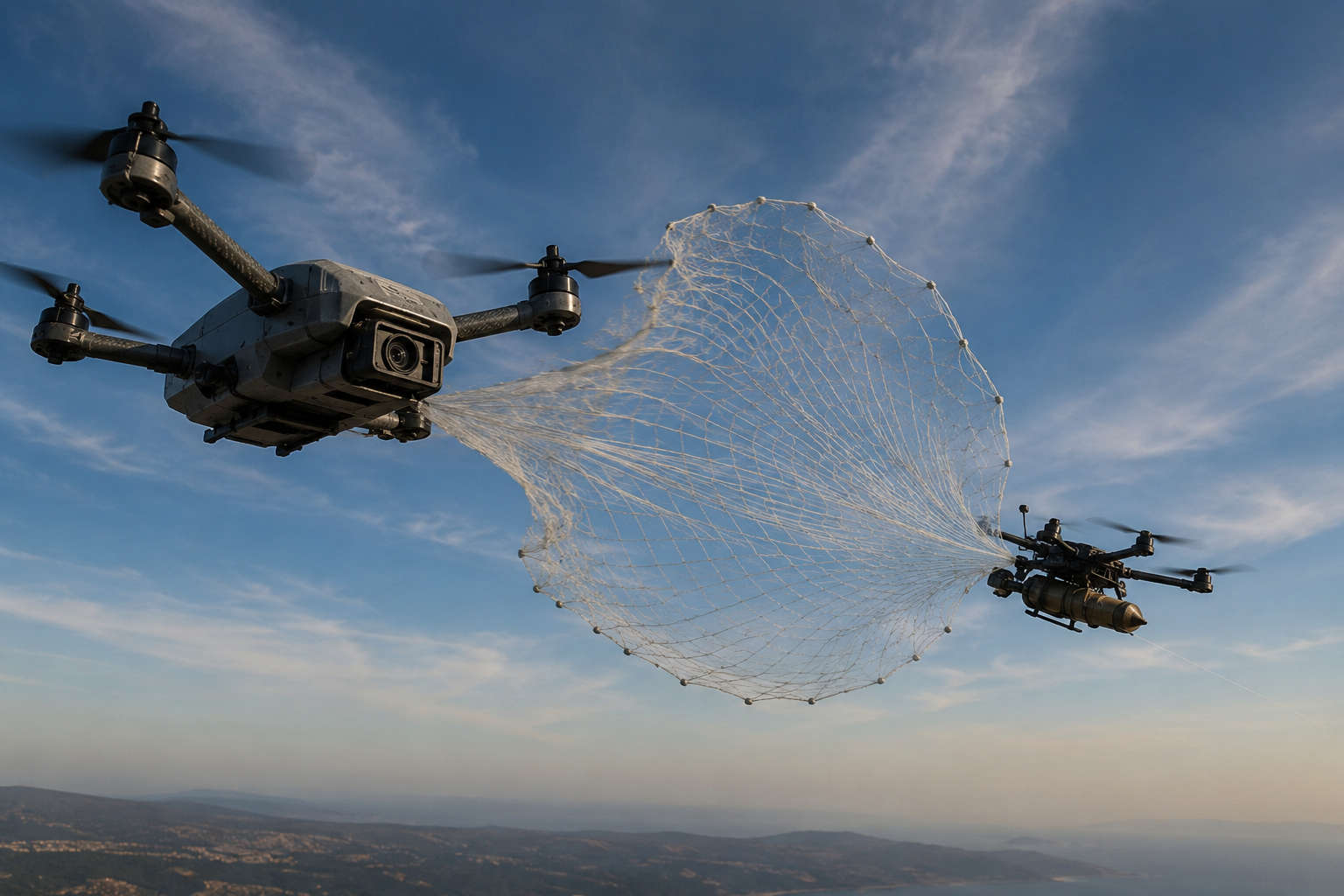
Hezbollah lost roughly 90% of its rocket arsenal during the Gaza war, and Iran, its strategic patron, is in economic collapse. And yet the most lethal weapon the Israeli army faces in southern Lebanon costs between three and four hundred dollars per unit. It is built from civilian quadcopters imported from China, married to small grenades, guided by a fiber optic filament the thickness of dental floss that unspools in flight up to ten or fifteen kilometers between the operator and the target.
The sophistication is not in the drone but in the idea. By using a physical cable instead of a radio signal, Hezbollah neutralized in a single stroke the entire Israeli doctrine of electronic warfare. There is no frequency to jam, no GPS to spoof, no control link to break. The drone emits no electromagnetic signature of its own, its radar return is minimal, and its infrared profile negligible. Even the Trophy active protection system on Merkava tanks has been bypassed repeatedly by these quadcopters, manually steered into specific vulnerabilities of the armor.
The cost in lives is concrete. Hezbollah launched around eighty explosive drones at Israeli forces over two and a half weeks, and fifteen scored hits. Four soldiers died alongside civilian Amer Hujeirat, with dozens wounded. Sergeant Idan Fooks, nineteen years old, fell in Taybeh on April 26 when his armored unit was struck. As the medevac helicopter rescued the wounded, a second drone exploded meters from the aircraft.
Captain Maoz Israel Recanati, a commander in the Golani Brigade’s 12th Battalion who was engaged to be married the following month, was killed by another Hezbollah drone strike in southern Lebanon shortly after.
Known countermeasures fall short. The IDF distributed over one hundred fifty thousand square meters of protective netting on vehicles and positions, with a similar amount on order. But IDF ground forces research and development officials describe the solution as highly problematic. Vehicle undersides remain exposed, drone detonation at distance from the netting disperses lethal shrapnel toward the troops, open-top vehicles remain uncovered. One Israeli military source put it bluntly to CNN: beyond physical barriers like nets, there is little that can be done. The Israeli Air Force has officially acknowledged that no effective immediate response exists.
The Dangerous Terrain of Lethal AI
Until now, the scenario of autonomous robots in war has been the one the world would prefer to avoid. The concerns are legitimate. An offensive machine with lethal decision-making capacity can mistake its targets, be compromised and turned against its operators, or degrade in its ability to discriminate between combatant and civilian. Moral discrimination between killing and not killing requires a judgment no current system possesses with the necessary reliability.
In my piece “Why Anthropic Denied the Pentagon Full Access to Its AI—In This War or Any Other,” I argued that Anthropic did the right thing in refusing the Pentagon full access to its artificial intelligence model. The underlying concern was precise. An AI integrated into combat command chains, capable of reasoning about military objectives, is a dangerous architecture, not for what it might do wrong but for what it might be asked to do. The general rule should be inviolable: there should never exist autonomous weapons designed or trained to directly harm human beings, not even to kill the enemy on the battlefield.
In asymmetric, urban, or guerrilla warfare, that requirement is more urgent. When even a trained soldier struggles to distinguish a real civilian from an enemy dressed as a civilian, asking an autonomous robot to perform that discrimination is to hand the gravest moral decision of war to a system without the capacity to bear it. The Stop Killer Robots coalition, the thirty governments and more than one hundred sixty-five non-governmental organizations calling for a preemptive ban are right in their general concern.
The Intermediate Zone
But there exists a category the debate has tended to ignore, trapped in binary positions. Not every autonomous robot in war is designed to kill humans. Some could be designed, specifically, to be incapable of doing so under any circumstance. The case of the fiber optic drones offers precisely that scenario.
The conceptual asymmetry matters. The Hezbollah drone is not autonomous; it is piloted by a human through the filament. It is a machine directed by a human. An autonomous interceptor designed to neutralize it would be an autonomous machine acting on a non-autonomous machine. The autonomy would lie on the side of the defender, not the attacker. This inverts the scenario most critics of military AI imagine, where the concern is a race between machines eliminating each other without human participation.
A piece in the Harvard International Law Journal from February 2024 already raised the distinction between Defensive Autonomous Weapons Systems and Lethal Autonomous Weapons Systems, using Iron Dome as an example of ethically legitimate autonomous defense. But that piece remained at the level of general argument, without descending to concrete operational doctrine, enumerable, applicable by any military. That specific gap deserves to be filled.
Six Minimum Criteria for an Exception Doctrine
The following six minimum criteria could serve as a basis for doctrinal discussion. They would apply not only to the Hezbollah case but to any autonomous defensive system meeting the same structural conditions.
- Target restriction to non-human machines. The system must be technically and architecturally incapable of identifying, pursuing, or engaging human beings under any operational circumstance.
- Exclusively reactive posture. Activation only in response to a threat detected within a predefined defensive perimeter, without the capacity to initiate proactive engagement or pursue targets outside that perimeter.
- Narrow and non-transferable function. Intelligence limited to the specific task, without general reasoning, without field learning, without technical possibility of being reconfigured for offensive use.
- Operational subordination to human command. The commander of the protected unit retains permanent authority over activation, deployment, and abort, with a manual override mechanism accessible at all times.
- Structural incapacity for serious human harm. The hardware of the system, including its neutralization method, must be designed so as not to cause serious injury to a human being even if applied incorrectly or captured and repurposed by the enemy.
- Auditable transparency. Every engagement generates an immutable record of sensor data, decision logic, and outcome, accessible to commanders and to advisors on international humanitarian law.
These criteria are not a technical novelty. They are simply what the debate has avoided specifying while it remains in convenient abstractions. The case of the Hezbollah drones forces that precision.
What the System Would Look Like in Operation
An aerial interceptor drone assigned to each squad or vehicle, equipped with specialized acoustic sensors of multiple microphones, beamforming, and intelligence that isolates the signature of the hostile quadcopter from ambient noise. Detection reaches up to one thousand meters, well before human hearing registers the threat. The system reacts while the soldier does not yet know he is being attacked. That anticipation separates successful defense from late victim.
The neutralization method uses compressed air to launch a lightweight net over the attacking drone. The net captures the quadcopter together with its fiber optic filament, which is severed when separated from the operator. An integrated parachute lowers the bundle gently to the ground. No explosive, no conventional ammunition, no warhead. The kinetic energy of the launch is capped below the medical threshold for blunt injury, so that even if the net struck a human accidentally, the worst outcome would be a bruise.
Any uncertainty in identification triggers automatic abort. Firmware that cannot be updated in the field prevents modifications that could repurpose the system for offensive use. The incapacity to harm humans rests not on code that can be modified but on hardware that admits no modification.
An Asymmetric Weapon That Has Come to Stay
The Hezbollah drone problem will not disappear. A weapon costing three hundred dollars, assembled from civilian components purchased online, that renders billions of dollars of Israeli air defense investment irrelevant is exactly the asymmetric tool a degraded enemy keeps using. Hezbollah lost ninety percent of its rockets but found something cheaper and harder to stop. The lesson will not be lost on Hamas, the Houthis, the Iraqi militias, or any future organization confronting Israeli forces. The fiber optic FPV drone is becoming a permanent fixture of the arsenal of those who fight Israel.
In that landscape, the autonomous defensive interceptor is not one option among several. It is the only solution meeting both the technical requirements of the threat and the ethical requirements of legitimate defense. Electronic warfare has been bypassed. Netting is a palliative. What remains is a flying machine designed to capture another flying machine, structurally incapable of harming the humans it protects. The choice is no longer between deploying autonomous defense or refraining from it. It is between deploying it under strict ethical architecture, or accepting more casualties like that of Sergeant Idan Fooks.