International Holocaust Remembrance Day– Part III

Continuation of Part II of the Letter to Tova Friedman
The role of women during the Nazi regime idealized them primarily as mothers, wives, and caretakers of the family. Women and families who had children with disabilities were often stigmatized, blamed, and devalued because they were seen as failing the state’s ideal of racial purity and reproductive fitness. Honors such as the Mother’s Cross and programs like Lebensborn rewarded women for producing children deemed racially pure. Within Nazi racial ideology, reproduction was not only a family matter but a national duty. The Law for the Prevention of Offspring with Hereditary Diseases, enacted on July 14, 1933, mandated the forced sterilization of people with conditions including epilepsy.
Children were targeted in the Aktion T4 program and murdered because they were seen as threats to the racial health of the nation. Sterilization was enforced through so-called Hereditary Health Courts, which were authorized to approve compulsory procedures. Estimates suggest that more than 400,000 people were forcibly sterilized under this law between 1934 and 1945.
Within Nazi discourse, intellectual disability and epilepsy were constructed as social and biological threats, while Jewish people, Black people, and Sinti and Roma were considered racial threats. All were defined as inferior and as dangers to the so-called master race.
Even healthy children of women who had a child with a disability were affected by these pressures. They, too, were often stigmatized as genetically unfit because their families were believed to be at risk of producing unhealthy offspring. Shame and suspicion extended beyond the mother to the entire family.
Under the Nazi regime, Aryan German women were strictly prohibited from having abortions because the state sought to increase the birth rate of those it considered racially valuable. Women who underwent illegal abortions faced imprisonment, fines, or, in extreme cases death.
These attitudes did not disappear in 1945. They continued to shape the lives of women who later gave birth to children with disabilities and epilepsy in postwar Germany.
Why does this history matter for families in Germany after the war who had children with intellectual disabilities and epilepsy?
My mother gave birth to my brother Jens in 1970, at a time when former Nazis, including doctors, nurses, and other medical staff who had participated in the Aktion T4 program, were still part of German society and continued to hold positions of authority.
I grew up in the tension surrounding my mother’s position as a woman who gave birth to a child with a condition that had once been heavily stigmatized. My brother was not planned. She had wanted to abort the pregnancy, but was not permitted to do so under the law at the time. She had no choice. No one could have foreseen that my brother would develop epilepsy or that he would have a severe intellectual disability.
From the moment he was born, my mother loved and embraced him, yet she carried a deep sense of guilt when he was diagnosed with epilepsy, as if she were being punished for not wanting a third child.
Her situation was extraordinarily difficult. She had to care for a child with complex medical and support needs while navigating bureaucracy, constantly worrying about her child’s safety and confronting societal prejudice, all without sufficient assistance. Although Germany had a postwar disability law, it was vague and limited in scope. Consequently, she had little institutional protection when her child was mistreated. This included instances where he was left in wet clothing after a seizure or when a caretaker photographed a girl with Down syndrome in a hay-filled bathtub and circulated the images among friends in one of those facilities in a nearby town, though not all of the facilities were like that. Because of his age, he eventually had to leave the others, where she had trusted the personnel more. She also had no legal recourse when a neighbor in a nearby garden, just fifteen minutes from their home, suggested that my brother should be pushed down the stairs so the family could live in peace.
These incidents, along with the broader hostility of the outside world, reinforced her determination to protect her child from harm. I witnessed this daily. She spent most of her life at home with him and lived under constant strain. She slept next to my brother every night to monitor his seizures, took him to the bathroom during the night, and often changed his pajamas and sheets, while my father worked and frequently traveled for business. When he returned home, he took over care and spent his vacations helping her.
Some doctors repeatedly pressured her to place my brother in a residential facility for children with disabilities to preserve a normal family life. None of us wanted to abandon him. He was part of our family. He could not speak and was vulnerable. Physicians sometimes proposed treatments that involved risks, forcing my mother to make decisions that could have unforeseen negative consequences. I still remember when my brother was scheduled to undergo an invasive procedure at the Epilepsiezentrum Kork-Kehl in the early 1970s. My brother was not yet two years old. The suitcases were already packed with new pajamas and clothes, and my mother was prepared to stay with him in the hospital. At the last moment, she decided against the procedure. Instead, he underwent a different treatment that caused his face to swell dramatically. Years later, when he was around eleven, doctors predicted that he would likely not survive adolescence after experiencing his first status epilepticus. Much later, I learned that the same institution had previously been involved in deporting patients with his condition to killing centers.
It is one thing to make such decisions in a society where people with epilepsy are treated like any other patients. It is another when rumors still circulated that people with disabilities were gassed under Hitler. Although the details of Aktion T4 were concealed for decades, and I did not learn about them until 2009, when I visited the library of the House of the Wannsee Conference, my mother’s instinct was to keep her child close, where she believed he would be safest. She felt anxious leaving him with strangers, and that anxiety had valid reasons because there is a profound difference between being treated at the Department of Neurology at UCLA for epilepsy and being placed in a facility with such a history. The neglect of this history in public memory is itself a form of neglect, signaling that vulnerable people remain at risk when society fails to confront its past. How can anyone fully trust the health care system when this history is omitted from International Holocaust Remembrance and school lessons, and when the Bundestag includes descendants of high-ranking Nazi officials? Intuition and instinct form a “seventh sense,” a perception beyond the ordinary senses, as described in Jung’s psychological theory.
The years of caregiving, amounting to approximately 220,000 hours over more than three decades, took a severe toll on her body. Caring for an adult with significant physical needs is profoundly different from caring for a baby. This labor was never fully acknowledged by the German state. She could not return to the job she was trained for, and those missing years show up in her modest retirement.
I felt my mother’s pain throughout my life. There was little I could do beyond helping with caregiving, cleaning, and shopping, and later studying Nazi history beyond the classroom to understand the broader context and find answers. Yet that does not mean I wish I had not had a brother like mine. I feel honored that I did. He turned me into a more evolved human, someone able to see the humanity in a person like him. As the musician Yo-Yo Ma said, he first sees himself as a human being, then as a musician. That order is truly important. Health is important. Medical research is important. Kindness is important. Compassion is important. Tolerance is important. Regardless of his abilities, my brother was my brother. He brought joy to people’s lives through his pure and authentic nature. There are people in this world who are incredible performers, absolutely talented, yet never reveal their true selves, walking around with a facade. There is beauty in honesty. In my view, that deserves honor.
I grew up at a time when his condition was not discussed openly in school and when students were not given opportunities to address intellectual disability as a subject in class. I grew up at a time when German schools had no counselors, and my city offered neither psychotherapy nor support groups. I grew up at a time when children did not say epilepsy but spoke of “elektrische Anfälle haben”. They thought it was funny, yet I couldn’t laugh with them. I grew up at a time when children with cerebral palsy or spasticity were called “Krüppel”. I grew up at a time when individuals with intellectual disabilities were called “Depp” or “Idiot” or spoken of as a dog who should be beaten to death. I grew up at a time when someone with hydrocephalus was called a “Wasserkopf’, and when people with Down syndrome were still called “Mongoloid” or simply “Mongo”. I also grew up at a time when racial slurs were still widely used. In other words, the violence did not stop in 1945. It survived in language, where words continued to wound and to exclude.
I learned these derogatory words before I entered first grade. I learned the word epilepsy at age five, along with other medical terms, outside of school, in the hospitals and doctors’ offices where my brother was treated. I also learned that society had a tendency to divide people into two categories, described as normal and abnormal, or abled and “behindert.” I was in a position to observe both worlds. This dual exposure shaped my understanding of human dignity and exclusion long before I had the language to analyze it theoretically.
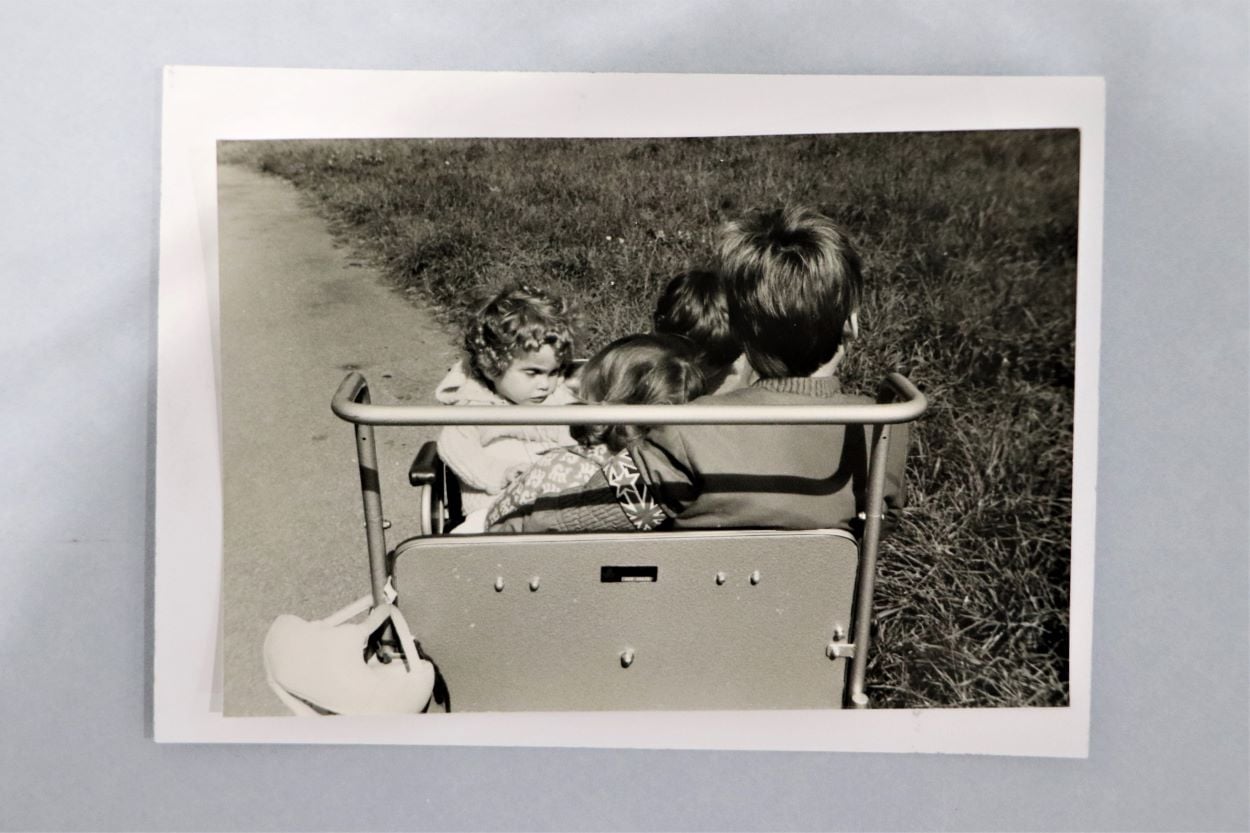
Through my brother, I encountered people whose lives unfolded under very different conditions due to illness or disability. One of them was Brigitte Lichtenberger. She had kyphosis, which at the time was simply described as having “a Buckel”. She worked at the daycare facility for the disabled, where my brother was first placed, and he was in her group. She was a kind woman who cared about people more than her job required. She died far too young, not yet fifty. I also remember a boy whose name was also Jens, who was in the same group as my brother and who died after choking during a seizure. His death made it painfully clear how constant supervision was a necessity to protect my brother’s life. There was also Ramona, my brother’s first crush. She had crossed eyes, ponytails, and a slightly protruding tongue. She was a lovely and affectionate little girl. There is a photograph of the two of them sitting together in a wagon, my brother’s epilepsy helmet hanging from its handlebar.
Then there was Andreas Eichele, who lived on our street and was diagnosed with multiple sclerosis. He studied music at a conservatory and wanted to become a music teacher. His mother cared for him until her body could no longer manage the physical demands. He later lived in a residential home for people with multiple sclerosis. He died before he turned sixty. These were lives lived in the shadow of this history, marked by care, dependency, and perseverance, but also by social invisibility.
Through these encounters, I lived in parallel worlds. One aligned with normative expectations, the other shaped by illness, disability, and social marginalization. I remain grateful for this perspective. It taught me to look beyond surfaces and to value forms of existence and humanity that are often overlooked. It also made me see things that others would never notice. I know that in German intellectual circles, one is not expected to disclose personal experience, and that for people like filmmaker Werner Herzog, this would be considered the least artistic thing to do. However, I did draw on my personal experience and transformed it into fiction by stepping into the shoes of Therese W. and writing a novel and a screenplay about her life.
Because of my brother, I became an early witness to how National Socialist ideology continued to cast a shadow long after 1945. Thus, to prevent history from repeating itself, it is essential to remember all victims of the Holocaust properly and to personalize their stories so that they do not remain numbers. It is also necessary to observe how governments treat vulnerable groups on occasions such as International Holocaust Remembrance Day, and to continually examine which stories are told, who is invited into public conversations, and which forms of suffering remain overlooked. Ableism remains one of the least addressed forms of discrimination.
I want to state clearly that it was never my intention to diminish the suffering of Jewish victims of the Holocaust. My intention is to raise awareness of this history and to show how its consequences continue to affect later generations.
If we are serious about confronting the legacy of National Socialism, then remembrance must be inclusive and balanced. Only by acknowledging all those who suffered can we begin to heal from intergenerational trauma and stand together against antisemitism, either coming from the left or right, ableism, and every form of dehumanization.
I feel that many contemporary intellectuals who advocate for social justice still show little awareness of this group and of the people who belong to it via family bonds. It is deeply challenging to belong to a group that is rarely valued, rarely included, and rarely seen. If one person in a family is treated as lesser, marginalized, or harmed, it affects the entire family. I hope that my three-part letter contributes to greater awareness and inclusivity. That is my sincere hope.
I wrote this for all those who were silenced, could not speak for themselves, and for whom no rescue came. I wish to close this with a performance by Yo-Yo Ma, playing ‘Song of the Birds’ by Pablo Casals.
Yo-Yo Ma performing “Song of the Birds” by Pablo Casals
Thank you for allowing me to express these reflections. I thank the Times of Israel for providing a platform to share my thoughts and experiences. I wish you, your family, and the Times of Israel staff a very happy Valentine’s Day, and I extend my gratitude to all journalists and filmmakers who work to bring social justice to those who have not yet received it.
I leave these words here, hoping they carry a little light for all who may come across them.
Thank you,
Simone Suzanne Kussatz
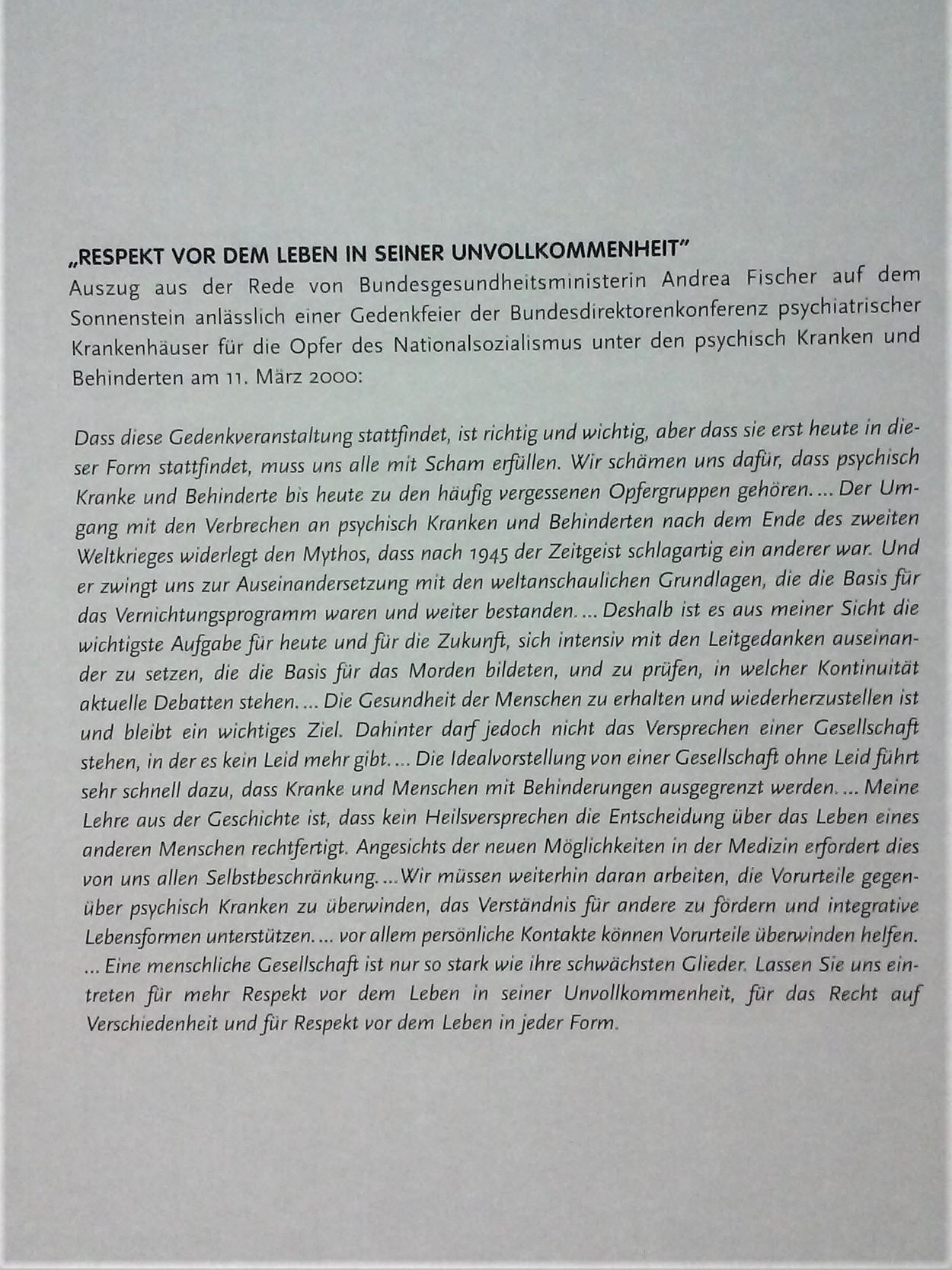
Here is the English translation
Respect for Life in Its Imperfection
Excerpt from a speech by Federal Minister of Health Andrea Fischer at Sonnenstein on the occasion of a commemorative ceremony of the Federal Conference of Directors of Psychiatric Hospitals for the victims of National Socialism among the mentally ill and people with disabilities on March 11, 2000.
That this commemorative event is taking place is right and important, but the fact that it is only taking place today in this form must fill us all with shame. We are ashamed that people with mental illness and people with disabilities still belong to the groups of victims that are most frequently forgotten.
The way crimes against people with mental illness and people with disabilities were dealt with after the end of the Second World War disproves the myth that after 1945, the spirit of the times suddenly changed. It forces us to confront the ideological foundations that formed the basis for the program of extermination and that continued to exist.
For this reason, from my perspective, the most important task for today and for the future is to engage intensively with the guiding ideas that formed the basis for the killing and to examine the extent to which current debates stand in continuity with them.
Preserving and restoring people’s health is and remains an important goal. However, this must not be accompanied by the promise of a society in which there is no longer any suffering. The idealized vision of a society without suffering very quickly leads to the exclusion of people who are ill and people with disabilities.
My lesson from history is that no promise of salvation can justify deciding over the life of another human being. In light of the new possibilities in medicine, this requires self-restraint from all of us.
We must continue to work to overcome prejudice against people with mental illness, to promote understanding for others, and to support integrative forms of living. Above all, personal contact can help overcome prejudice.
A humane society is only as strong as its weakest members. Let us stand up for greater respect for life in its imperfection, for the right to be different, and for respect for life in every form.
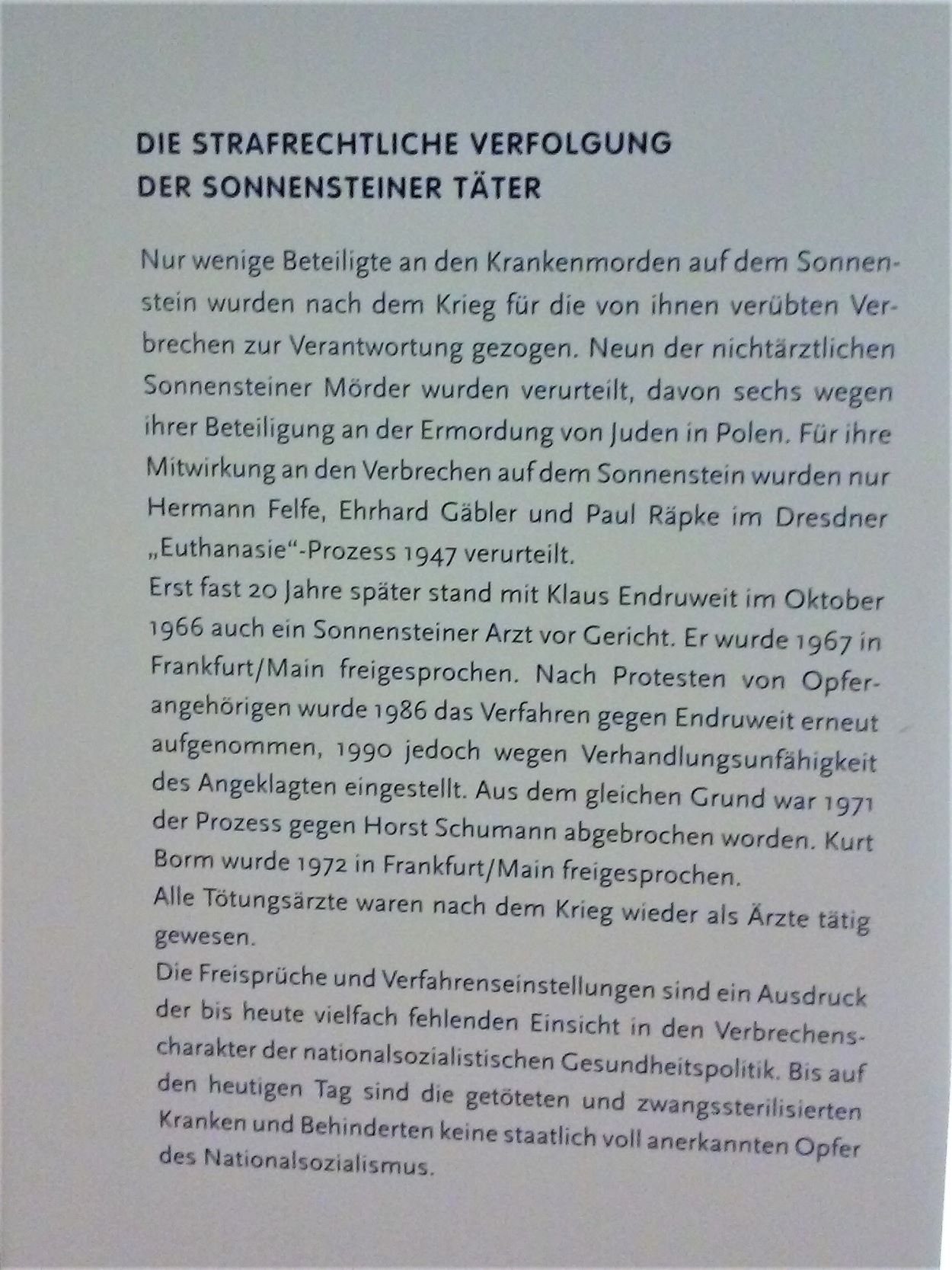
Here is the English translation
The Criminal Prosecution of the Sonnenstein Perpetrators
Only a few of those involved in the murders of patients at Sonnenstein were held accountable after the war for the crimes they committed. Nine of the non-medical Sonnenstein perpetrators were convicted, six of them for their involvement in the murder of Jews in Poland. For their participation in the crimes at Sonnenstein, only Hermann Felfe, Ehrhard Gaebler, and Paul Raepke were convicted in the Dresden euthanasia trial of 1947. It was not until twenty years later that a Sonnenstein physician, Klaus Endruweit, appeared in court in October 1966. He was acquitted in Frankfurt am Main in 1967. After protests by relatives of the victims, proceedings against Endruweit were reopened in 1986, but in 1990 they were discontinued due to the defendant’s inability to stand trial. For the same reason, the trial against Horst Schumann was abandoned in 1971. Kurt Borm was acquitted in Frankfurt am Main in 1972. All of the physicians involved in the killings had again been working as doctors after the war. The acquittals and the termination of proceedings reflect a lack of insight, still widespread today, into the criminal nature of National Socialist health policy. To this day, the murdered and forcibly sterilized patients and people with disabilities are not fully recognized by the state as victims of National Socialism.
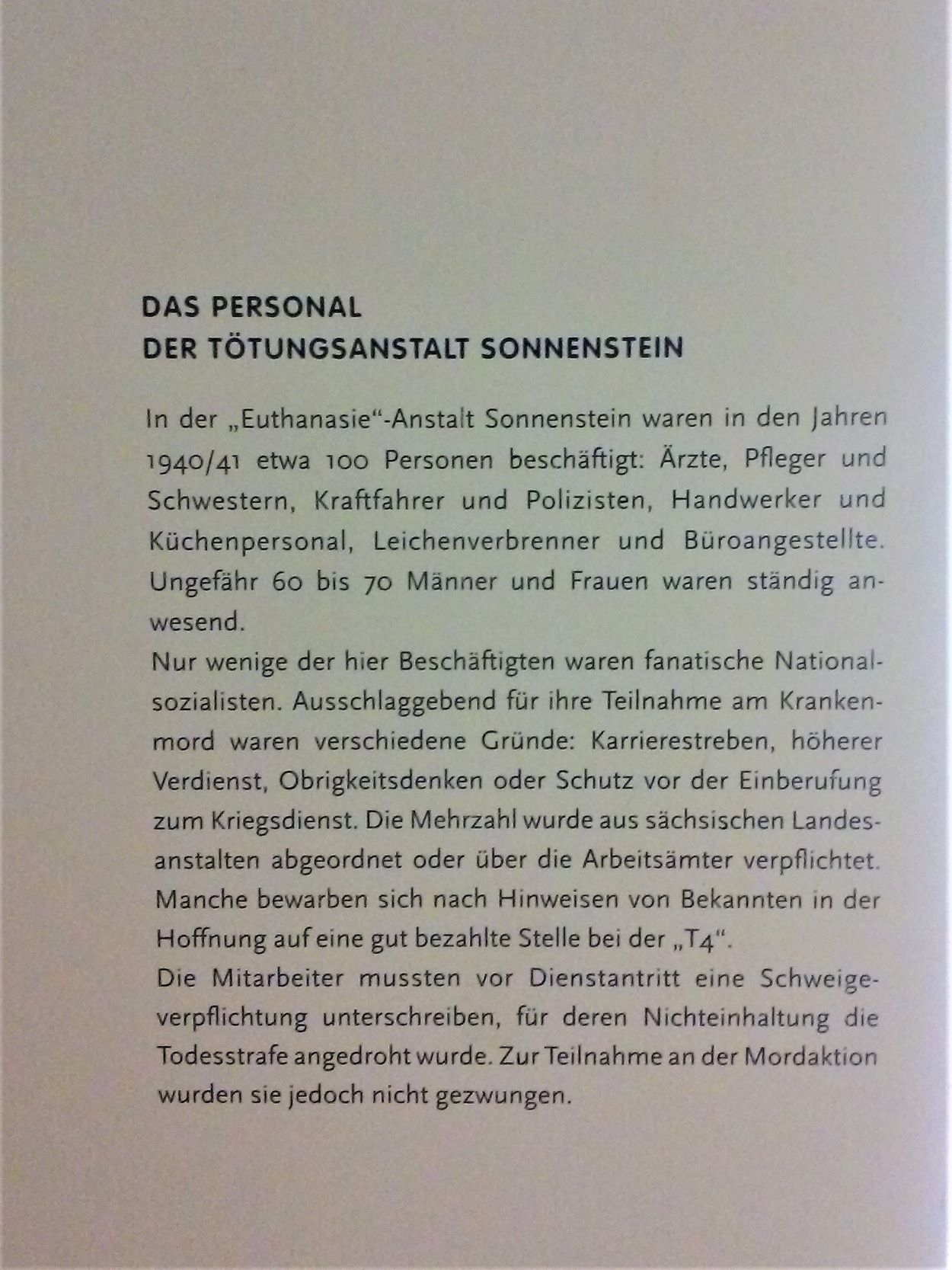
Here is the English translation of the panel.
The staff of the Sonnenstein killing center
At the Sonnenstein euthanasia center, approximately 100 people were employed in the years 1940–1941, including physicians, nurses and orderlies, drivers and police officers, craftsmen and kitchen staff, crematorium workers, and administrative personnel. Around 60 to 70 men and women were permanently on site.
Only a few of those employed there were fanatical National Socialists. The decisive factors for their participation in the murder of the sick varied: career ambitions, higher pay, obedience to authority, or protection from conscription into military service. The majority were seconded from Saxon state institutions or recruited through employment offices. Some applied after being encouraged by acquaintances, hoping for a well-paid position with the “T4” program.
Before beginning their duties, employees were required to sign a pledge of secrecy, the violation of which was punishable by death. However, participation in the killing operation itself was not compulsory.