

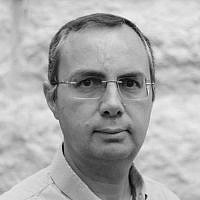
Interview of Jean-Pierre Lledo – film director and writer – 2nd part
Continuation from 1st part of this interview: https://blogs.timesofisrael.com/interview-of-jean-pierre-lledo-film-director-and-writer-1st-part/
Laurent Cudkowicz: Sansal’s novel The German Mujahid deals with the Holocaust — a topic to which both Germany and Israel are highly sensitive. What support has there been for him in Israel?
Jean-Pierre Lledo: Shortly after the publication of that book, the Jerusalem International Writers Festival invited Sansal as guest of honor in May 2012. He accepted — an extraordinary gesture. Never before had an Algerian writer publicly traveled to Israel.
He told me — and I included this in my film Israel, the Forbidden Journey — that many Algerian intellectuals had visited Israel secretly, via France, with separate-visa documentation. But he chose to go publicly.
At the same time, the Prix du roman arabe was being awarded in Paris, financed by Arab embassies. That year, the jury — which included the writer Tahar Ben Jelloun — chose to award the prize to The German Mujahid, but the ambassadors refused to pay the prize money.
While shooting my film, I recorded a scene with Boualem in Jerusalem, on a small terrace overlooking the Western Wall and the Temple Mount. He was overwhelmed. His first words were:
“How could I have imagined being here, when in Algeria, the name ‘Israel’ is never spoken? Since 1962, our TV and radio only refer to ‘the Zionist entity’ or ‘the occupying power’ — never ‘Israel.’”
That conversation touched on the denial — or erasure — of Israel’s existence, but also on his personal connection to the country.
He said, simply:
“I love Israel. It’s not ideological. If I didn’t, I wouldn’t have come.”
So you can imagine my shock, my outrage, when I realized that the 2025 Jerusalem International Writers Festival — held from May 19 to 22 in the beautiful Mishkenot Sha’ananim neighborhood — didn’t once mention Sansal’s imprisonment. This neighborhood was the first one built outside of the Old City’s walls, by Sir Moses Montefiore, the famous 19th century Jewish English benefactor.
LC: Even though he had been their guest of honor in 2012?
JPL: Exactly. I tried to contact the festival’s new management, which was not easy. When I finally did, they didn’t seem to know who he was. This team was completely different from the 2012 team — and far worse.
I explained who Boualem Sansal was. I argued that he embodies the universal spirit of the festival. Writers from around the world were invited that year. The opening featured Bernard-Henri Lévy, the closing with Michel Houellebecq — whose novel Submission describes a future France overtaken by Islamism, which is precisely Sansal’s subject.
I thought Houellebecq could have provided a perfect bridge — supporting Sansal, whose entire literary work addresses the same issue.
Sansal is published by Gallimard, France’s most prestigious publishing house. I couldn’t believe the festival, which claims to celebrate global literature, wouldn’t even mention that one of its former guests of honor was now a political prisoner.
I contacted Julia Fermento-Tzaisler, the festival’s young artistic director — a novelist herself, though with only one book published. Her answer to my request was: “Niet.”
I had merely asked for a 4-minute address at the opening ceremony, just to say:
“A former guest of honor of this festival, Boualem Sansal, a French-Algerian writer, is in prison.”
This could have been placed just before Bernard-Henri Lévy’s speech — he’s also a French writer born in Algeria — or before Houellebecq’s. But the response was a flat no.
Even on the final day of the festival, when I attended the closing with the film editor Ziva Postec[1] — there was still no mention. I approached Fermento-Tzaisler again. She confirmed her refusal, with no explanation.
I said I would address the audience anyway — this caused some panic. I even showed them the short English text I intended to read (or that anyone else could have read). [2]They told me I could speak at the end of the conference. But once the event ended, I was given no chance to speak.
I still cannot understand this stubbornness. I had provided all the arguments and information they needed — well in advance, ten days before the festival began. They had time to verify everything, including that Sansal had indeed been the guest of honor in 2012.
On that very same day — May 22 — Sansal was named the 2025 recipient of the Cino Del Duca World Prize, a major literary award worth 200,000 euros.
The contrast is staggering. I was stunned. I wrote a public letter to the director of Mishkenot Sha’ananim, the festival’s host institution — and received no reply.
LC: When you see how the 2025 Jerusalem International Writers Festival refused — without explanation or logic — to even mention Boualem Sansal, despite hosting Bernard-Henri Lévy and Michel Houellebecq… When you see that the Cannes Film Festival also failed to say a word… When you see that a significant number of members of the French and European Parliaments refused to call for a writer’s release, despite claiming to fight for freedom… Do you think that, like Israel — which became “radioactive” in the eyes of some after the Hamas attacks — supporting Boualem Sansal has become “radioactive” too?
JPL: Yes, absolutely — at least in part.
As I mentioned earlier, Bat Ye’or demonstrated, with documentary evidence going back to the 1970s, that Europe effectively sold its soul. In exchange for oil, it pledged to support the Palestinian cause.
This “radioactivity” is just a new version of that same old strategy: an international campaign cloaked in humanitarianism — famine, genocide — but deeply politicized.
Figures like Boualem Sansal may simply be impossible for some to support, because they force Europe to confront truths it doesn’t want to face. Terror attacks, murders — these now occur almost daily in Germany, France, Sweden…
This is happening because, to a large extent, Europe has been bought. By Qatar, for example — which doesn’t just fund football teams, but is also the principal global backer of the Muslim Brotherhood.
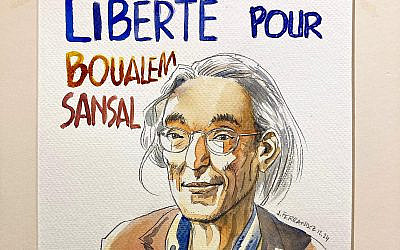
So yes, Sansal — as a subject — has become “radioactive.” But in the specific case of the Jerusalem Writers Festival, I don’t think it was political. I think it was pure ignorance.
Still, once I gave them all the background — ten full days before the event — why did they continue to refuse? They had time to verify who Sansal is. They had time to look me up, to confirm that he had truly been their guest of honor in 2012.
If their refusal was ideologically motivated, it would be extremely serious. But I don’t think that was the case.
LC: What would you suggest to readers who want to take action in support of Boualem Sansal?
JPL: People can join the International Support Committee by email and contribute financially, if they wish. Boualem Sansal had a warm relationship with the writer David Grossman, who has been involved in the support initiative in Germany.
The only way to fight the strategy of attrition that Algeria is pursuing is to speak out — to spread information so more people become aware and take a stand. That’s why the missed opportunity at the Jerusalem Festival was so unfortunate.
Sadly, neither Bernard-Henri Lévy nor Michel Houellebecq said a word about Sansal. They could have. Yes, they were invited to talk about their own work, but they still could have mentioned him. It’s very disappointing.
LC: Thank you very much, Jean-Pierre Lledo.
To support Boualem Sansal’s release: https://www.helloasso.com/associations/comite-de-soutien-international-a-boualem-sansal/formulaires/1
To become a member of the International Support committee, please send an e-mail to: soutien.boualemsansal@gmail.com
[1] Chief-editor of the film Shoah directed by Claude Lanzmann. She took part to the conversation with Sansal in 2012 a producer and chief-editor of the film: “Israël, le voyage interdit” (Israel, the forbidden journey).
[2] Arab novel prize created in Paris in 2008 by the Council of Arab Ambassadors.