
Russian-American-Israeli Palestinian. Palestine is Israel.
Invented Lineages: From Abraham and Ishmael to the ‘Palestinians’
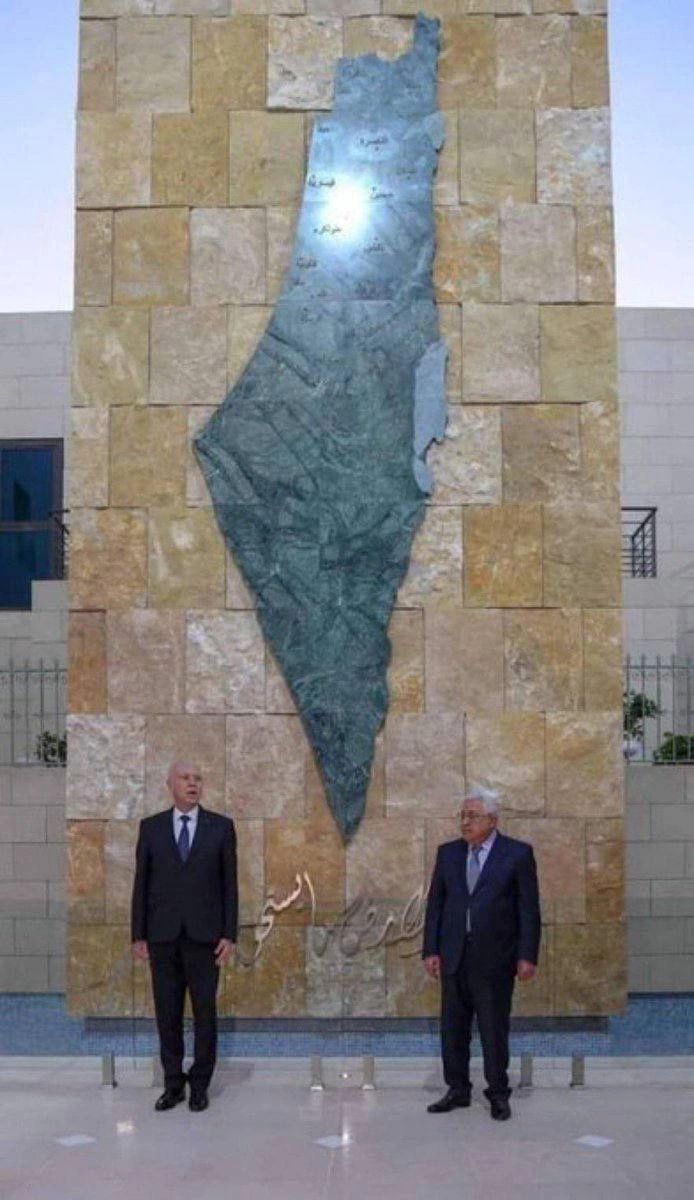
Arabs ≠ Ishmaelites, Ziophobes ≠ Palestinians. Mahmoud Abbas and Tunisia’s President Kais Saied stand before a map that appropriates Israel and Jewish-Palestinian identity—an emblem of supersessionism. Photo: the new “Palestinian Embassy” in Tunisia, Dec 8, 2021.
How Ancient Myths and Modern Fabrications Pervert History
The question of origins has always been central to identity and legitimacy. Nations and religions alike anchor themselves in stories of ancestry, covenant, and continuity. But not all such stories withstand scrutiny. One of the most persistent is the belief that Arabs are the direct descendants of Abraham through Ishmael. Another, more recent claim is that some Arabs — those claiming the fabricated identity of “Palestinians” — are simultaneously the most ancient people on earth, continuously rooted in the land since time immemorial. Both narratives share the same structure: fabrication, repetition, and eventual acceptance as fact.
This article examines the sources of these myths and shows how they fit into a larger pattern of supersessionism — the appropriation of Jewish identity by external traditions seeking legitimacy.
What the Jewish Texts Actually Say
The Hebrew Bible (Tanakh) recounts the story of Ishmael with striking clarity. Genesis 25 lists his twelve sons and locates their settlements: “from Havilah to Shur, which is opposite Egypt in the direction of Assyria” (Genesis 25:18). Ishmael’s lineage is remembered, but always distinct from Isaac’s — the covenantal line.
The rabbinic tradition (Talmud, Midrash, classical commentators) expands on Ishmael’s character and destiny. Yet nowhere do these sources equate Ishmael’s descendants with the Arabs who emerge millennia later in history. In fact, the very word “Arab” (Arav, ʿArab) appears in the Bible, but it refers to desert tribes and geographic regions, not to Ishmaelites or a unified ethnic group.
In short: there is no internal Jewish textual basis — biblical or rabbinic — for identifying Arabs with Ishmael.
Where the “Arab–Ishmael” Link Comes From
The connection was forged elsewhere.
- Greco-Roman writers occasionally lumped together nomadic peoples east and south of Judea under vague categories like “Saracens” or “Arabs.”
- Christian theologians, seeking to fit new peoples into biblical genealogies, began identifying Arabs with Ishmael. This aligned with their broader project of universalizing biblical history for their own purposes.
- Islamic tradition later canonized the claim, integrating it into the Qur’an and Hadith, where Ishmael becomes not only the ancestor of Arabs but also a proto-Muslim who prefigures Muhammad himself.
The “Arab–Ishmael” narrative is therefore a retroactive identity claim, invented and imposed millennia after the biblical period.
Supersessionism as Identity Theft
This fits into a broader theological pattern: supersessionism. Both Christianity and Islam claim to inherit the covenant, land, and God of Israel while simultaneously dismissing or distorting Judaism.
- Christianity asserts that the “New Covenant” supersedes Sinai.
- Islam asserts that the Torah and Gospel were corrupted, with the Qur’an restoring the true revelation.
Both require the same maneuver: to appropriate Jewish ancestry and legitimacy while denying Jews their ongoing role.
As I argued in The Metaphysical Root of Antisemitism and Ziophobia, supersessionism is not merely theology — it is theft: of prophets, of covenants, of history, and even of God Himself. The Jewish people become an intolerable presence because they are the living contradiction to the replacement story.
The “Arab–Ishmael” myth is one of the earliest examples of this theft: a claim to Abrahamic descent designed to establish legitimacy where none existed.
The “Palestinian” Narrative: A Modern Parallel
The same pattern reappears in modern times. The notion of a distinct “Palestinian” nation is not an ancient truth but a 20th-century invention, gaining force only after 1967. The Soviet Union actively supported its promotion, while local Arab leaders enforced it through propaganda and terror.
Like the “Ishmael” myth, the “Palestinian” identity was hammered into being through relentless repetition until it became “obvious.” Its fluid genealogy — Canaanites one day, Philistines the next, sometimes Israelites, Phoenicians, or Amalekites — reveals its purpose: not historical accuracy, but a supersessionist claim to indigeneity and legitimacy.
As a result, many now believe that “Arab–Palestinians” are the most ancient people on earth, never displaced and eternally rooted — while Jews are recast as recent intruders. This inversion mirrors the earlier theological theft: the erasure of Jewish continuity by those seeking to appropriate it.
This modern fabrication has been formally challenged in the Palestinian Identity Manifesto and its accompanying Petition, which document the ideological construction of this identity and expose it as a recent invention rather than an ancient lineage.
The Manifesto underscores that the “Arab–Palestinian” identity, as widely understood today, is a political and cultural fabrication, not a historical fact, mirroring the same pattern of retroactive legitimacy seen in the “Arab–Ishmael” narrative.
Why Exposing These Myths Matters
Skeptics may dismiss these narratives as harmless mythmaking. But myths repeated with authority and enforced through violence twist reality. The “Arab–Ishmael” story, though absent from Jewish sources, has been repeated for so long that even some Jews assume it to be true. At the same time, in Israel, Arabs are often mockingly called “cousins”—a sarcastic nod to the persistence of this unfounded belief. Meanwhile, the “Arab–Palestinian” identity, though less than a century old, is now treated by global institutions as an eternal fact.
To confront such deceptions, one must return to the sources. The Torah and Talmud do not equate Arabs with Ishmael. The archaeological and historical record does not support a continuous “Arab–Palestinian” nation. These myths were created by others — Christianity, Islam, modern political movements — each seeking to replace Jewish identity with their own.
Recognizing this pattern is not merely an act of historical clarification. It is a defense of authenticity against the endless cycle of identity theft.
Conclusion
The “Arab–Ishmael” narrative and the “Arab–Palestinian” narrative may seem different in age and form, but both belong to the same genre: fabricated legitimacy through supersessionist appropriation. They remind us how powerful repetition can be in distorting perception — and how essential it is to hold fast to original sources and historical truth.
In the end, the Jewish people themselves remain the decisive fact. Their continuity, survival, and return are the living refutation of every replacement story.
See Also
Related Topics
Related Posts