Iran: Don’t Repeat the Mistakes of the Past
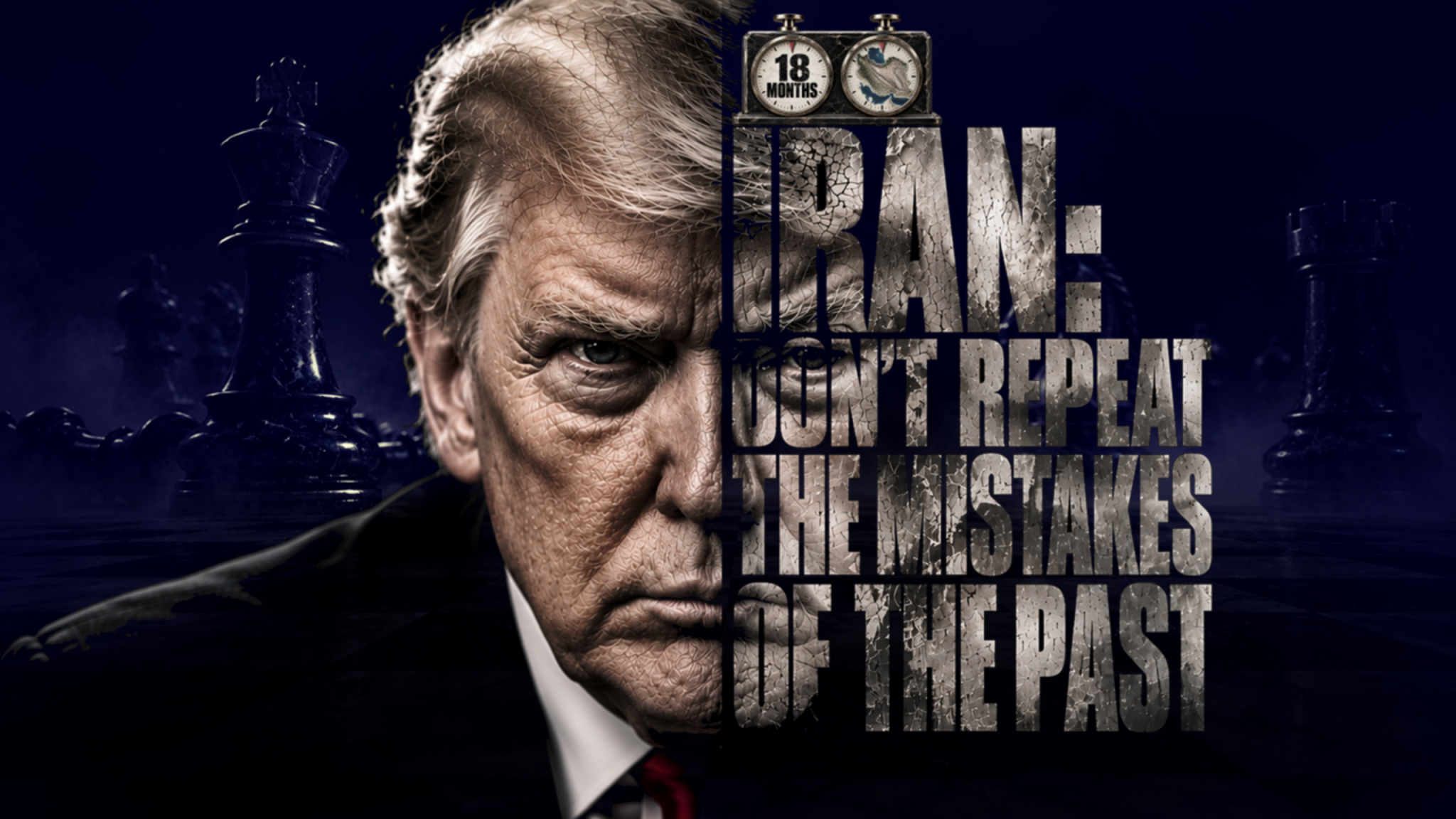
Donald Trump has been the bravest and most effective American president in confronting the Islamic Republic’s nuclear ambitions. He took military action where others hesitated. Yet the work remains unfinished. After the midterm elections he will have roughly eighteen months to finish it. History offers a blunt lesson: no war has ever been won from the air alone. The uranium buried beneath Iranian soil must leave the country if the nuclear threat is to disappear. That requires action on the ground. That requires something to happen on the ground.
The logic is straightforward. The danger lies elsewhere. The regime has spent years conducting psychological operations, propaganda, and lobbying aimed at American decision-makers. The question is how successful those efforts have been in luring Washington toward the very mistakes the Islamic Republic wants it to make.
History supplies two categories of error. First, the United States has repeatedly failed when it did not understand the nuances of the culture, emotions, and priorities of the people whose country it entered. In Afghanistan and Iraq, Washington toppled governments with relative ease and then proved unable to produce a stable successor order because it never grasped what those societies actually wanted. Second, Vietnam showed that creating conditions in which the population unites with the regime is a path to defeat. When people and government close ranks, American power is neutralized.
Both dangers exist in Iran. The question is how they become real.
The first and most immediate trap is any policy that even smells of partitioning Iran. Some circles discuss arming Kurdish or Baluchi groups as a ready-made ground force against the Islamic Republic. On the surface the idea looks efficient. In reality it would be a gift to the regime. Iranians possess a powerful national identity. Territorial integrity ranks higher than democracy in the hierarchy of popular priorities a distinction that matters if one is to avoid repeating the mistakes of the past. The Islamic Republic has exploited this for decades by warning that the fall of the regime means the dismemberment of the country. Crown Prince Reza Pahlavi understood this when he placed the territorial integrity of Iran first among his four principles.
Recent events confirm the point. Amid the current conflict, a nation of ninety-five million produced not a single protest of a hundred thousand people against the United States or Israel. When the dollar in December 2025, reached one hundred thousand Tomans, people took to the streets by the millions. When it later climbed far higher under the economic pressure in September 2026, they remained silent. The reason for this is simple: the people are giving time and space to the United States and Israel to finish the job. Concurrently, they are preventing the IRGC from utilizing their uprising for propaganda against the ultimate campaign for their freedom. Therefore their silence does not equate to contentment, instead it is an act of resistance. They are paying a price they believe will buy freedom. They will not remain silent if they conclude the country’s borders are at risk and worst case will team up with their captors against foreign threats just like Iran-Iraq war.
If Washington arms Kurdish or Baluci militias and say they take control of parts of Iran, the IRGC will immediately declare that America and Israel seek to Balkanize Iran. It will then rally the population around the defense of territorial integrity exactly as Khomeini did during the Iran-Iraq War, when people who despised the regime still fought Iraq to prevent partition. Ethnic fragmentation is therefore a non-starter. If popular forces are to be armed, the effort must begin from coastal regions where no credible secessionist threat exists.
A second, related miscalculation concerns the groups themselves. The majority of Kurds and Baluch are honorable and clear-eyed. A minority, however, has long cooperated with the regime. In Sistan and Balouchestan, armed networks have worked with the IRGC on fuel and narcotics smuggling. IRGC intelligence is already trying to steer American policy toward arming precisely those networks. In Kurdistan the picture is similar: certain factions with bases in Iraqi Kurdistan have served as the regime’s gateway into Iraq. They sent condolences after Khamenei’s death and received Iranian help against ISIS. Arming such actors would produce the familiar result: American weapons diverted to the wrong hands. The United States must therefore rely on the Iranian people as a whole, not on ethnic groups.
The third error is ignoring Iran’s national opposition leader and substituting a “strongman” model. Regime insiders already assume the system will fall and are positioning themselves to capture whatever follows, as occurred in Iraq. In negotiations, some present themselves as distinct from the IRGC and therefore usable. The old reformist dualism that part of the regime is merely under Revolutionary Guard domination and therefore innocent is the Islamic Republic’s most successful deception operation. Rumors that a figure analogous to Syria’s Jolani might be installed after the fall would be equally disastrous just like Ahmed Chalabi was in Iraq. The 72,000 Iranians who, according to President Trump’s UNGA speech, sacrificed their lives in the four corners of Iran while chanting the name of Reza Pahlavi did not do so so that Islamic Regime officials could put on new suits and rule them again. Where the Iranians’ alternative is a George Washington, installing a Jolani is a grave mistake. This mistake will diminish whatever trust the Iranian people have in the United States and Israel. A sea of blood separates the Iranian people from every layer of the current oligarchy and its so-called “moderates,” whether military or civilian. They want not only departure but justice on the model of Nuremberg tribunals. Any plan that sidelines Crown Prince Reza Pahlavi will fail. A change of facade that leaves the underlying problem intact will simply force another uprising.
The only viable approach is one that takes the Iranian people and their priorities seriously. The United States should think freshly about the deployment of special forces. As the line attributed to Churchill goes, “The Americans can always be trusted to do the right thing, once all other possibilities have been exhausted.” Perhaps the time has come to stop exhausting the alternatives and do the right thing. 18 months after the midterms leaves no margin of error. Operations should use coastal access, arm popular forces under unified command, provide advisory, logistical, and air support, and coordinate with the recognized leader of the Iranian opposition. Any other course risks uniting the Iranian people with the Islamic Republic against the United States in the name of preventing partition the Vietnam outcome in a new setting.
Time is of the essence. The window is short. The mistakes the regime is hoping for are already visible. Avoiding them is the difference between ending the nuclear threat and repeating history.