Iran Has Every Condition for an Uprising. No Guarantees Yet.
In November 1944, Ancel Keys, a physiologist at the University of Minnesota advising the War Department, began the Minnesota Starvation Experiment. He needed to understand how prolonged hunger affects the human body and how to safely treat severe malnutrition.
Thirty-six conscientious objectors, facing the draft, volunteered for the study instead of serving at the front. For twelve weeks they ate a full diet. For the next twenty-four they ate half of it: potatoes, turnips, cabbage, and dark bread, with scant meat and dairy. By the end of the experiment, they had lost roughly a quarter of their body weight.
Irritability was the effect Keys recorded most consistently. Men who had become apathetic and socially withdrawn grew hostile over minor delays in the dining hall, particularly in the minutes before meals were served.
Mohammad Bagher Ghalibaf, speaker of Iran’s parliament, told Iranian and Iraqi businesspeople at the Iranian embassy in Baghdad on August 20 that no matter how much military power Iran has, if the people are hungry and there is no financial circulation or economic growth, the country will not endure. Hardliners attacked him for saying it.
The Statistical Center of Iran put food inflation at 128 percent in August, with cooking oils at 258. Red meat supply fell to about 623,000 metric tons last year, roughly 20 percent below 2024 and 39 percent below 2010, according to FAO data; chicken, which had replaced it on poorer tables for years, is now following it out of reach.
Ali Ehsan Zafari, head of the Dairy Cooperatives Union, says Iranians consume around 40 kilograms of dairy products a year per person, milk, yogurt and cheese combined, down from around 130 in 2010.
HRANA, an Iranian human rights monitoring group, reported in June that the poultry industry is in crisis from its dependence on imported feed, the disruption of the war and the maritime blockade, and the end of the preferential dollar.
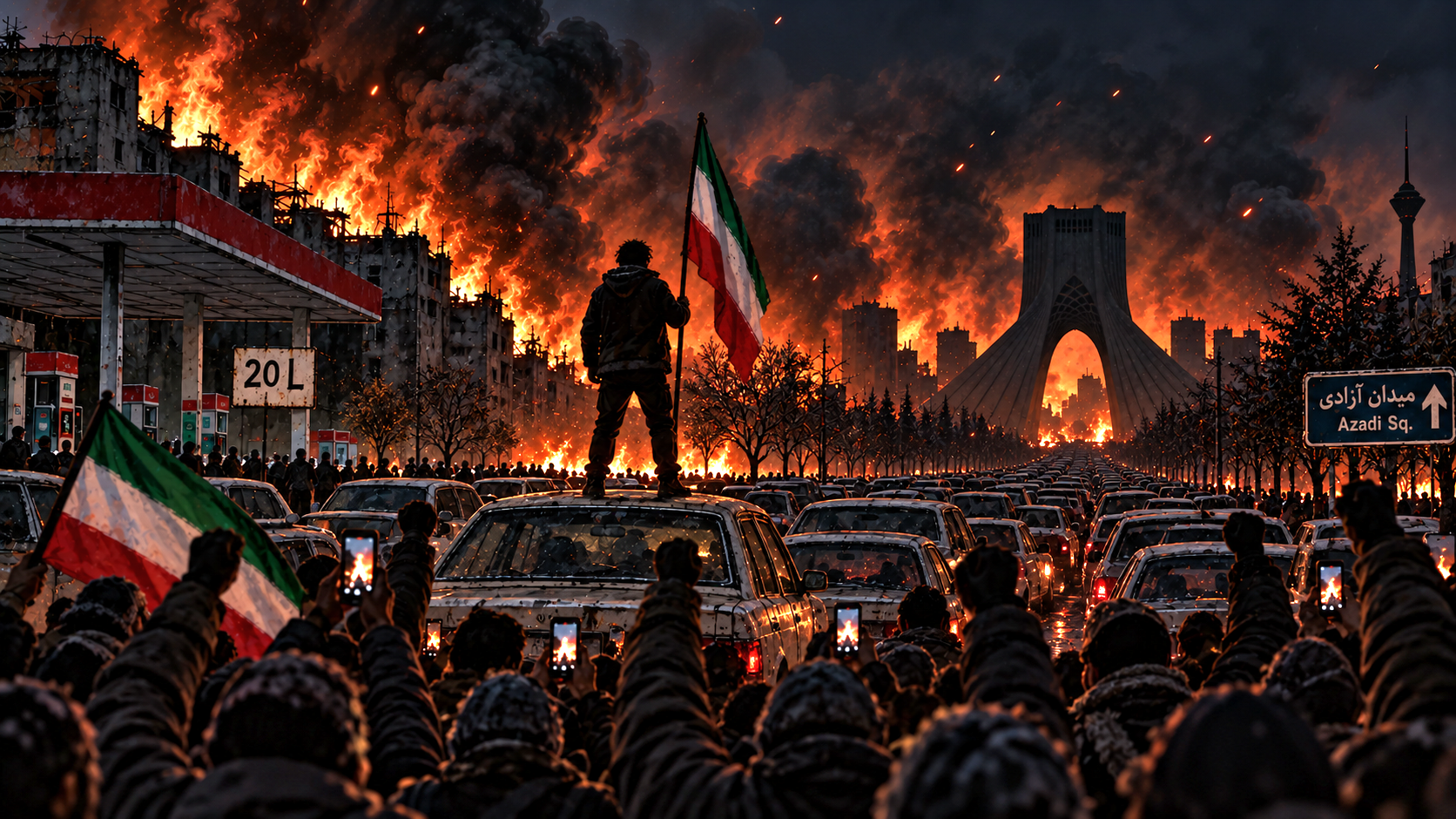
Beyond food, the parliamentary health committee counts 43 medicines in critical shortage. Gas stations closed across Tehran in late August. Lines in Tehran and Mashhad blocked whole streets. Twenty liters per visit.
Mansour is 40, a car mechanic in Tehran with two children. He told Euronews Farsi on August 31 that his family stopped buying meat, chicken, and rice in any real quantity, living on bread instead. He expects the blockade to bring new protests. He also expects security forces to answer them hard. Both thoughts in a single breath.
Ismail, another Tehran resident, told The New York Times that same week that an economic uprising cannot be stopped by anything, not by war, not by violence. He also said Iranians had fallen into a black hole: hungry, confused, and unable to find a way out.
So the conditions are there. They were there in December, too, when Ayandeh Bank collapsed after regime officials walked off with loans they never meant to repay, the Tehran bazaar shut its doors, and by January the streets were full. The state shot unarmed people by the thousands; highest estimates run to tens of thousands. Then came the arrests, the trials, the hangings.
While those protests were underway in January, Donald Trump urged Iranians to take over their institutions, telling them help was on its way and promising to back them. People took the risk and paid with their lives. Seven weeks after the slaughter, on February 28, the United States and Israel launched their airstrikes.
Benjamin Netanyahu told Iranians that night that they were not Israel’s enemies and should cast off the yoke of the regime. On March 7 he said the moment of truth was near, that Israel was trying to free Iran, and that it depended on them; to members of the Revolutionary Guard he offered that whoever put down his weapon would come to no harm. Trump told them this was probably their only chance for generations.
They did not come out. The targets were missile silos, radars, and air defenses. But not the Basij, the regime’s urban repressive arm that carried out the January slaughter and blends into the very neighborhoods it polices.
As the war progressed, it became clear that strategic containment had taken priority over regime change, leaving the Iranian people with no reason to hope for a better future. When U.S. strikes resumed on September 1 to destroy new naval minelaying sites in the Strait of Hormuz, Trump again called on the Iranian population to rise up and fight, offering no explanation on how an unarmed population was meant to neutralize the Basij.
Meanwhile, there is more hunger now than in January, and the anger is on the record. What no one has is a guarantee that going out would change a thing.
There is no reported crack in the Revolutionary Guard. The Basij’s structure remains fully intact. The organized opposition lives abroad. Any deal offering quick relief would require Tehran to surrender its enriched uranium, open the Strait of Hormuz, and abandon its regional proxy wars. These are conditions the regime will not accept, making immediate economic relief a fantasy.
The only plausible scenario for the regime to collapse from within is one where its entire energy infrastructure is destroyed, forcing a starving, desperate population into the streets under total darkness to create the chaos necessary to tear the it down.
Yet that outcome would be as bloodstained as the crackdowns of January, and it sits right around the corner if Tehran chooses to strike Israel again. From any angle, Iran’s outlook is bleak.
If the country is indeed sent back to the Stone Age over the next few months, as Israel’s defense minister promised, this coming winter will be the harshest in its modern history.
Until then, food prices will continue to climb, gas lines will stretch longer, and hunger and resentment will continue to feed the storm brewing to sweep away everything in its path inside Iran.