


Writing on Jewish life, relationships, trauma, and resilience
Iran Is Not Receiving a Pardon. It Is Receiving a Deadline.
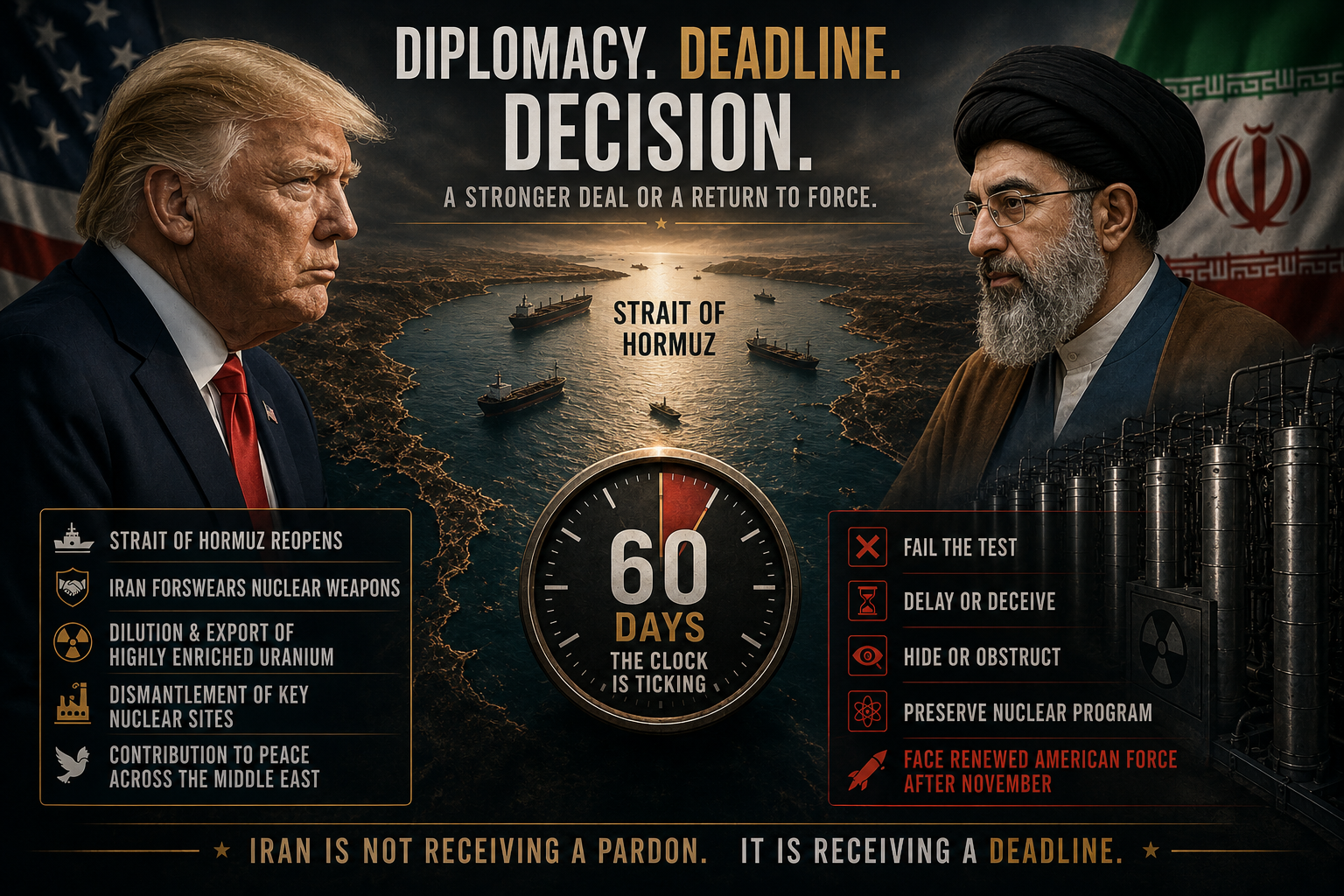
Illustrative. AI image created by the author.
Jacob Nagel is right about the danger.
The question is whether he is right about the strategy.
No serious observer should confuse an Iranian signature with Iranian surrender. Tehran has mastered delay, ambiguity, propaganda, and the art of turning negotiations into breathing room. Any agreement that gives Iran money, time, or legitimacy without dismantling the machinery of nuclear breakout would be dangerous.
Nagel’s warning deserves to be taken seriously. But his alternative assumes that maximum pressure would continue degrading Iran’s capabilities at an acceptable cost. Trump appears to be making a different calculation: pressure is not the objective. Compliance is.
That calculation is now being tested.
The agreement is no longer theoretical. According to The New York Times, the United States and Iran have announced a memorandum of understanding that halts fighting for 60 days, reopens the Strait of Hormuz, lifts the U.S. naval blockade, and leaves the most difficult nuclear questions for a new round of talks.
That is the difference between Trump’s Iran framework and Obama’s JCPOA.
The JCPOA asked whether time, inspections, and incentives could manage Iran’s nuclear ambitions. Trump’s framework asks a harder question: after seeing American force, will Iran submit to terms that actually reduce the threat?
Israelis do not debate Iran in the abstract. For three decades, they have heard Iranian leaders call for their destruction while financing Hezbollah, Hamas, Palestinian Islamic Jihad, the Houthis, and other forces committed to Israel’s isolation or annihilation. Skepticism is not paranoia. It is experience.
So no, Israel should not relax. The Islamic Republic has not earned trust. It has earned scrutiny.
But a deal backed by demonstrated force is not the same as a deal backed by hope.
The Strait of Hormuz piece is not trivial. Reopening it relieves pressure on global energy consumers, Gulf allies, and Western economies. Critics will say this gives Iran an escape hatch.
Perhaps.
But it also strips Iran of its most immediate weapon of blackmail. If Tehran’s leverage depends on strangling Hormuz, then forcing the strait open is not appeasement. It is the first test.
The latest reporting makes clear that the deadline is not metaphorical. The agreement creates a 60-day cease-fire while postponing the hardest questions: Iran’s nuclear program, uranium stockpiles, inspections, and sanctions relief. In effect, the parties have agreed to stop shooting first and negotiate second. Critics see danger in that sequencing. They may be right.
But the structure also creates a measurable test. Sixty days from now, the world will know far more about whether Tehran intends to reduce the nuclear threat or simply preserve it under a different timetable.
The essential question is not whether Iran says it will never build a nuclear weapon. The regime has said variations of that for years. The question is whether this framework forces Iran to prove it — by removing or verifiably diluting highly enriched uranium, dismantling advanced centrifuge capacity, neutralizing underground enrichment sites, opening all relevant facilities to inspectors, and accepting automatic consequences for obstruction.
On that point, Nagel’s concern is exactly right. Negotiations without prior, verifiable dismantlement can become a trap. Iran excels at turning process into protection.
That is why this agreement should not be judged as a peace deal. It should be judged as a test.
Iran is not receiving a pardon.
It is receiving a deadline.
Israeli skepticism is understandable. Israelis were not parties to these negotiations, and many fear that military gains are being converted into diplomatic concessions before Iran’s nuclear infrastructure has been dismantled. Those concerns should not be dismissed. They should define the benchmarks by which the next 60 days are judged.
If Iran reopens Hormuz but preserves its nuclear infrastructure, the deal is a dangerous pause.
If Iran receives financial relief before it performs, the deal is a reward for blackmail.
If Tehran drags out technical talks, hides material, denies access, or turns the process into another maze of evasions, Israel and the United States should treat that not as a misunderstanding but as an answer.
For Jerusalem, the posture must be disciplined vigilance. Any final arrangement must include removal or verified dilution of highly enriched uranium, dismantlement of advanced centrifuge cascades, neutralization of underground enrichment sites, full IAEA access, and automatic penalties for noncompliance. Those are not maximalist demands. They are the minimum requirements for preventing the Islamic Republic from reaching nuclear weapons capability.
Whether one agrees with President Trump or not, the distinction from the Obama era is becoming clearer. The administration is pairing diplomacy with a continuing threat of force. Trump told The Times that if Iran fails to reach a final nuclear accord, he would restart military attacks on Tehran.
That does not guarantee success. But it means Tehran is negotiating under conditions fundamentally different from those that existed in 2015.
Trump’s critics fear Tehran is being rescued. That fear deserves respect. But another interpretation is possible: Tehran is being cornered.
The regime faces a president who has shown that military action is not theoretical. It faces a region exhausted by its proxies. It faces a global economy unwilling to tolerate energy blackmail indefinitely. And it faces a 60-day diplomatic test that, if failed, could make renewed American action look less impulsive, not more.
That is the potential strength of this moment — if the terms are written, verifiable, time-limited, and enforced.
The announcement is not the victory.
The cease-fire is not the victory.
The reopening of the Strait of Hormuz is not the victory.
The victory, if it comes, will be measured by what exists sixty days from now.
If Iran emerges from this process with reduced uranium stockpiles, dismantled nuclear infrastructure, intrusive inspections, and fewer opportunities to threaten its neighbors, President Trump will have achieved something significant.
If Iran emerges with its nuclear capabilities intact, sanctions relief underway, and another negotiation process designed to buy time, critics will have been proven right.
That is why this moment should be viewed neither with celebration nor despair.
It should be viewed with disciplined skepticism.
The agreement has bought time.
The next sixty days will reveal whether that time belongs to diplomacy — or to Iran.
About the Author
Seth Eisenberg is President and CEO of PAIRS Foundation and has spent his career at the intersection of Jewish life and relationship education. He has worked extensively throughout the Jewish community and with individuals, couples, and families to strengthen the emotional skills that sustain connection across difference and adversity. He writes about emotional literacy, trauma, resilience, parenting, and what it means to raise the next generation grounded in worth rather than wound — and, at times, about how those same dynamics of trust, broken agreements, and accountability play out between nations.
Related Topics
Related Posts


Seth Eisenberg