Iran Is Not Vietnam, Iraq, or Afghanistan
The Islamic Republic of Iran presents a unique strategic challenge for any potential US military ground invasion, one that fundamentally differs from America’s previous experiences in Vietnam, Iraq, and Afghanistan. In those conflicts, US forces faced regimes or movements backed by substantial popular or nationalist support, often engaged in complex insurgencies where distinguishing civilians from combatants was nearly impossible.
A ground operation in Iran, whether a broad offensive or a limited tactical strike aimed at neutralizing the regime’s coercive apparatus, would encounter a very different result. The country’s population is largely alienated from the ruling elite, which is tightly controlled by a small ideological minority. Effective neutralization of the regime’s security forces could trigger a rapid collapse rather than prolonged resistance, potentially unleashing tens of millions of Iranians in a wave of liberation. This is not a case of nation-building against a unified adversary; it is a confrontation with an internal system of apartheid, in which a tiny minority dominates a vast majority.
Iran’s population is projected to reach approximately 93 million in 2026. Official statistics suggest near-universal adherence to Shia Islam, yet independent surveys reveal widespread disillusionment: significant portions of the population, sometimes over 50 percent, identify as atheists, agnostic, or effectively secular, and genuine adherence to the regime’s religious ideology is far lower. Decades of economic mismanagement, corruption, mandatory hijab policies, and harsh repression have eroded the regime’s legitimacy. The 2022–2023 protests following the death of Mahsa Amini, along with recurring unrest and December 2025 uprisings demonstrate that the Iranian people are not synonymous with the regime. The government does not represent the people and country; it effectively occupies it.
Consider previous US campaigns for comparison. In Vietnam, the United States intervened in a civil conflict in which the Ho Chi Minh drew on deep nationalist- Communist sentiment against colonialism and Imperialism. The Viet Cong and North Vietnam enjoyed substantial rural support, reinforced by promises of land reform and anti-imperialist ideology. American forces faced guerrilla warfare across forests and villages, where “people” and “enemy” were often indistinguishable. Casualty counts became meaningless, as the population did not passively await “liberation”, many actively resisted the foreign presence.
In Iraq in 2003, Saddam Hussein’s Baathist regime was rooted in the Sunni Arab minority within a majority-Shia, minority-Kurdish country, yet it maintained loyalty through networks of patronage, fear, and Arab nationalism-Communism. After the invasion, a power vacuum fueled sectarian insurgencies: Sunni militias, Al-Qaeda affiliates, and later ISIS exploited popular grievances. Shia militias some supported by Islamic Republic, further complicated the picture. The United States found itself policing a fragmented society, where removing a dictator did not produce a democratic transition but intensified competition among rival groups. Reconstruction efforts collapsed amid corruption and violence, and the initial “shock and awe” devolved into a prolonged quagmire.
Afghanistan mirrored these challenges on an even larger scale. The Taliban drew strength from Pashtun tribes, rural conservatism, Islamism and resentment of foreign occupation. Warlords, ethnic divisions, and the narcotics economy sustained insurgency even after the Taliban’s initial defeat. The Afghan National Army, trained at enormous cost, collapsed in 2021, lacking genuine loyalty from a population fatigued by the central government and foreign intervention. US forces confronted not only ideologues but entrenched local power structures resistant to imposed modernization.
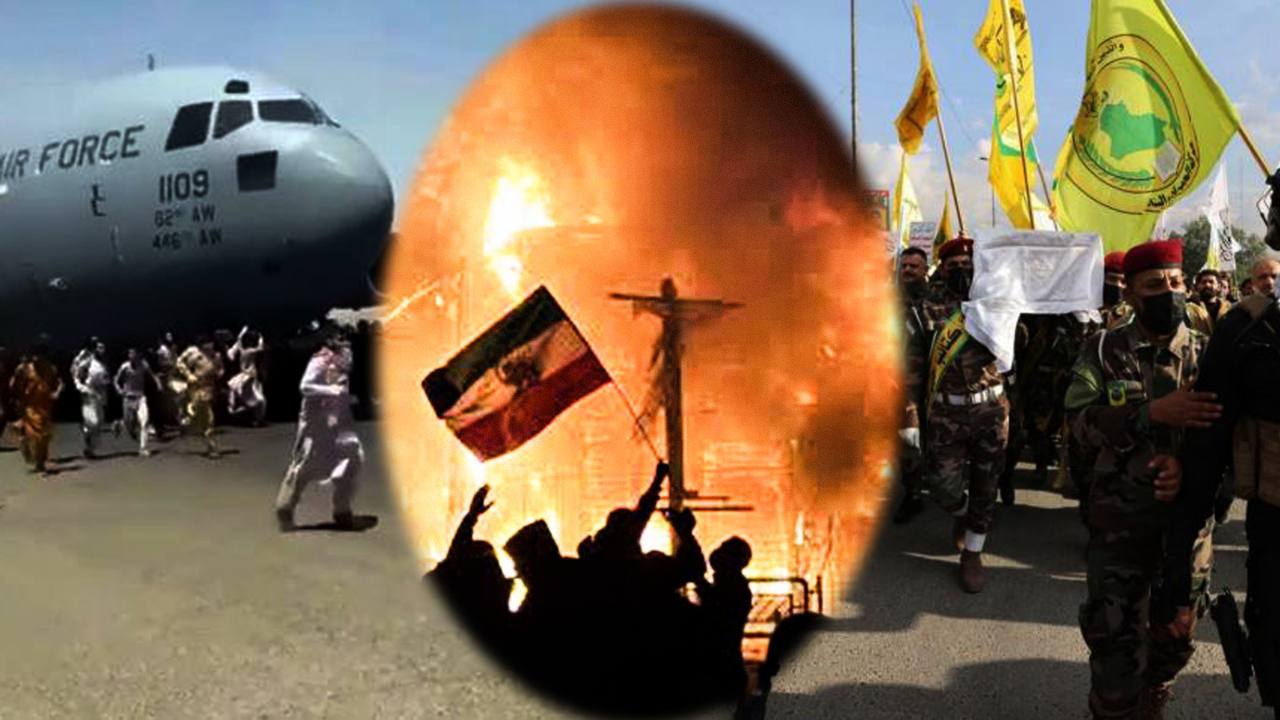
Iran reverses these patterns. The regime’s coercive core, the Islamic Revolutionary Guard Corps (IRGC), maintains roughly 100,000 active personnel, supplemented by about 90,000 Basij militiamen (official claims of millions are exaggerated). These are not nationwide military forces but an ideologically-driven guard loyal to former Supreme Leader Ali Khamenei. Evidence of structural disconnection is clear: during periods of mass protests, the regime has repeatedly relied on foreign forces like Hash Al-Shabie because it does not trust its own troops to carry out full suppression. Reports from recent unrest, including 2026 incidents, indicate the deployment of Iraqi, Afghan, Pakistani, and Hezbollah elements, with hundreds of Arab-speaking personnel visible in Iranian streets waving Iraqi flags. These forces are used precisely because Iranian security personnel hesitate to act against fellow citizens. This pattern reflects an occupier minority, not a government embedded in society.
The ruling elite, hardline clerics, IRGC commanders, and their families, accounts only a few hundred thousand in total. They have created an apartheid structure that prioritizes ideology over citizenship. Women, youth, and minorities face restrictions that fuel emigration. In contrast, the Iranian opposition, unlike Iraq or Afghanistan, is broadly united in rejecting the Islamic Republic under the leadership of Crown Prince Reza Pahlavi. Concepts such as Iran’s territorial integrity, separation of religion and state, freedom and equality of citizens, and the right of the people to determine the final form of political system through free elections enjoy widespread support.
Any US ground operation targeting the regime’s oppressive forces, coupled with precise airstrikes, could exploit these vulnerabilities. Targeted strikes can weaken leadership and disrupt command structures. By breaking the monopoly on violence, tens of millions of Iranians will take to the streets in support of change. A historical parallel exists in the rapid collapse of Eastern European communist regimes in 1989.
This is not to suggest resistance would be absent. Hardcore IRGC elements and proxy forces may fight back, and regional networks could respond asymmetrically. But the key difference is that the “people” would not form the backbone of insurgency against liberators; they would reinforce transformative change. On top of that there won’t be any Islamic Republic to fuel and fund them anymore.
Contradictions in some Western analyses are also notable. For years, policymakers pursued engagement while some experts dismissed the regime’s long-range missile capabilities, arguing that Iran could not produce over 2000-kilometer missiles. Yet Iran’s demonstrated missile strike on Diego Garcia in the Indian Ocean, reaching 4,000 kilometers, disproved these assumptions. A regime that prohibits Western modernity, prioritizes Israel’s destruction, practices antisemitism, and opposes Western democracy cannot credibly be treated as a legitimate negotiating partner anymore.
Ultimately, Iran is neither Vietnam, whose population opposed foreign invaders, nor Iraq, with its deep sectarian divides, nor Afghanistan, with its chronically ill ideology and economy. Here, the situation is exceptional: a small minority holding a vast majority hostage. Any operation that dismantles this apparatus could produce rapid collapse rather than quagmire. Policymakers must understand this distinction: the Iranian people are not the problem but they are the solution. Former “Supreme” Leader Khamenei and the system of Velayat-e Faqih remain loyal to their oppressive apparatus, and the regular army is deliberately kept separate to prevent coups. The regime’s survival depends on this security apparatus, not popular consent.