
The High Holidays Climate Verdict: Ancient Mediterranean Survival in Warming Era
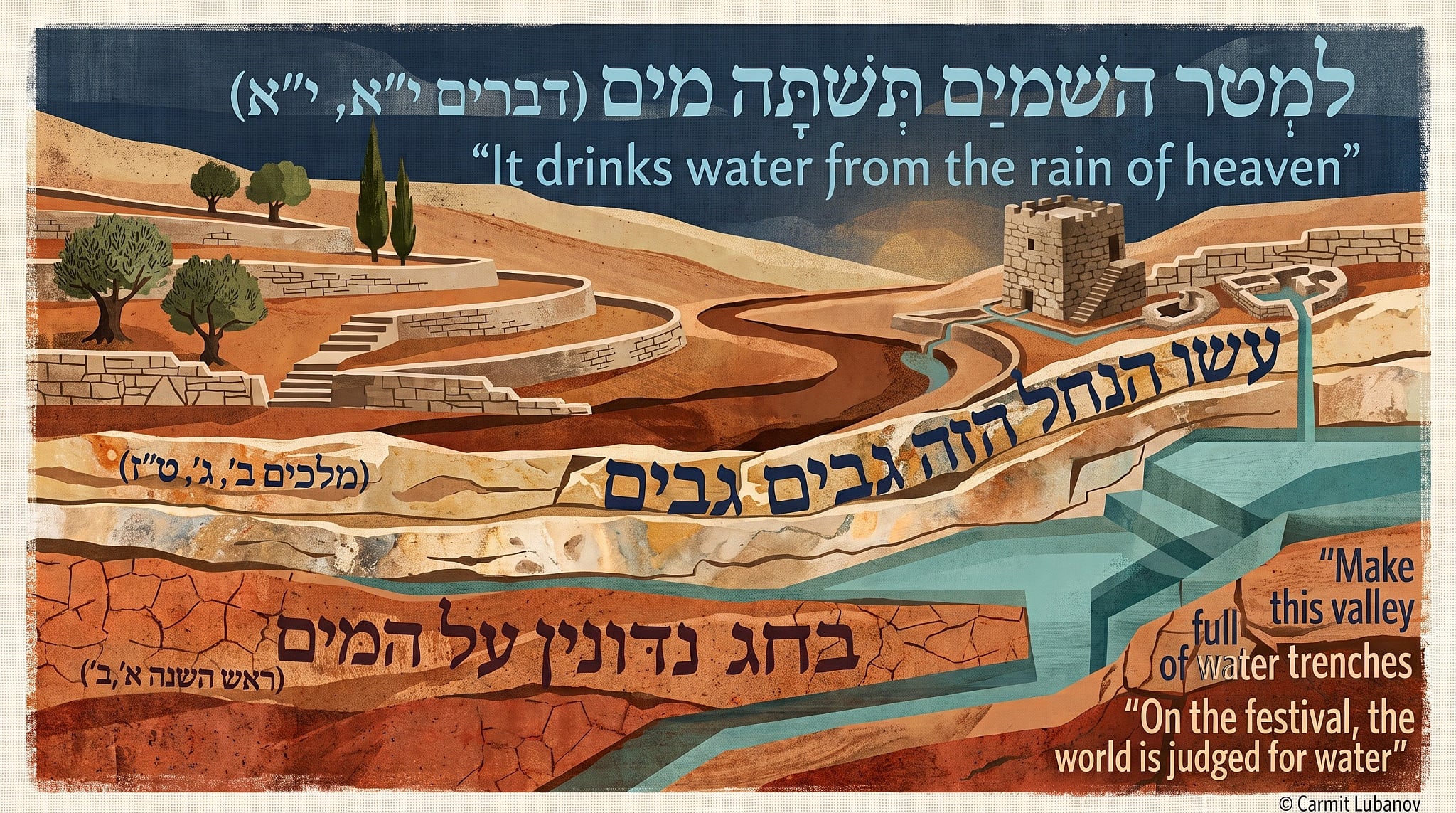
Every autumn, as the Jewish calendar pivots from the solemn introspection of Rosh Hashanah to the open-air vulnerability of Sukkot, tradition introduces a quiet, existential question. According to the Mishnah, it is during Sukkot that the world is judged for its water (ba-ḥag nidonin al ha-mayim). Long before modern meteorology tracked isobaric shifts, our ancestors understood that human renewal and survival in the Southern and Eastern Mediterranean have always hung upon a volatile atmospheric thread.
Today, as climate change accelerates across our region—manifesting in prolonged droughts, shrinking aquifers, and devastating heat extremes—we tend to seek refuge solely in modern technocratic answers: mega-desalination plants, cross-border gas pipelines, and digital irrigation grids. Yet looking at our shared regional geography through the lens of ancient cultural narratives and material history reveals an essential truth: climate shocks are not new to this land. The ancient societies of Israel, Egypt, and Jordan survived not because they were immune to aridity, but because their cultural frameworks and vernacular technologies were built to absorb it.
The Nile and the Illusion of Centralized Control
Our shared regional memory has always been defined by a stark contrast between two hydraulic models. In Deuteronomy, the land of Israel is explicitly contrasted with Egypt: an empire watered by foot, where the predictable annual swell of the Nile allowed for a vast, centralized hydraulic state.
When the East African monsoons failed—triggering historical mega-droughts such as the 4.2k BP aridification event—the Egyptian centralized apparatus faced catastrophic collapse. The biblical narrative of Joseph’s response to Pharaoh’s dream of the lean cows is humanity’s earliest documented strategy of institutional climate resilience. Facing seven years of severe shortfall, the state mobilized to gather grain “like the sand of the sea” into vast regional networks.
As archaeological excavations across Egypt now reveal, these were not simple mud barns; they were sophisticated engineering feats. Constructed with thick mud-brick for passive thermal cooling, elevated against capillary moisture, and plastered airtight to deplete oxygen and naturally arrest insect infestation (pest-resistant anoxia), they preserved viable grain across multi-year deficits. The lesson for modern North Africa and the Levant is acute: in a region recognized as a global climate hotspot, our reliance on brittle “just-in-time” global grain shipments ignores thousands of years of regional wisdom. Food security requires multi-annual strategic physical buffers, not blind faith in seasonal abundance.
Engineering the Desert Margin: Lessons from the Southern Border
Further south, across the hyper-arid landscapes of the Negev and the red sandstone ravines of Petra in modern Jordan, another civilizational response emerged. Rather than retreating before the desert, the ancient inhabitants of these shared borderlands — most brilliantly perfected by the Nabataeans but foreshadowed in biblical accounts of capturing sudden desert floods (gevim) in the wadis of Edom—embraced a philosophy of radical catchment.
They recognized that desert rain, while scarce, arrives in ferocious, concentrated downpours. By clearing stone hillsides into precise micro-catchment slopes and constructing cascading dry-stone terraces across dry riverbeds, they transformed flash-flood hazards into life-giving agricultural terraces. Their vast underground cisterns, sealed with hydraulic lime plaster, preserved cool, potable water beneath blistering desert sands without losing a drop to ambient evaporation.
This was not monumental, top-down engineering. It was a distributed, decentralized ecology of stone, slope, and gravity—a testament to what happens when local communities design with the terrain rather than fighting it.
Bridging Ancient Resilience with 21st-Century Reality
As we look at the contemporary Middle East, we find ourselves caught in a dangerous paradox. Israel is rightly celebrated as a global pioneer in seawater desalination and wastewater reclamation. Yet our near-total reliance on a handful of centralized, energy-intensive mega-facilities leaves our core lifelines exposed. They are vulnerable not only to geopolitical conflicts and power grid failures, but directly to climate change itself.
We witnessed this vulnerability firsthand when unprecedented marine heatwaves and ecological disruptions triggered massive toxic algal blooms along the southern coastline, forcing the emergency shutdown of five out of six of Israel’s national desalination plants. When centralized mega-infrastructure falters under the weight of warming seas, an entire nation’s drinking water is jeopardized within hours. Meanwhile, our neighbors in Jordan and across the southern Mediterranean face depleted aquifers and eroding soils. High-tech centralization alone is not enough; true resilience requires layered, distributed buffers.
The bridge between past and future lies in reviving what environmental researchers call Traditional Ecological Knowledge: Decentralized Catchment: Integrating urban micro-catchments, permeable ground surfaces, and modern neighborhood cisterns can capture high-intensity flash-flood runoff that currently overburdens municipal drainage and washes into the sea. Reviving the “Sponge Landscape”: Restoring dry-stone agricultural terracing in the Judean and Samarian hills and the Negev wadis naturally arrests catastrophic soil loss and recharges local groundwater aquifers. Regional Climate Diplomacy: Water and drought have never respected political borders. Just as the ancients shared hydraulic know-how across trade routes connecting the Levant, Egypt, and the Nabataean kingdom, climate adaptation must become the primary pillar of Euro-Mediterranean and regional cooperation.
A Season for Climate Humility
The fragile booth of the Sukkah, with its permeable roof open to the elements, serves as an annual reminder of our absolute dependence on ecological balance. It strips away the illusion of human invulnerability right at the moment we begin to pray for the winter rains.
As the new year begins, our task is not merely to invent new technologies, but to cultivate climate realism. By listening to the ancient echoes carved into our dry wadis, preserved in our cisterns, and codified in our foundational texts, the Eastern Mediterranean can reclaim a proven path toward genuine, enduring resilience.