
Iran, North Korea, and the New Logic of Indirect Deterrence
In the Book of Judges, Deborah and Barak faced a threat that was not only military, but also political. Jabin, the king of Canaan, and his commander Sisera had a formidable advantage: 900 iron chariots. Yet, this story is also about mobilization. Some tribes responded to Deborah’s call; other tribes refrained from answering. Deborah’s song praised the ones that joined the struggle, while rebuking those who remained distant when the common order was in peril.
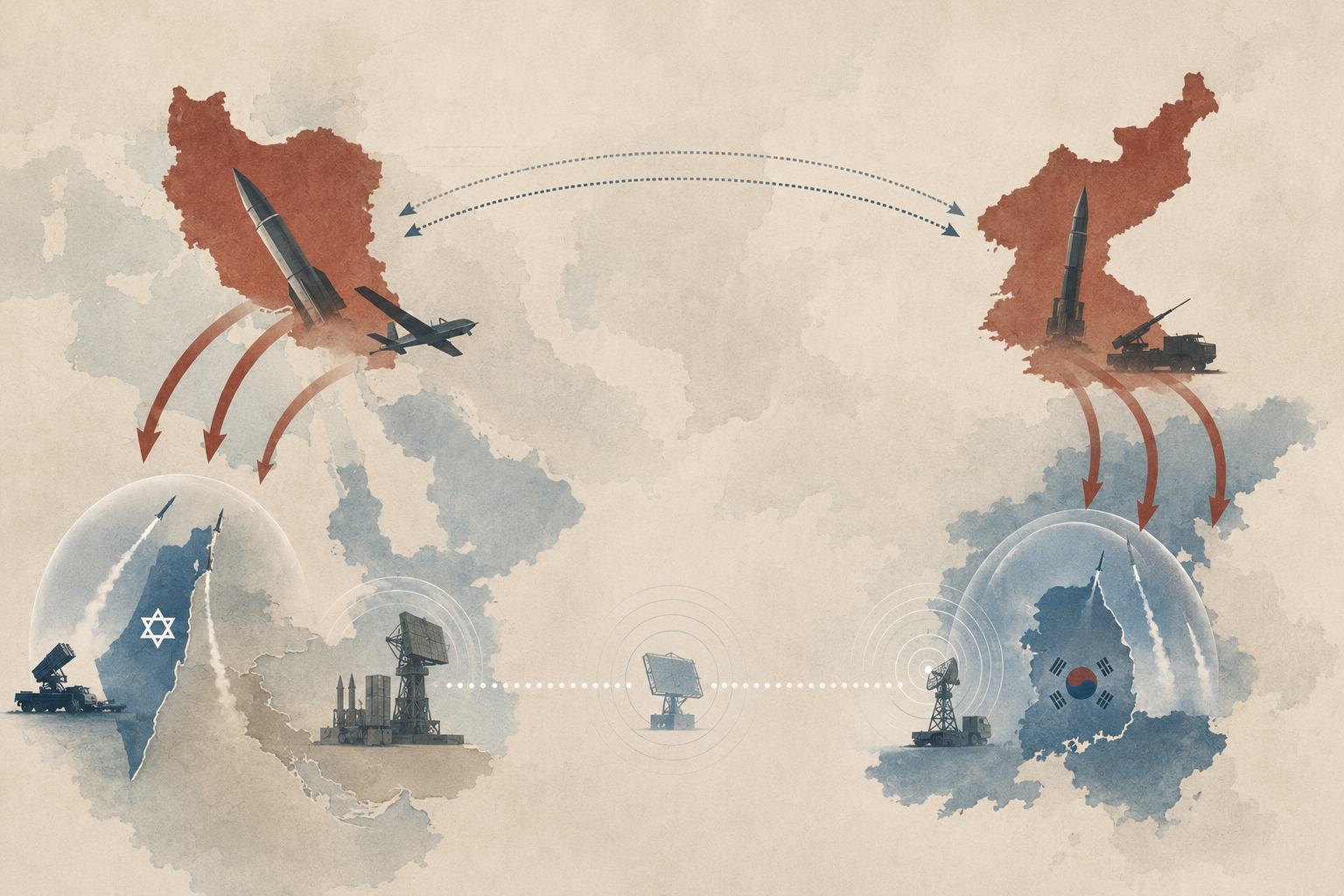
The ancient lessons have strategic implications for the contemporary era: when adversaries coordinate across distance, frontline countries do not have the luxury of thinking within the confines of their respective regions. Israel and South Korea are separated by geography, history, and immediate threat environments. Israel confronts Iran, Hezbollah, the Houthis, and other participants in the regional network. Meanwhile, South Korea faces North Korea’s nuclear weapons, ballistic missiles, long-range artillery, cyber operations, and special forces. At first glance, these two security problems seem unrelated to one another.
They are not.
Iran and North Korea have long understood that geographical distance does not prevent strategic cooperation. Their relationship is, of course, not backed by a formal alliance like NATO. Nonetheless, it is more practical. For decades, Iran’s missile program was drawn from North Korea’s technology and experience, which includes the lineage connecting North Korea’s Nodong missile with Iran’s Shahab variants. Both regimes have also learned how to survive sanctions, conceal military programs, utilize underground facilities, and exploit the West’s hesitation.
The fundamental problem for today is not just about missile transfer. Rather, it is about strategic learning.
Iran studies how Israel, the United States, and regional partners respond to missile and drone salvos. North Korea studies the same subject. Iran’s recent missile and drone attacks against Israel, the Houthis’ attacks against maritime and regional targets, and aggressions against critical energy infrastructure in the Gulf region offer insights about saturation, interception, air defense coordination, and political endurance. North Korea may have observed how rapidly missile interceptors could be depleted, how civil society absorbs pressure, and how alliance coordination functions under attack.
North Korea, in turn, offers the model of nuclear brinkmanship tactics, missile mobility, hardened underground bunkers, cyber operations, sanctions evasion, and strategic ambiguity to Iran. Pyongyang’s development of weapons platforms such as the KN-23 and KN-24, its rhetoric on tactical weapons, and its deepening cooperation with Russia illustrate that North Korea is no longer merely a Korean Peninsula matter. Rather, North Korea is part of a broader network of revisionist military cooperation involving Russia, China, Iran, and other actors that challenges the US-led order.
For Israel, the immediate risk is an Iranian regime that is more militarized, radicalized, and more willing to use missiles, drones, proxies, and regional escalations to challenge the pre-existing balance of power. Even if the current Middle Eastern conflict dies down, Iran would search for ways to restore deterrence, rebuild damaged capabilities, and preserve its regional influence. Tehran does not necessarily need to directly defeat Israel in order to create danger. It could pressure Israel through various indirect means, including Hezbollah, the Houthis, Iraqi militias, Syria, cyber operations, missile threats, and attacks against Israel’s regional partners.
For South Korea, the risk is different but interconnected. Seoul is faced with a North Korean regime that is enhancing its nuclear and missile forces while drawing lessons from Ukraine and the Middle East. The most perilous scenario is not necessarily a second Korean War in a traditional sense. Rather, it is the outbreak of a dual contingency in East Asia. If China either embarks upon an invasion or a naval blockade against Taiwan, US intelligence, naval, air, missile defense, and logistics assets would be under serious strain. At that very moment, Pyongyang might calculate that it has an opportunity to conduct a serious provocation against South Korea.
Such aggression could take various forms: a missile campaign, an artillery attack near the Northern Limit Line (NLL), cyber operations against critical infrastructure, limited territorial occupation, or nuclear blackmail that is carefully designed to test US-ROK alliance cohesion. The danger is not whether the United States would defend South Korea or not. The danger is whether Pyongyang would believe that US attention and assets are overly thinned out to allow a decisive response.
This is where Israel and South Korea share a common strategic problem. Both countries are frontline democracies that are confronted with adversaries that are attempting to alter the regional balance of power through coercion. Both depend on US support. Also, both countries are fully aware that the United States cannot be everywhere with unlimited resources at all times. In an era of simultaneous crises, deterrence could be weakened not only when capabilities disappear, but also when adversaries recognize distraction, fatigue, or division.
The solution lies not in creating an Israel-South Korea military axis. It would be politically unrealistic and strategically unnecessary. A better answer would be indirect deterrence. Each country can help stabilize its respective region by reducing the US burden and complicating the strategic calculations of Iran, North Korea, and their partners.
South Korea can contribute to Middle East stability without directly arming Israel. Seoul could enlarge defense cooperation with countries exposed to Iranian or Iran-backed missile and drone threats, including the UAE, Saudi Arabia, and Qatar. South Korea’s defense industry is particularly suitable for the task. It has become a major supplier of artillery, armored vehicles, precision-strike systems, and missile defense platforms. Weapons systems such as Cheongung-II missile defense interceptors, counter-drone technologies, and potentially the Chunmoo multiple-launch rocket system (MLRS) could help defend Gulf states’ critical infrastructure, air bases, ports, and energy grids.
For countries that have faced missile and drone attacks, greater defense is not equivalent to escalation. It is stabilization.
This would indirectly benefit Israel. A Middle East in which the Gulf states are more capable of defending themselves is a Middle East in which Iran would face a more complex strategic environment. If Tehran understands that its missiles and drones would be less likely to coerce the capitals in the Gulf region, the chances of horizontal escalation would diminish. In that sense, stronger Gulf defense would reduce the pressure for Washington to dispatch its finite resources whenever Iran or its proxies opt for escalation. This would help preserve US capacity for other theaters, including East Asia.
Israel, too, has an indirect role to play in stabilizing the Korean Peninsula. Israel has comprehensive operational experience when it comes to missile defense, intelligence fusion, counter-drone warfare, civil defense, and rapid wartime adaptation. It does not necessarily need to become a direct military supporter of South Korea. Nonetheless, Israeli bureaucrats, analysts, and defense experts could help Washington and its allies extract appropriate lessons from the Middle East. This would include how to manage missile defense saturation, integrate early warning, protect civilians, maintain interceptor stockpiles, and sustain political resolve under attack.
This matters particularly as South Korea is continuously debating the transfer of wartime operational control (OPCON). The issue is not only about who commands South Korean troops during wartime. The heart of the problem is whether deterrence against North Korea would remain credible even after OPCON is transferred. If North Korea interprets OPCON transfer as a sign of US disengagement or US-ROK disunity, the process would generate unnecessary strategic risk. To prevent this from happening, Seoul needs stronger intelligence integration, missile warning, command-and-control resilience, ammunition stockpiles, and visible alliance coordination.
Here, Israeli experience is highly relevant. Israel fully grasps that deterrence is psychological just as much as material. Adversaries would look for fatigue, fragmentation, overextension, and political chaos. They test assumptions and probe seams. This is exactly what North Korea would do if it believes that a Taiwan contingency has either distracted or weakened Washington’s interest in the Korean Peninsula.
Deborah and Barak’s key lesson is not that every nation should fight every other nation’s war. It is, rather, that capable actors should not remain passive when a common order is under threat. In today’s world, Iran and North Korea do not need to share borders to help each other. They could simply learn from each other, exchange capabilities, and force democratic allies to distribute their attention across multiple theaters.
Israel and South Korea may be geographically far apart from one another. However, they are faced with a common strategic reality: deterrence is no longer purely local. Events in the Middle East can shape Pyongyang’s calculations. In reverse, things that occur on the Korean Peninsula could influence how Washington allocates its assets in the Middle East. When authoritarian regimes connect theaters, democracies should also think across theaters.
Neither Israel nor South Korea needs to fight the other’s war. Yet each country could help prevent regional disputes from merging into a bigger strategic crisis. South Korea could reinforce the defense capacities of Middle Eastern partners. Meanwhile, Israel would contribute by applying its lessons of missile defense, intelligence fusion, and wartime resilience to East Asia. This is not a formal alliance. Instead, it is indirect deterrence.
In an era of simultaneous contingencies, indirect deterrence would be one of the most important ways for middle powers to help preserve regional stability.