Rafi Glick
From Kibbutz to the global stage

Iran Talks Shift From Tehran to Beijing – NY to key UN Security Council Meeting

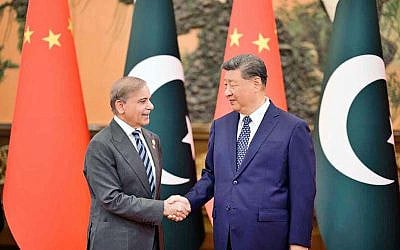
image:Chinese President Xi Jinping meets Pakistani Prime Minister Shehbaz Sharif during events marking 75 years of diplomatic relations between China and Pakistan. (AP Photo)
The diplomatic contacts surrounding the Iranian issue have entered a phase of strategic ambiguity. In the United States, the long Memorial Day weekend has begun, financial markets are closed, and the American political system is not expected to return to full activity until Tuesday, after the holiday ends.
At the same time, intensive discussions continue across Asia and the Middle East. Pakistan’s army chief arrived in Tehran last night and, together with Pakistan’s interior minister, is continuing talks with Iranian officials. Al Arabiya reported this morning that the discussions extended late into the night.
Meanwhile, Pakistan’s prime minister is beginning a four-day visit to China as part of the celebrations marking 75 years of diplomatic relations between the two countries. The economic dimension of the visit is expected to focus on a conference in Hangzhou dealing with advanced technology, the China–Pakistan Economic Corridor (CPEC), and additional strategic issues.
On the political side, a meeting with the Chinese leadership is expected in Beijing. It is possible that China and Pakistan may attempt to shift some of the more disputed elements of the negotiations with Iran from Tehran to Beijing, in an effort to narrow remaining gaps and avoid further escalation.
On Tuesday, May 26, China’s foreign minister is expected to arrive in New York City for a special discussion on the Iranian-American crisis at the United Nations Security Council. China, currently serving as the rotating president of the Security Council, has chosen to place the issue at the center of the agenda.
If preliminary principles for an agreement are reached by then, the Security Council discussion could provide the emerging framework with an initial form of international diplomatic cover.
It remains unclear whether the world is moving toward an agreement or toward military escalation. However, it increasingly appears that the major powers and international institutions are preparing for both scenarios.
About the Author
Rafi Glick is a writer, lecturer, farmer, and business executive with decades of experience at the intersection of academia, technology, agriculture, and international trade. • He has served as a Senior Teaching Associate at Ben-Gurion University of the Negev, Ono Academic College, Ariel University, Ruppin Academic Center, and as a guest lecturer at Sofia University’s Faculty of Economics and Business Administration (FEBA). At Ben-Gurion University he also advised the BGU–NHSA Accelerator in the Faculty of Science. • In business, Rafi was CEO of Bidsnet Ltd., a pioneer in deploying fiber-optic cables through unconventional infrastructure (in partnership with CableRunner), delivering high-speed connectivity to homes, enterprises, institutions, and cellular networks. Earlier he held senior roles at ECI Telecom and served on the board of RLF Venture Capital, working with partners such as Intel, Teva, and the Jerusalem Development Authority. • He contributed extensively to Israel’s trade and investment ecosystem: he directed industrial and agricultural technology divisions at the Israel Export Institute, founded Israel’s AGRITECH as international exhibition, and served on the board of the Israeli Investment Center at the Ministry of Industry and Trade. • In his early career, Rafi established and served as the first director of the Cargo and Aircraft Supply Security Department in the Security Division at Ben-Gurion Airport (1972–1976). He lived in Kibbutz Parod until 1974. • Rafi has also been recognized for his writing: in 2008 he was named Best Economic Blogger by TheMarker, Israel’s leading business daily. • Today he continues to publish essays and commentary—with a special passion for astrophysics, space exploration, technology, economics, and social issues. From Kibbutz Parod to the global stage, Rafi Glick’s career reflects a lifelong commitment to building connections—between people, industries, and ideas. Email: rafi.glick@gmail.com
Related Topics
Related Posts
Sign in or Register
Please use the following structure: example@domain.com
Or Continue with
By registering you agree to the terms and conditions
Register to continue
Or Continue with
Log in to continue
Sign in or Register
Or Continue with
check your email
Check your email
We sent an email to you at .
It has a link that will sign you in.