
Jewish Leader and Activist from Guatemala
Iran Targets America´s Political Distress Point
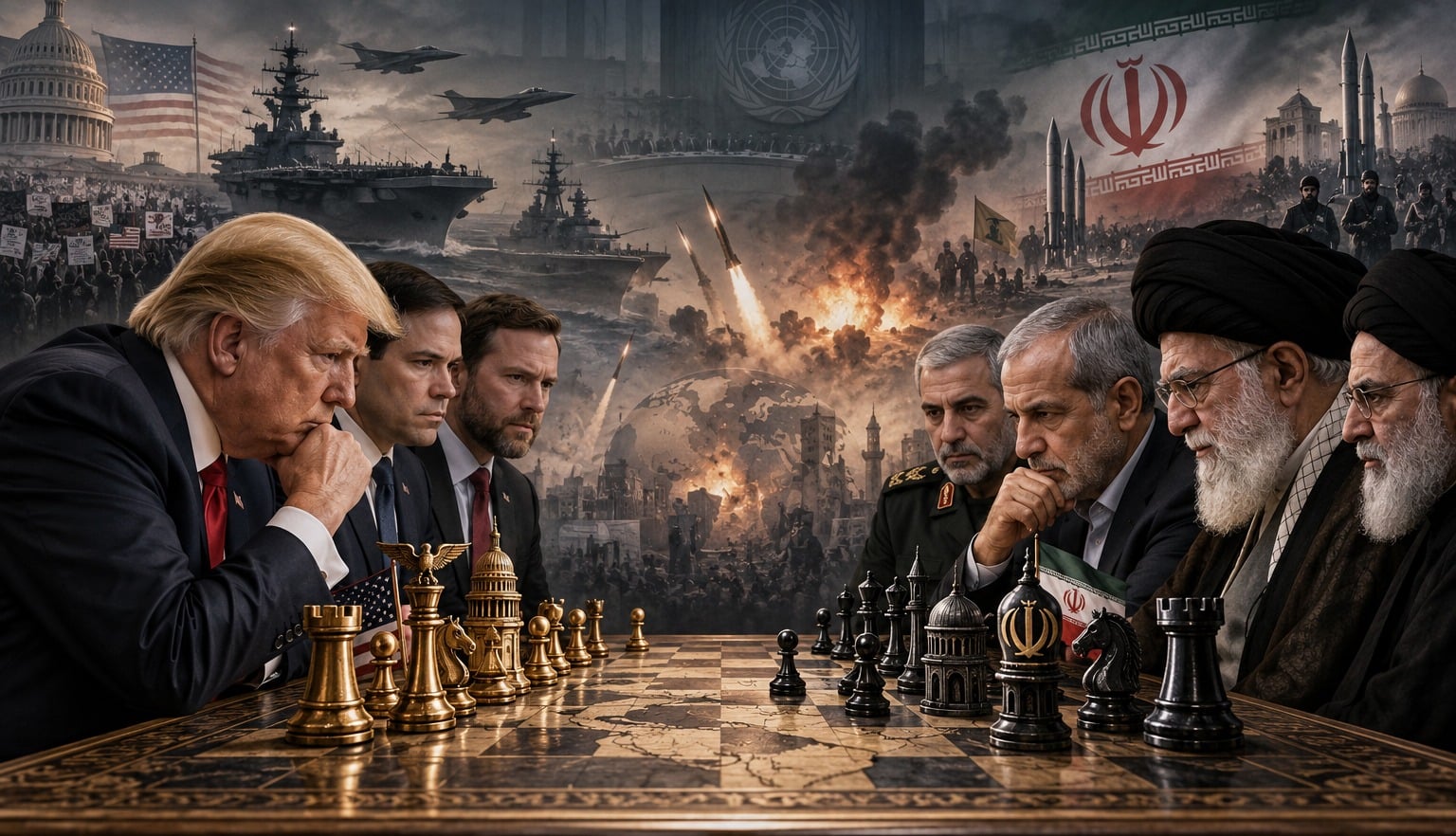
(ChatGPT)
Two facts are difficult to view as entirely unrelated. First, recent online assessments, such as the International IQ Test rankings, place Iran, a country deeply rooted in the history and culture of ancient Persia, among the world’s highest-scoring nations in their datasets, with reported average IQ scores ranging from approximately 104.8 to 106.3 and rankings as high as fourth worldwide. Second, despite overwhelming American military superiority, the United States has repeatedly struggled to translate that advantage into its preferred political outcome against Iran. Tehran has suffered enormous military damage, yet it has neither capitulated nor abandoned its broader strategic objectives.
The lesson is simple: never underestimate your enemy. President Trump prides himself on being a great negotiator. In this case, however, he may have met his match. Even as Iran plays on multiple local and international chessboards simultaneously, it has demonstrated a remarkable ability to negotiate from a position of weakness, and turn that weakness into leverage.
Iran’s objectives are ultimately about survival, autonomy, influence and ideology. Internally, Tehran seeks to preserve the Islamic Republic, maintain political stability and sustain an economy battered by sanctions and years of confrontation. Externally, it aims to deter attacks, preserve military and nuclear leverage, maintain its position as a major regional power and prevent the United States and Israel from dictating its security and foreign-policy choices.
But Iran is not merely pursuing conventional national interests. Born of the 1979 Islamic Revolution, the regime also sees itself as the guardian of a religious and revolutionary project: promoting Islamic unity, supporting those it describes as the world’s “oppressed,” resisting Western domination and extending its ideological influence beyond Iran’s borders. Iran therefore does not necessarily need to defeat the United States in the conventional sense. Denying Washington the ability to impose its preferred outcome can simultaneously advance Tehran’s strategic interests and reinforce its revolutionary narrative of resistance.
Iran also appears to understand that America’s most vulnerable battlefield may not be military at all, but political. Rising energy prices and cost-of-living pressures, war fatigue, deep partisan polarization and the approaching midterm elections create pressure points that Tehran can potentially exploit simply by refusing to capitulate. Prolonging the confrontation increases its economic and political cost to the United States and, with it, the domestic pressure on Washington. In such a contest, endurance itself becomes a weapon.
Iran may also recognize that some of America’s most consequential vulnerabilities lie within its own society. In recent years, increasingly contentious debates over race, economic inequality, gender and identity, immigration, Gaza and trust in political institutions have contributed to a deeply fragmented public discourse. Iran did not create these movements, nor the legitimate grievances underlying many of them. But U.S. intelligence agencies have documented Iranian efforts to exploit existing societal tensions, amplify divisions and undermine confidence in American institutions. Tehran does not need Americans to support Iran; strategically, it can benefit when Americans become increasingly divided among themselves and when that division makes sustained foreign-policy consensus more difficult to maintain.
Perhaps this is the real battlefield Iran has chosen. The United States can destroy military installations, cripple infrastructure and impose extraordinary economic costs, but military superiority does not automatically produce political submission. Iran’s strategy appears to rest on a different calculation: survive, absorb the punishment, exploit time and allow the economic and political costs of the confrontation to reverberate inside the United States. Washington may possess vastly greater firepower, but Tehran understands that in a democracy, wars are fought not only on distant battlefields but also at gas pumps, kitchen tables and ballot boxes. The question, therefore, may not be whether Iran can defeat the United States militarily. It cannot. The more consequential question is whether it can endure long enough to make the political price of victory greater than Washington is willing to pay.
Related Topics