
Iran tells its diaspora to die for the country
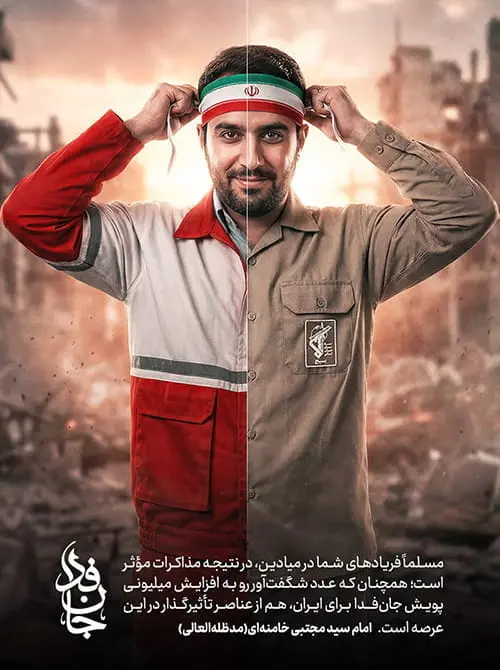
The Iranian embassy in London posted on its official Telegram channel and pointed readers toward a government portal called Mikhak. Mikhak is the system that Iranian citizens abroad use to renew passports and navigate bureaucratic processes. Since April, it has also registered volunteers for a campaign called Jan Fada (sacrificing life). Messages promoting the campaign appeared on the official websites of Iranian missions in fourteen other countries.
The message, written in Persian, addressed Iranian nationals in Britain, urging them to choose death over surrendering their country to the enemy. Iranian President Masoud Pezeshkian claimed that more than 14.2 million Iranians had already pledged to defend the country. When the story broke in late April, the London mission issued a statement calling Jan Fada a purely symbolic initiative.
The embassy in Finland published an image of a man in a shirt bearing the Basij emblem. The Basij is the paramilitary volunteer force of the IRGC.
Jan Fada is one part of an Iranian information operation that expanded sharply after the war that began on February 28, 2026. Tehran has moved from religious-ideological propaganda to integrated information warfare, with AI content, embassy social media, and influence campaigns aimed at Western audiences. Outside the information space, the evidence is heavier. An Islamic, Iran-linked group (Harakat Ashab al-Yamin al-Islamiya) has claimed responsibility for arson attacks on Jewish sites across Europe.
Overall, dozens of antisemitic incidents and attacks targeting Jewish individuals, synagogues, and Jewish community institutions were reported across Europe and the US in the first months of 2026. The MI5 tracked more than twenty potentially lethal Iran-backed plots in Britain alone in 2025.
The operational model relies on disposable agents, locally recruited individuals, often young, paid in cash, kept ignorant of who is hiring them. The Jan Fada fits this model, filtering the diaspora for ideological sympathizers and routing them through the same consular database that holds their identifying documents. It produces a recruitment shortlist that bypasses the slow work of finding willing locals through criminal middlemen.
Europe has built an entire vocabulary for Russian hybrid warfare (gray zone, sub-threshold, plausible deniability). The same framework applies to Iran, and the embassies are now a visible node in it. A foreign mission running an open call for citizens willing to die for a hostile foreign state, on accredited diplomatic infrastructure, is no longer a diplomatic incident.
Fifteen Iranian missions are using accredited diplomatic buildings to recruit for a martyrdom campaign, and the consequences are landing on European streets, in European synagogues, and on European citizens. Host states have the evidence in front of them, and can treat Jan Fada’s participation as what it functionally is: a public declaration of willingness to act on behalf of a hostile foreign power. Or they can keep filing each new post as a curiosity. The choice is already being made, made by inaction.