
Middle East Analyst
Iran War: ‘I Don’t Think About American Financial Situation.’ — Trump
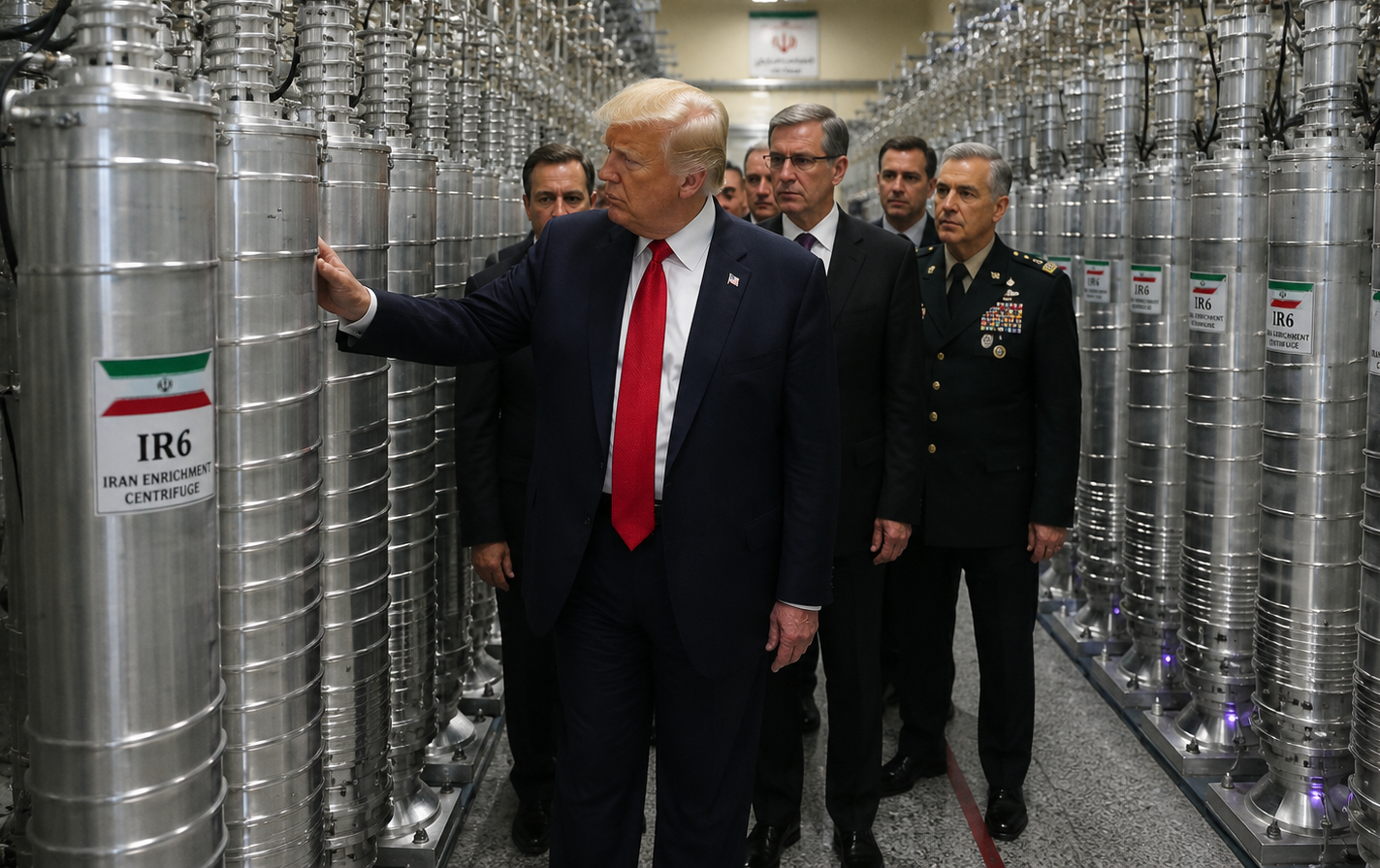
By author (AI)
“I don’t think about American financial situation — I don’t think about anybody. I think about one thing: We cannot let Iran have a nuclear weapon.”
That sentence, delivered without qualification as inflation data showed the Consumer Price Index spiking 3.8 percent year-over-year — including a gasoline price surge of 5.4 percent in a single month driven by the ongoing standoff over the Strait of Hormuz — crystallizes a policy posture that is both rhetorically simple and strategically consequential. Other presidents have warned about Iran’s nuclear ambitions and taken steps to constrain them. Few have so plainly signaled indifference to domestic economic pain, and none have done so while a war they launched was already imposing cascading costs not merely on American households but on the global food supply.
“Israel First”: The Fracture No Slogan Can Paper Over
The president’s framing will not be heard the same way by every audience — and the political damage from that is already visible.
For most Democrats, the statement confirms what the war’s critics argued from the start: that US military action against Iran served Israeli security interests before American interests. That critique is not confined to the progressive wing. House Democratic leader Hakeem Jeffries, speaking on CNN days after the strikes, made clear the party’s mainstream view that the operation lacked congressional authorization and a credible exit strategy. Polling released within a week of the strikes found that 74 percent of Democrats and 62 percent of independents opposed the military action.
What is arguably more politically consequential is where the same critique is coming from on the right. Tucker Carlson declared flatly: “This is Israel’s war. This is not the United States’ war.” Former Representative Marjorie Greene, in a widely circulated statement before her resignation from Congress, put it in the movement’s own language: “‘Make America Great Again’ was supposed to be America first, not Israel first, not any foreign country first, not any foreign people first, but the American people first.” Bloomberg’s headline captured the result succinctly: “MAGA Is Split.” The conservative commentator Matt Walsh added that the White House’s shifting justifications for the strikes were, “to put it mildly, confused.”
The critique carried particular weight coming from Joe Kent, a former Green Beret and Trump’s counterterrorism director who resigned in March 2026, accusing the administration of having been drawn into the war by Israeli influence rather than a clear-eyed assessment of American interests. Kent went further than most, arguing that Israel had actively undermined US de-escalation efforts by striking Iranian energy infrastructure during sensitive negotiation windows — a charge that, if accurate, reframes the conflict not merely as a matter of misaligned priorities but as an instance of a foreign government shaping American military decisions to suit its own timeline.
When a president running on domestic economic renewal tells Americans he doesn’t think about their financial situation in the same breath as defending a war that a significant portion of his own base views as waged primarily for a foreign government’s benefit, the political exposure is severe on both flanks. The statement does not merely invite the criticism — it hands opponents the quote.
A War Without a Credible Premise
The political fractures over who wanted this war are compounded by a more fundamental problem: the intelligence community did not support the case that it was necessary.
Director of National Intelligence Tulsi Gabbard testified before Congress that the US intelligence community had not assessed that Iran was preparing to attack the United States or its allies — a direct contradiction of the urgent, imminent-threat framing the administration used to justify military action without a formal declaration of war. For a public already skeptical of the intervention, Gabbard’s testimony was significant precisely because she was the administration’s own intelligence chief. The threat, as assessed by the people whose job is to assess it, did not meet the threshold the president’s rhetoric implied.
That testimony collided with a second credibility problem of the administration’s own making. Both Trump and Israeli Prime Minister Netanyahu had, in the weeks following the June 2025 strikes on Iran’s nuclear infrastructure, publicly claimed that those strikes had “obliterated” the Iranian nuclear program. If that claim was accurate, the premise for a renewed and far more expansive military campaign — that Iran remained on the verge of acquiring a nuclear weapon — required an explanation that was never provided. The administration could not coherently argue both that the threat had been eliminated and that it remained so urgent as to justify global economic disruption and an open-ended military commitment.
Then came the admission that cemented the “war of choice” narrative in the public mind. Secretary of State Marco Rubio, in remarks on February 28th, stated that the United States decided to strike because it knew Israel was going to act regardless. The statement was intended, presumably, to frame US involvement as damage control — better to lead than to be dragged in. But the political effect was the opposite. It was seen as confirmation that the decision to go to war was not driven by an American threat assessment or an American timeline. It was driven by the certainty that a foreign government had already made its decision and the US chose to follow. Combined with Gabbard’s testimony that American intelligence had not assessed an imminent threat, the picture that emerged was unambiguous: Netanyahu told Trump the threat was imminent; America’s own intelligence community did not agree; and the United States went to war anyway, on a foreign government’s schedule.
Most Americans noticed. Polling consistently showed that a majority did not believe the threat was imminent, and a substantial plurality concluded the war was therefore avoidable — a judgment that makes “I don’t think about American financial situation” land not as resolve but as recklessness.
The Economic Pain Is Not American Alone: A Global Crisis Is Just Beginning
The framing of domestic pain as an acceptable trade-off understates the severity of the problem by orders of magnitude. The economic disruption unleashed by the closure of the Strait of Hormuz — through which approximately one-fifth of the world’s oil supply and one-third of global seaborne fertilizer transits — is a global emergency, not a domestic inconvenience.
The Center for Strategic and International Studies (CSIS) has documented that global urea prices increased nearly 26 percent within weeks of the conflict beginning, rising from $465 per metric ton to $585 per metric ton. The Food and Agriculture Organization (FAO) warned that a prolonged closure of the strait could lead to a global food “catastrophe.” The UN Secretary-General noted that the Gulf countries are primary suppliers of raw materials for nitrogen fertilizers, and that disruption at a critical planting-season window could cause cascading harm to harvests worldwide.
As a Foreign Policy analysis put it, the contrast with the war in Ukraine is stark: that conflict disrupted a breadbasket — a crisis of agricultural outputs. This conflict disrupts the industrial inputs that make breadbaskets possible. India, the world’s largest urea fertilizer importer, is scrambling to secure alternative supply. Brazil, which imported its entire urea supply in 2025 with roughly 40 percent transiting the strait, faces a gap between agricultural ambition and industrial dependence. Countries including Bangladesh, Sri Lanka, Somalia, Sudan, Tanzania, Kenya, and Egypt are among those facing the sharpest exposure.
Sudan, already experiencing civil war with Gulf monarchies as participants, faces famine conditions affecting an estimated 40 percent of its population — roughly 19 million people — according to the World Food Program. The war’s disruption to humanitarian supply chains is deepening that crisis in real time.
Experts from the SOAS Middle East Institute describe the combination of the strait closure, elevated fertilizer costs, lingering La Niña conditions affecting rainfall across key producing regions, and existing debt crises in much of the developing world as “a perfect storm.” The next global food crisis, these analysts argue, has already begun — visible not yet in empty shelves but in planting decisions being made right now that will determine harvests months from now.
To tell Americans you “don’t think about” financial pain while this cascade is unfolding is not merely a domestic political liability. It is a statement that will echo in capitals from New Delhi to Nairobi.
The Russia Problem: A Formal Treaty, Not a Loose Alliance
Any serious accounting of the Iran campaign must grapple with a fact the administration has not explained: Russia is now formally bound to Iran by treaty.
On January 17, 2025, President Putin and Iranian President Pezeshkian signed the Iranian–Russian Treaty on Comprehensive Strategic Partnership — a 47-article agreement covering defense, counterterrorism, energy, finance, cybersecurity, and technology cooperation, structured to govern relations between the two countries for the next 20 years. It entered into force on October 2, 2025. The treaty commits each party not to assist any aggressor against the other and provides for nonaggression and consultation during conflicts. Beyond its legal architecture, the practical military cooperation is extensive: Iran has supplied Shahed drones to Russia for use in Ukraine; Russia has been providing Iran with advanced air defense systems, fighter jets, and intelligence on American military operations in the region. The relationship is structurally interdependent in ways that no air campaign against Iranian nuclear sites can simply erase.
The strategic incoherence of the administration’s posture follows directly from this. A president who publicly praises Putin while waging war against Russia’s formal treaty partner creates a credibility gap that adversaries can exploit and allies cannot ignore. If preventing Iranian nuclear capability is worth severe global economic disruption, that case is fatally undercut when the president extends warmth to the leader of a nuclear superpower who regularly threatens Europe with annihilation.
The Networked Adversary Problem
The Iran-Russia treaty is the formal expression of a broader adversary architecture that no single-objective military campaign can dismantle on its own. Russia and China have been central to enabling Iran’s economic resilience under sanctions — developing alternative financial mechanisms, facilitating gray-market oil exports, and building trade corridors through the Shanghai Cooperation Organization and BRICS frameworks, both of which Iran joined as a full member in 2024. These relationships are now partially institutionalized in treaty form.
A campaign aimed at Iran’s nuclear infrastructure, conducted without accounting for this network, risks producing second-order effects that deepen the very architecture it seeks to weaken. Strikes on Iran give Moscow and Beijing a demonstration case for their argument that the US-led order is unpredictable and that alignment with them offers more durable security guarantees. Sanctions-evasion channels, already well-developed before the war, will be hardened further. The long-term containment problem does not disappear when bombs fall; in important respects, it gets harder.
Related: Trump May Not Care About Hormuz, Oil Prices, or the Midterms
Rubio’s Iran Strike Rationale Raises More Questions Than Answers
Related Topics
Related Posts