
Middle East Analyst
Trump May Not Care About Hormuz, Oil Prices, or the Midterms
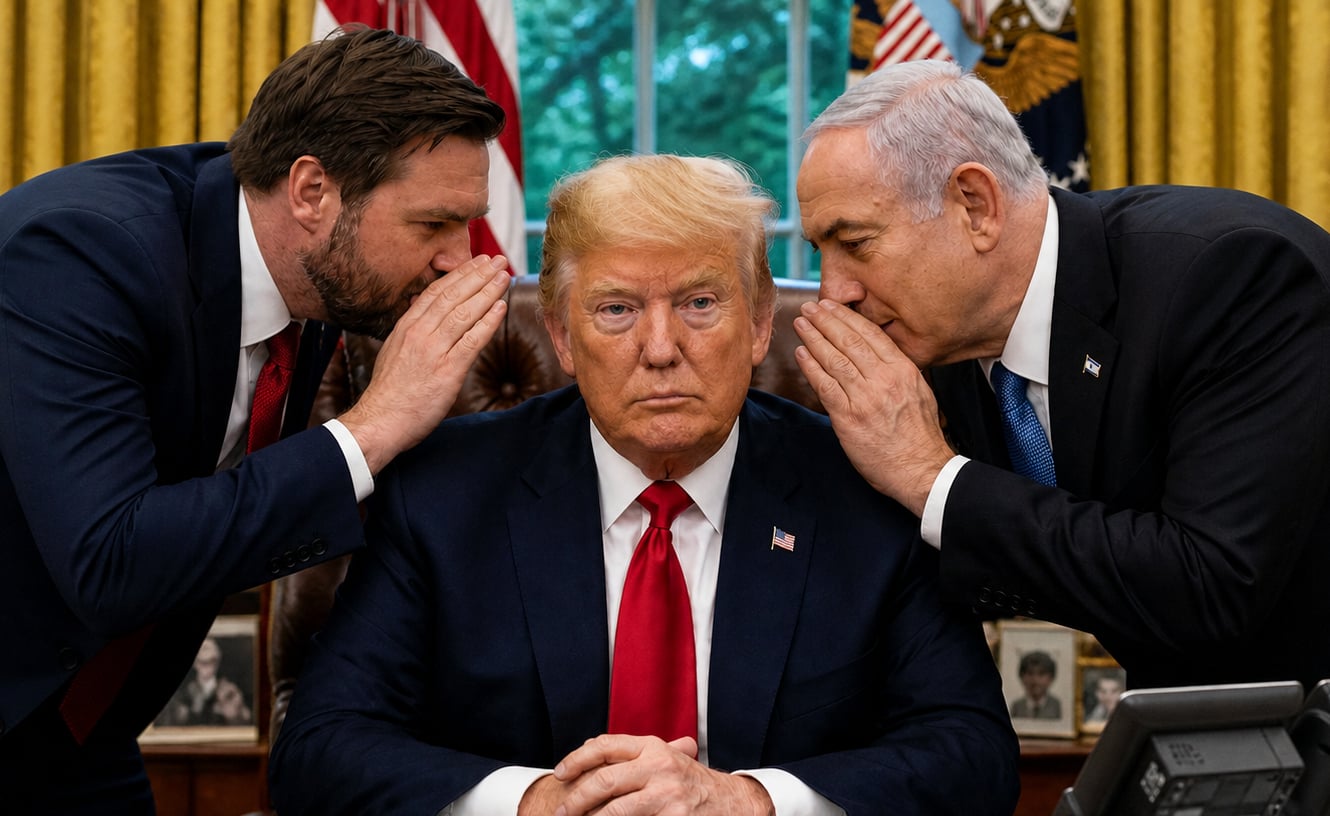
by author (AI)
Recent polling confirms what Democratic strategists have been watching for months: the party now holds a lead of between three and ten points on the generic congressional ballot, a significant swing from Republican advantage at the start of Trump’s second term. The conventional diagnosis is familiar — an unpopular war, a chokepoint in crisis, gasoline prices more than 30 percent higher than in February — and it produces a predictable set of prescriptions: reopen the Strait of Hormuz, calm markets, deliver visible relief at the pump before November. That logic assumes the administration wants to solve the problem. The more unsettling possibility, examined here, is that it does not, and that losing the midterms may be instrumentally useful to a longer project of reshaping the rules of American governance.
The Timing Problem Is Worse Than It Looks
The Strait of Hormuz has been effectively closed since February 28, when the United States and Israel struck Iran and assassinated Supreme Leader Ali Khamenei. The IEA has described the resulting disruption as the largest oil supply shock in the history of the global market, surpassing the 1970s. What is less understood is that the problem is no longer merely physical. Even during brief official announcements that the strait had “reopened,” actual traffic remained near collapse — sometimes as few as three vessels per day against a peacetime baseline of 120 to 140. Baker Hughes has built its financial guidance around the assumption that the strait will not be fully operational until the second half of 2026, a view shared by nearly 80 percent of oil and gas executives surveyed by the Dallas Federal Reserve.
Demining, insurance recalibration, and the restoration of commercial confidence are sequential processes measured in months. A diplomatic agreement signed tomorrow would not produce a meaningful drop in pump prices before November. The lag is structural. Any adviser telling the president he can move the electoral needle on energy prices is working from a premise the industry has already rejected.
Competing Counsel and the Hawkish Counternarrative
Within conservative and allied circles there is no consensus on what to do next. Some Republican strategists privately favor a negotiated resolution to reopen the lanes. Others — hawkish advisers and regional partners, notably Prime Minister Netanyahu, with incentives to sustain pressure on Tehran — argue that short-term domestic pain is a tolerable cost of a strategic opportunity that will not recur. That alignment of internal hawks and external partners gives the president political cover for inaction. NATO allies have already refused to join the Hormuz effort; Germany publicly stated “this is not our war.” That diplomatic isolation forecloses clean exits and validates inaction or escalation as a deliberate posture rather than a failure of will.
Losing as Strategy, Not Catastrophe
If no available action can change the electoral trajectory before November, then a midterm defeat ceases to be an existential threat and can instead be internally reframed as a tactical variable. This is the argument’s most uncomfortable claim, and it is worth being precise about it. The hypothesis is not that the administration is actively engineering a loss. It is that an administration that has already concluded the loss is unavoidable faces a different set of incentives than one that believes it can still win. In that posture, a midterm defeat can be instrumentally useful: it amplifies narratives of institutional dysfunction, delegitimizes ordinary governance, and creates a political climate in which extraordinary remedies appear necessary and justified. Historical patterns support this logic. When conventional electoral avenues are judged unwinnable, actors sometimes pivot to disruption, delegitimization, and the normalization of emergency authority as a pathway to longer-term consolidation of power — particularly when the next critical election, in this case 2028, remains within reach.
The Executive Toolkit and the Friction of Loyalty
The plausibility of that logic rests on the concentration of unilateral tools in the executive branch. Appointments, prosecutorial discretion, regulatory authority, pardons, and control over federal enforcement agencies are not trivial levers. When staffed by loyalists, the bureaucratic friction that normally constrains questionable orders is reduced. The current record provides direct evidence: in 2025 and into 2026, the administration deployed or attempted to deploy federalized National Guard troops in Los Angeles, Portland, and Chicago over governors’ explicit objections. Courts ruled against these deployments in all three jurisdictions. The administration pushed forward regardless. That sequence is the key data point. Courts are a real constraint — but they function as a speed bump, not a firewall, against an executive willing to act, absorb a judicial loss, and act again.
The Insurrection Act Vector
It is necessary to be direct about the most acute domestic risk: the invocation of extraordinary legal authorities. The Insurrection Act authorizes the president to deploy federal troops to suppress insurrection or enforce federal law under defined conditions. It is not martial law — it does not suspend the Constitution, and it cannot by itself cancel or postpone elections, an authority that belongs to Congress. Those are important legal distinctions. But the practical effect of deploying federal forces domestically is not limited to legal formalities. The presence of federalized troops can intimidate officials, disrupt local administration, and generate pretexts for further measures. What makes the current moment different from historical warnings about this power is that the threat is no longer theoretical. Trump has publicly threatened Insurrection Act invocation in connection with immigration enforcement protests, and legal experts have noted that after a series of judicial defeats on related deployments, the administration may be actively seeking a new factual predicate to try again. The operative risk is real and live.
Coercion does not require tanks on Main Street. If administrative loyalty is entrenched across the Department of Justice, the Pentagon, the Department of Homeland Security, and the FBI, the coercive effect can be bureaucratic and legalistic rather than theatrical. Selective prosecutions, funding freezes, regulatory pressure, and strategic pardons can chill state and local officials without a single troop movement. The administration’s pattern of making contradictory public claims — as when the president announced on March 9 that Iran’s military had been destroyed and the strait had reopened, neither of which was true — illustrates an additional lever: the deliberate generation of informational fog that delays coordinated response and undermines certified facts before they harden.
Constraints Are Real but Not Determinative
This scenario is constrained, and those constraints deserve honest accounting. Distributed election administration across fifty states resists single-point capture. Governors and attorneys general can assert authority, mobilize state National Guards, and file challenges; Congress controls funding; professional norms in the military and justice system still bind many officers to legal limits. International costs — capital flight, sovereign credit exposure, allied estrangement — are real penalties in a moment when the Hormuz closure is already straining the global economy. Leaks and internal dissent can fracture administrative capture.
Those constraints do not make the threat impossible. They make it costly and contestable. The appropriate response is preparation: prepositioned emergency legal filings, public gubernatorial commitments to protect lawful certification, transparent chain-of-custody procedures that reduce the surface area for legal fog, and press and civil society readiness to raise the political cost of extralegal steps in real time.
The idea that a president might treat midterm losses as a strategic opportunity is uncomfortable but analytically coherent. The combination of a structurally unfixable energy crisis, entrenched executive loyalists, an actively tested legal boundary around domestic military deployment, and a critical 2028 election on the horizon creates a credible pathway by which losing in November could serve longer-term ends. That is not a prediction. It is a strategic hypothesis that demands sober attention.
Related Topics
Related Posts