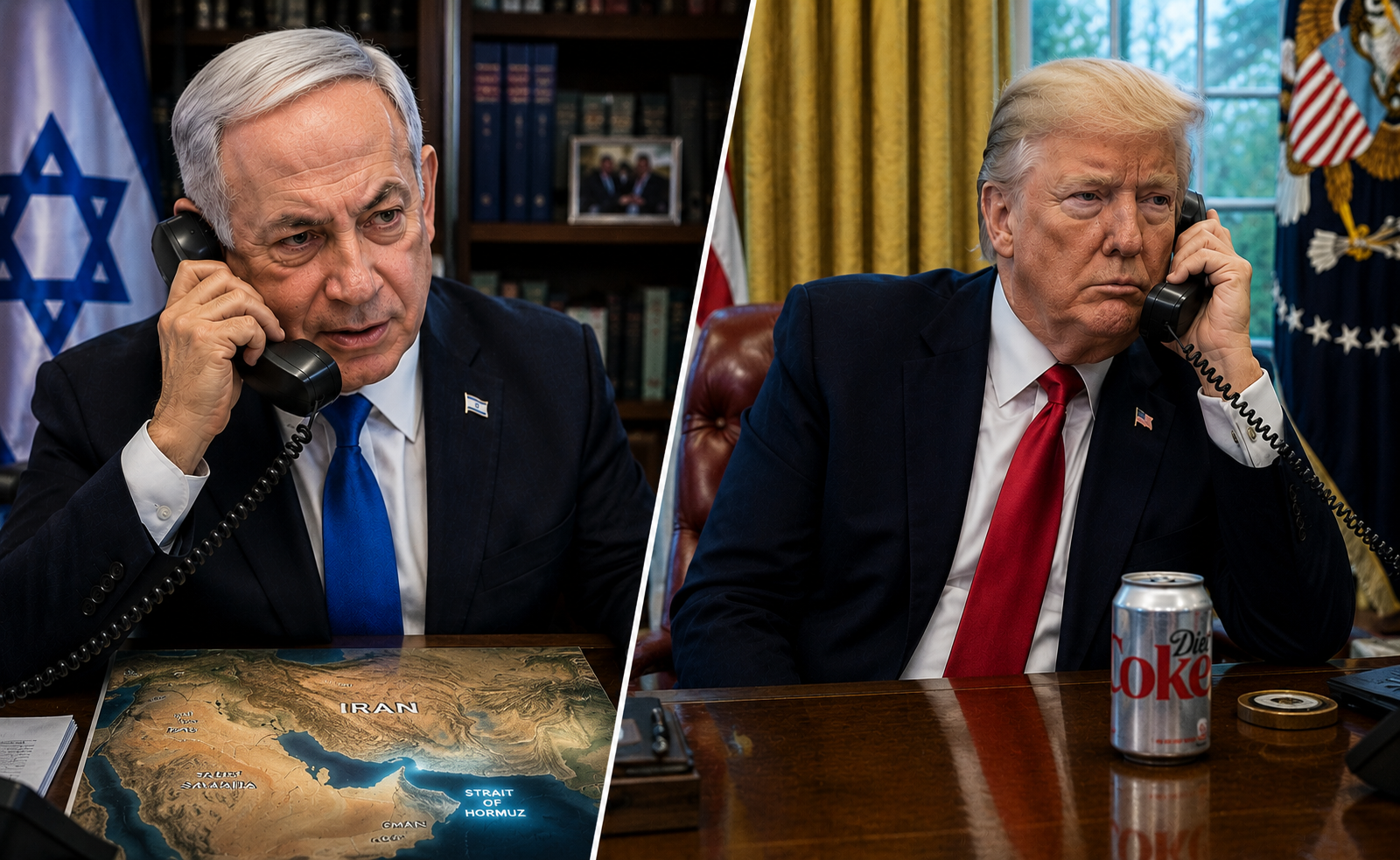
But in the days that followed, a new development forced Kagan back to the keyboard: a phone call between President Donald Trump and Israeli Prime Minister Benjamin Netanyahu that, according to a U.S. source briefed on the conversation, left Netanyahu’s “hair on fire.” The call — and the reaction it triggered — became the catalyst for Kagan’s follow-up article, a piece that shifted his focus from American defeat to what he now warns could become the worst strategic defeat in Israel’s history.
The reporting surrounding the call was stark. Trump reportedly told Netanyahu that mediators were working on a “letter of intent” that both Washington and Tehran would sign to formally end the war and begin a 30-day negotiating process covering Iran’s nuclear program and the reopening of the Strait of Hormuz.
Kagan interprets the meaning of that proposal bluntly: the United States is preparing to exit the crisis.
Importantly, Kagan does not argue that Trump would necessarily leave without additional military action. In fact, he suggests the opposite. Trump, he writes, “may launch another limited strike to look tough and satisfy the demands of the war’s supporters,” but such action would amount to little more than political theater — symbolic demonstrations of resolve intended to provide cover for a negotiated exit rather than materially alter the strategic balance.
Two Israeli sources confirmed that Trump and Netanyahu were in sharp disagreement over the way forward, while Israel’s ambassador to Washington reportedly informed U.S. lawmakers that Netanyahu was deeply alarmed by the conversation. In Kagan’s view, the reason is straightforward: Trump’s proposed endgame effectively abandons Israel at the moment of maximum strategic vulnerability.
That marks a significant escalation from Kagan’s earlier argument. Checkmate in Iran focused primarily on American defeat. The follow-up article warns that the consequences may fall even more heavily on Israel.
To understand why the phone call triggered such a dramatic shift in Kagan’s analysis, it is necessary to understand who Kagan is. For more than three decades, he has been one of the most prominent intellectual voices behind neoconservative American interventionism. As a co-founder of the Project for the New American Century in 1997, Kagan helped shape a political and strategic movement built on the belief that sustained American military dominance was essential to preserving global order, deterring adversaries, and protecting allies.
When Kagan argues that the United States is suffering a strategic defeat, he is not speaking casually. He is effectively diagnosing the collapse of the very framework he spent much of his career promoting.
In Checkmate in Iran, Kagan argued that the United States had entered a strategic trap from which there was no clear exit. Iran’s leverage over the Strait of Hormuz — through which roughly 20 percent of global oil supplies transit — had, in his view, fundamentally altered the balance of power in the Gulf. The implications extended well beyond the region itself. “America’s once-dominant position in the Gulf is just the first of many casualties,” he warned.
But the Trump–Netanyahu phone call introduced a new variable: the possibility that Washington would not merely lose strategic ground but would seek a negotiated exit that leaves Israel exposed, isolated, and strategically diminished.
For Kagan, even limited follow-on strikes would not change that reality. A few additional missiles would do little to reverse Iran’s structural gains or restore deterrence credibility. Instead, they would underscore Washington’s apparent desire to demonstrate toughness long enough to facilitate an orderly disengagement.
Kagan lays out the potential consequences with unusual bluntness. On the current trajectory, he argues, Iran could emerge from the conflict substantially stronger and more influential than before the war. Tehran would possess significant leverage over dozens of energy-dependent economies with a direct interest in maintaining stable relations with Iran and avoiding future disruptions in Gulf shipping.
Under those conditions, Kagan warns, many countries would become increasingly reluctant to align openly with Israel in future confrontations involving Iran or its regional proxies. The result could be an Israel more strategically isolated than at any previous point in its history — including from its most important ally, the United States.
This is why the phone call mattered so deeply in Kagan’s analysis. Trump’s proposed endgame — negotiations potentially preceded by limited face-saving strikes — is not simply a tactical diplomatic maneuver. In Kagan’s view, it represents the moment when Washington signals that it is stepping back from the conflict while offering Israel just enough military theater to soften the political impact of American disengagement.
Trump himself suggested he remained prepared to resume military operations if negotiations failed, reportedly stating that the “only question is do we go and finish it up or are they gonna be signing a document.” But Kagan clearly believes the answer is already evident.
The call also exposed a widening divergence in strategic priorities between Washington and Jerusalem. Trump, facing domestic political pressure and mounting risks associated with a prolonged regional war, appears increasingly interested in securing a negotiated off-ramp. Netanyahu, by contrast, reportedly favors continuing military operations in order to further degrade Iran’s military capabilities and weaken the regime through sustained attacks on critical infrastructure — objectives that a letter-of-intent framework would likely foreclose.
The May 10 article diagnosed a potential American strategic defeat. The follow-up article, triggered by one tense phone call, warns of something even more consequential: a scenario in which the United States dresses up its withdrawal with limited strikes, presents Israel with a diplomatic fait accompli, and leaves Jerusalem confronting a more powerful and emboldened Iran largely on its own.
For Kagan — who spent decades arguing that American power was the indispensable foundation of Middle Eastern order — such an outcome would represent not merely a policy setback, but the unraveling of the strategic worldview he helped build.
Kagan’s argument may overstate the certainty of his projected endgame. Middle East wars have repeatedly humbled analysts, policymakers, and intelligence services alike, and events that appear strategically decisive in one moment can look very different weeks or months later. Nothing in war is fully predictable, particularly in the Middle East. Still, the strategic concerns Kagan raises — especially regarding U.S. disengagement, Israeli isolation, and Iran’s expanding leverage in the Gulf — are serious enough that they cannot be lightly dismissed.