
Iran Won’t Give Up Its Uranium and the Hormuz Strait. Trump Knows It.
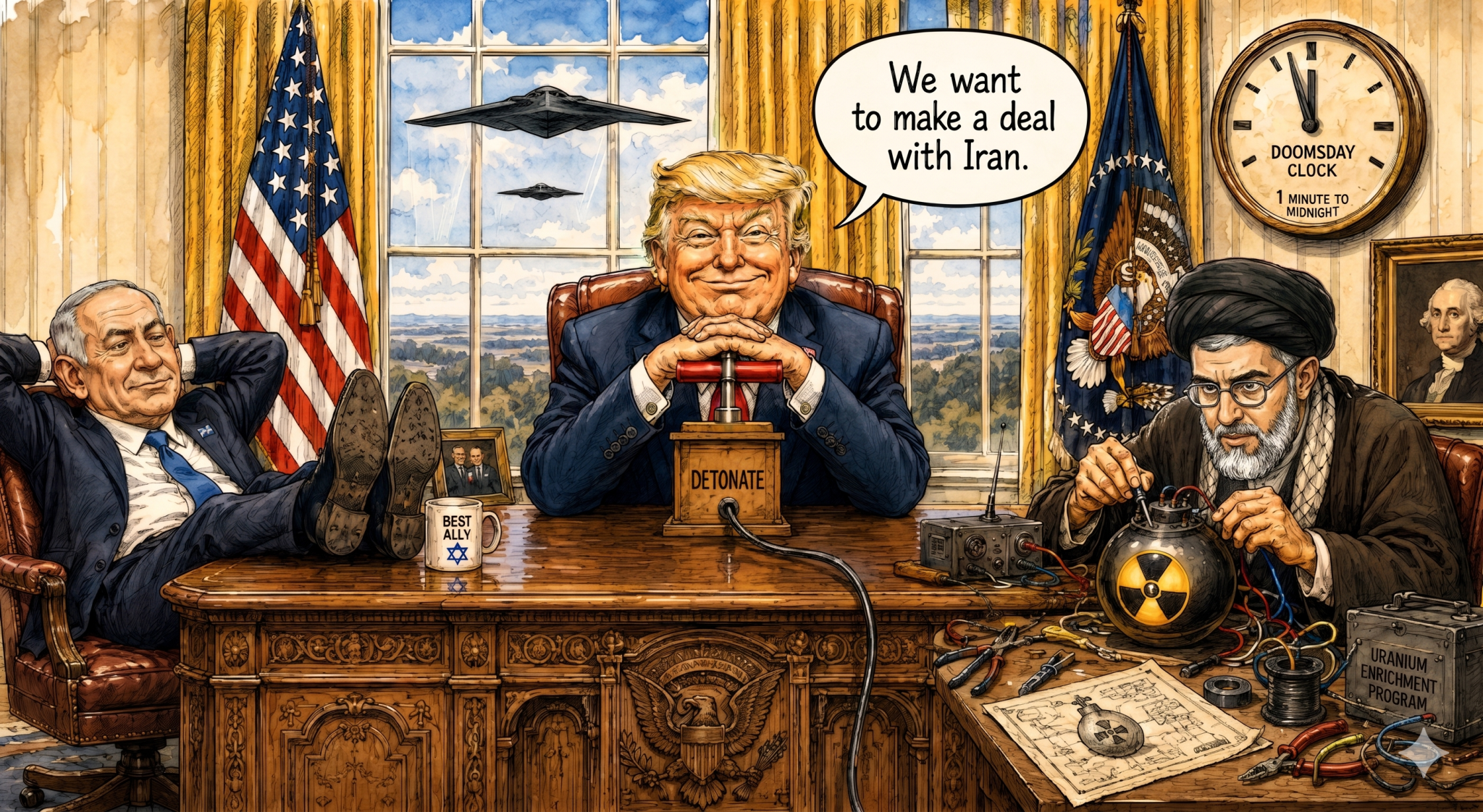
It has become a constant. In late March, the president gave Iran forty-eight hours to open the Strait of Hormuz or watch its power grid burn. The forty-eight hours passed. Then he spoke of progress and granted five more days. Then ten. Then one. By early April he announced a two-week ceasefire, tied to the strait, and called the long problem all but solved. The two weeks ended. The bombing did not come. He extended the truce indefinitely instead, explaining that Tehran’s government was too fractured to give him an answer.
The pattern held into May. He warned that the bombs would start going off. He threatened strikes at a higher level. He said there would be nothing left of them. He called the ceasefire something on life support. And each time the deadline arrived, a mediator surfaced, a phone call came in from the Gulf, and the strike slid two or three days down the calendar.
Iran did not act like a cornered government. It acted like a theocracy whose worldview promises it the final victory. It gave up nothing. It kept its hand on the strait. It rebuilt its missiles and started turning out drones again. It survived the death of its supreme leader, installed his son Mojtaba in his place, and closed ranks instead of splintering. Defiance, not surrender. Every threat met with the same silence, and the same waiting.
So why has Trump not attacked Iran again?
Because the Real Operation Is Enormous
Not because he lacks the nerve. Because the thing he actually needs to accomplish is among the hardest operations a military can attempt.
Start with the uranium. To take it, the United States and Israel first have to know precisely where it is, down to the chamber, inside the underground complex at Isfahan. Then they have to go and get it. Not bomb it. Get it. Four hundred and forty kilograms of enriched material does not come out of a tunnel from the air. It comes out with people on the ground, deep inside hostile territory, under fire, carrying shielded canisters and trusting that they found all of them. The material is not only a target. It is a radiological hazard, a danger to the very soldiers who would handle it if they manage to recover it. A physician knows what a breach in the open would mean.
An operation without precedent. And an operation without precedent demands planning. A great deal of planning. That is what the calendar has been buying.
Opening the Strait Means Ruins
Then there is Hormuz. To force it open is, in practice, to bomb Iran back to the Stone Age. Why so extreme? Because for the regime, closing the strait is almost effortless. A handful of mines, a few small boats, and the artery shuts. To guarantee it stays open, you cannot trim the threat. You have to break it to the foundations.
And Trump grasps the trap folded inside that. If he does it, it has to be fast. A campaign with a hard ceiling on the clock. Because if it drags, the world falls back into the same endless loop, the strait choking and clearing and choking again, the global economy sinking deeper with every week that passes. A short, total war he might survive politically. A long one drowns him, and the price shows up at every gas pump on earth.
The Deal Talk Is the Clock
So when Trump speaks of a deal with Iran, what he is really doing is buying time. Time to locate. Time to plan. Time to pick the moment. The negotiations and the preparations run on the same clock, and they always have.
Notice that he has not softened the terms that matter. He has said it without hedging. Iran cannot go nuclear. Iran has to hand over its uranium. And the Strait of Hormuz cannot be left in the hands of the regime. Those are not the words of a man rehearsing a compromise. They are the words of a man waiting for something to be ready.
And Netanyahu Says Nothing
Which brings us to the quiet man in the room. Why does Netanyahu say so little about any of it?
His silence says plenty. He is not anxious. He is not pushing. He leans back, feet up, because he knows something the rest of us do not. The timing. The readiness. The line that will not be crossed, and who will cross it. When the leader with the most to fear from a nuclear Iran goes quiet, it is not because he stopped caring. It is because he is waiting too, and he is comfortable doing it.
The Only Real Surprise
There is exactly one outcome that would shock. Trump accepting a bad deal. A paper that lets Iran keep the uranium and keep the strait, wrapped in the language of peace.
It is also the least likely move on the board. It would collapse everything he has said for months. It would hollow out his own narrative and shrink his image to nothing. The man who built a brand on never being played does not, at the final hour, let himself be played in front of the entire world.
Yes, the ideal is simple. Iran concedes everything at the table. No raid, no ruins, no oil shock, no radioactive risk. It is what the whole world wants.
But wanting a thing is one matter. Understanding the Middle East to its depths is another. And in the distance between the two, between what we wish for and what the region actually is, sits a smiling man with his hands resting on a detonator, telling everyone he wants a deal.
And Trump almost certainly has no appetite for the attack itself. But for a leader like him, what he prefers and what he must project to the world are two different things. He can dread the strike in private and still refuse to look weak before it.
He knows. The man with his feet on the desk knows. And somewhere under Isfahan, so does the third.