
Middle East Analyst
Iranian Unrest: Proxies Surge Potential
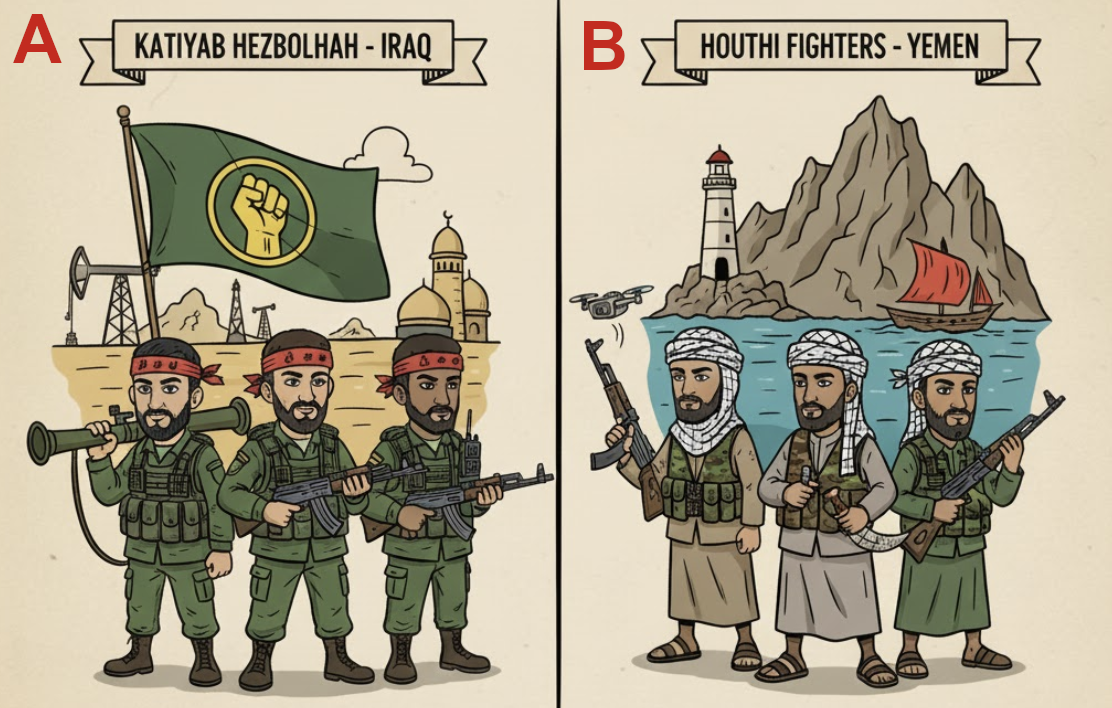
graphic by author/Nano Banana
As of January 2026, the Islamic Republic of Iran has moved beyond episodic crisis management and into what can best be described as a standing trans-national internal defense posture. The collapse of the Assad regime in December 2024 removed the Syrian land bridge that had long underpinned Iran’s regional logistics and proxy integration, but it did not dismantle Tehran’s external security architecture. Instead, the regime adapted. The Iraqi–Iranian border has been institutionalized as a primary land artery for bulk manpower, while an air and maritime bridge linking Sanaa and Iranian ports has emerged as a parallel channel for elite, ideologically hardened forces. Together, these pathways form the backbone of a multinational reserve designed not to govern Iran, but to prevent regime collapse at decisive moments.
In most plausible unrest scenarios, Tehran would not require mass foreign intervention. Limited deployments of foreign fighters—ranging from several hundred to perhaps two thousand—would likely be sufficient to stiffen domestic units, guard critical assets, and signal regime resolve. The more consequential question arises only in a worst-case scenario: one in which unrest becomes multi-provincial, domestic security forces show signs of fracture, and the IRGC leadership assesses that regime survival itself is at risk. Under those conditions, Iran retains both the capacity and the willingness to activate a far larger external reserve, surging well over ten thousand Iraqi militia fighters and, at the extreme margin, calling upon the Houthis as a final, loyalty-insulated line of defense.
Such a decision would not be aimed at restoring order or rebuilding legitimacy. It would represent a survival pact. The Houthis, in particular, would understand this moment not as a discretionary proxy request, but as an existential call. Their own movement is structurally dependent on Iranian support for weapons, training, finance, and international relevance. The collapse of the Islamic Republic would leave them isolated and strategically exposed. Under such circumstances, the Houthis would be compelled to do whatever lies within their power to ensure regime survival, even if that meant stripping Yemen to a risk-acceptant minimum and accepting catastrophic regional escalation as the price of survival.
The underlying driver of this posture is the growing strain within Iran’s domestic security apparatus. The Basij and regular police forces retain deep familial and community ties that inhibit sustained lethal escalation against civilians. IRGC units are more ideologically reliable, but they are not immune to fatigue, rotation strain, and morale degradation during prolonged, multi-city unrest. The regular army, or Artesh, remains the critical wildcard. While not inherently disloyal, it is acutely sensitive to nationalist symbolism, and the perception that Iran’s sovereignty is being defended by foreigners rather than its own soldiers carries significant defection risk. Foreign proxies, by contrast, offer Tehran a reserve that is entirely insulated from Iranian social pressures.
Foreign fighters are also particularly well suited to protecting what the regime values most in a crisis: its survival assets. Missile and UAV sites, IRGC depots, command-and-control nodes, intelligence facilities, detention centers, senior leadership compounds, and critical energy infrastructure all require absolute loyalty rather than cultural competence. These missions minimize civilian interaction and sharply reduce the operational penalties associated with language barriers and social alienation. In such roles, foreign fighters are often more reliable than local forces precisely because they lack local ties.
The patron–client logic binding Iran to its proxies further reinforces this dynamic. Iraqi militias, Hezbollah, the Houthis, and Afghan and Pakistani Shi’a networks all depend on Tehran not merely for ideology, but for their continued existence as organized armed actors. The fall of the Iranian regime would represent systemic collapse for the entire network. Intervention under existential threat would therefore be driven by self-preservation rather than ideological solidarity.
This logic is no longer theoretical. Credible, though unverified, open-source reporting indicates that approximately 800 to 850 foreign fighters—primarily Iraqi Shi’a militias with smaller Hezbollah- and Quds-linked elements—have already entered Iran to support internal security functions. This figure should be treated as a baseline floor rather than a comprehensive accounting, but it establishes an important precedent: Tehran has already crossed the threshold from contingency planning to active domestic deployment of foreign manpower.
Among Iran’s proxies, Iraqi Shi’a militias represent the most immediately accessible and scalable surge pool. Tens of thousands of fighters exist within the Popular Mobilization Forces ecosystem, and under current political and security conditions in Iraq, deploying ten thousand or more fighters to Iran would not materially weaken their domestic position. In most unrest scenarios, Tehran would require only one to two thousand Iraqi fighters. In serious multi-city instability, three to five thousand could be deployed. In a true existential crisis, well over ten thousand would be available and willing. These fighters would be embedded within mixed IRGC units, conduct targeted raids and intimidation, guard strategic facilities, and act as coercive backstops against wavering Iranian personnel. Their strengths lie in combat experience and command-level integration with the IRGC-QF. Their liabilities lie in visibility: limited Farsi proficiency at the rank-and-file level, distinct accents, and the nationalist backlash that follows sustained population-facing use.
Hezbollah’s role would remain qualitatively important but quantitatively limited. Ongoing confrontation with Israel constrains its ability to deploy large numbers of fighters. At most, dozens to low hundreds of elite cadres could be spared, primarily for intelligence, interrogation management, training, advisory roles, and close protection of senior regime figures. Hezbollah provides intellectual and organizational leverage, not mass.
The Houthis, by contrast, constitute Iran’s final reserve. By 2026, Ansar Allah commands a mass-mobilized force estimated at roughly 300,000 to 350,000 fighters. Under an existential survival framework—one in which Iran’s collapse would directly threaten the Houthis’ own survival—between twenty and thirty percent of this force becomes theoretically releasable. This yields a potential exportable pool of sixty to one hundred thousand fighters. The binding constraint is not willingness, but logistics.
Airlift capacity favors elite cadres rather than mass infantry. Maritime transport via the Red Sea, Gulf of Aden, and onward to Iranian ports would be vulnerable to interdiction and would likely require phased, disguised, or blended civilian–military movement. Inside Iran, the reception, housing, feeding, arming, and command integration of tens of thousands of non-Farsi-speaking fighters would strain IRGC logistics and dramatically increase visibility. As a result, any large-scale Houthi deployment would be tiered and time-extended rather than instantaneous.
Yemen itself cannot be assumed to be a static rear area. The divide between the STC and PLC remains contingent rather than permanent. A visible Houthi external mobilization could create incentives for temporary reconciliation among anti-Houthi factions or renewed external backing for counter-Houthi advances if Yemen is perceived as strategically neglected. Even under existential conditions, Houthi leadership would likely retain a minimum deterrent force at home, slowing but not preventing large deployments.
Within these constraints, a worst-case deployment model is nonetheless sobering. An initial shock surge of ten to fifteen thousand elite Hussein Brigades and urban coercion units could be dispatched to secure regime survival nodes and enforce compliance among Iranian forces. This could be followed by twenty to thirty thousand fighters tasked with static security of energy infrastructure, missile forces, ports, and leadership compounds. If corridors remained open and the regime’s survival continued to hang in the balance, a terminal infusion of forty to fifty thousand or more fighters over time is no longer analytically implausible. At that scale, the Houthis cease to function as a proxy and instead become a Foreign Legion–scale force.
The Houthis’ strengths in this role are stark. They have zero cultural or familial ties to Iranian society, near-zero defection risk, an extreme tolerance for lethal repression, and an organizational structure—the Mushrif or supervisory system—well suited to coercive oversight of other forces. Their liabilities are equally stark: no Farsi capability, total cultural alienation, and catastrophic symbolic escalation. Their deployment would almost certainly transform unrest into a nationalist struggle and sharply increase the probability of regional intervention aimed at severing Iran’s air and sea corridors.
Supplementary forces, including Afghan and Pakistani Shi’a networks, could contribute low-visibility manpower for static security roles, guarding facilities, logistics hubs, and detention centers. Their utility is real but secondary, and they lack the cohesion and discipline required for large-scale mobile repression.
Taken together, foreign proxies can achieve specific, critical objectives. They can prevent rapid regime collapse, secure strategic weapons and leadership, stiffen wavering Iranian units, and intimidate or fragment protest leadership in key nodes. They cannot restore legitimacy, sustain nationwide crowd control, or suppress a prolonged revolt if Iranian forces themselves fracture. They are a force multiplier, not a solution.
In a terminal scenario marked by fractures within the IRGC or Artesh and regime survival at stake, Iran could rapidly surge ten to twenty thousand Iraqi fighters and activate tens of thousands of Houthis over time to secure its core. This would represent a final rupture. The regime would survive as an armed entity or not at all. Iran would, in effect, become an internally occupying power, and the likelihood of intervention by Israel and the United States to sever proxy supply lines would rise sharply. Yet under existential logic, these risks may be judged acceptable, because the alternative is immediate collapse.
The bottom line is stark. Iran possesses a real, scalable external internal-security reserve. Iraqi militias provide the first and most effective layer. The Houthis represent the final reserve, activated only when survival overrides all other considerations. Logistics may slow deployment. Yemen contingencies may shape sequencing. Political backlash may accelerate escalation. None of these alter the core imperative. If the Iranian regime faces an existential threat, the Houthis must be prepared—and are structurally incentivized—to do whatever lies within their power to ensure regime survival. At that point, the central question is no longer whether escalation is too costly, but whether survival is possible without it.
Related Topics
Related Posts