
Iran Analyst | Human Rights | Middle East Politics
Iran’s $4 Billion Crypto Shadow Economy
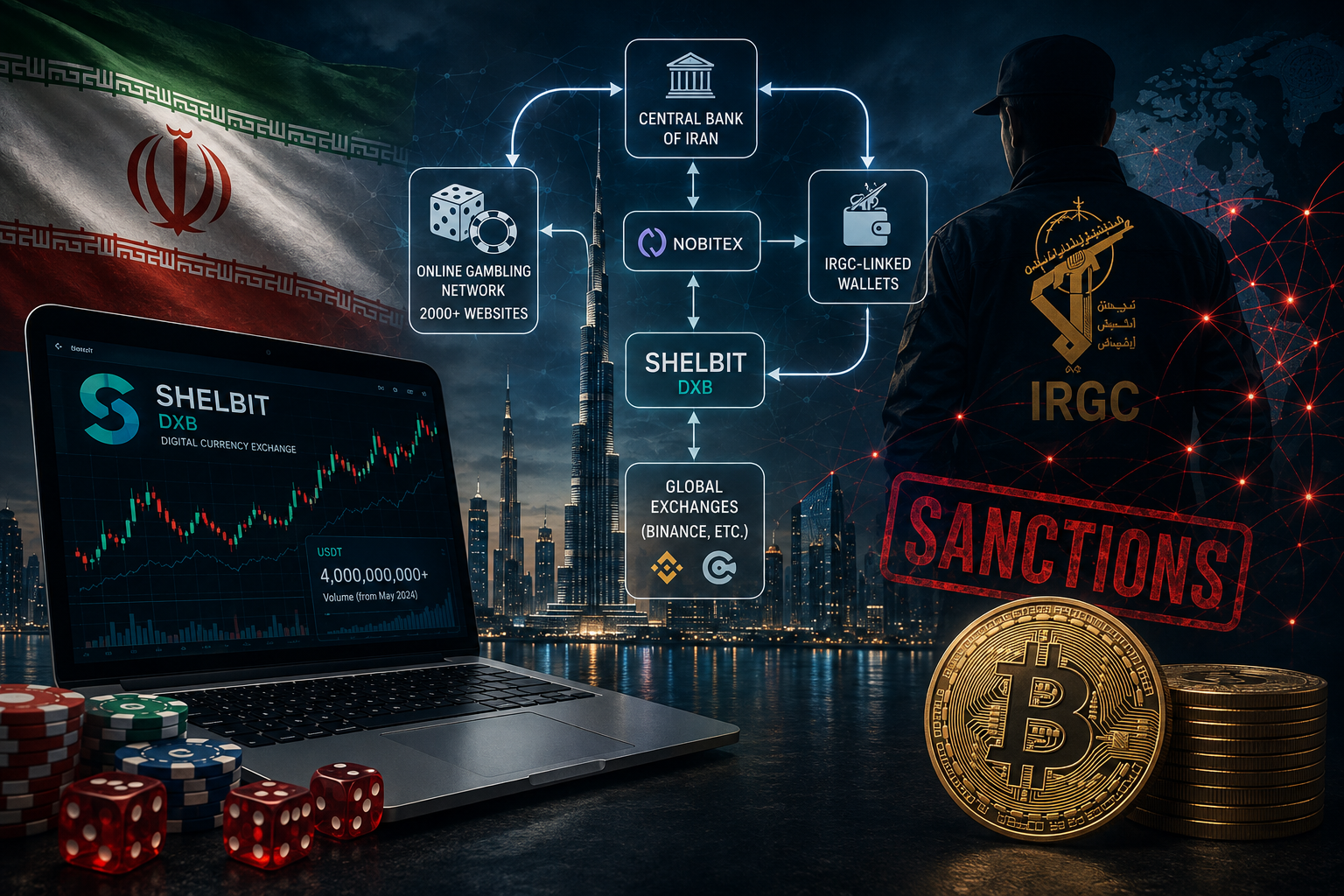
An AI-generated illustration of the financial networks connecting Iran’s cryptocurrency ecosystem, online gambling operations, sanctions evasion and IRGC-linked entities.
The Shelbit case reveals how gambling, cryptocurrency, sanctions evasion and Iran’s state-linked financial networks have converged — and why the blockchain may ultimately expose what the regime is trying to hide.
The Blockchain Remembers
Iran has spent decades trying to shield its finances from the global banking system. Yet one of the technologies helping it do so may also be creating a persistent record of where the money goes.
A Reuters investigation published in July found that Shelbit had processed at least $4 billion since May 2024, including flows connected to more than 2,000 Iranian gambling websites, Iran’s central bank and wallets associated by Israeli authorities with the Islamic Revolutionary Guard Corps, or IRGC. More than $676 million in crypto from Shelbit-linked wallets was sent to Binance, Reuters reported.
The story is bigger than one exchange, one gambling network or even one sanctions-evasion scheme. It offers a rare window into the financial architecture that allows the Islamic Republic and affiliated networks to operate across borders while much of Iran’s conventional economy remains cut off from international banking.
And it reveals something that Tehran may find harder to control than a bank account: the blockchain remembers.
A Forbidden Market at the Heart of the Network
The first contradiction is almost theatrical. Gambling is prohibited under Iranian law and can carry prison and corporal punishment. Yet Reuters found that a vast Farsi-language online gambling network had access to Iran’s domestic electronic payment system, which is closely overseen by the Central Bank of Iran.
The network included more than 2,000 websites and was promoted by prominent Iranian influencers operating outside the country. Reuters reported that the three men at the center of its investigation — the gambling figures and Shelbit founder Siavash Kayvanpour — had been convicted in absentia in Iran in 2023 in connection with illegal gambling.
The apparent contradiction matters because it points beyond gambling itself. A black market can exist despite state prohibition. It becomes something more significant when the infrastructure needed to collect, move and convert that market’s revenue intersects with official payment channels and state-linked financial actors.
Reuters’ reporting found that Shelbit functioned as a settlement hub between the gambling network and global crypto markets. Researchers who provided transaction data to Reuters said the exchange interacted with Iran’s central bank, Nobitex and wallets that Israeli authorities have linked to the IRGC. The reporting does not establish that the IRGC directly owned or controlled every component of the gambling network. That distinction is important. The significance lies in the network of financial relationships itself.
From Tehran’s Banks to Dubai’s Crypto Markets
For years, sanctions have pushed Iranian businesses and state institutions away from conventional correspondent banking and toward alternative payment channels. The result has been a financial ecosystem built around exchange houses, intermediaries, front companies and, increasingly, digital assets.
Nobitex provides a critical piece of this picture. In June, the US Treasury designated Nobitex, Iran’s largest digital-asset exchange, alongside three other Iranian exchanges. Treasury said Nobitex had processed more than half of Iranian digital-asset inflows in 2025 and described the broader sector as part of Iran’s effort to evade sanctions and move wealth beyond the reach of foreign financial authorities. Foreign financial institutions and other non-US persons can also face sanctions exposure for significant transactions involving the designated exchanges.
The Shelbit case suggests how offshore entities can sit between Iran’s domestic financial system and international crypto markets. A Dubai company can receive Iranian-linked crypto, interact with offshore exchanges and counterparties, and potentially move value across borders without requiring the same banking relationships that sanctions are designed to restrict.
That does not make cryptocurrency invisible. It makes it different.
The IRGC and the Shadow Economy
The broader significance of Shelbit lies in what it suggests about the relationship between Iran’s formal economy and its shadow economy. The IRGC is not simply a military organization. Over decades, it has accumulated extensive economic influence, including networks of companies, contractors and financial intermediaries that operate across multiple sectors.
Reuters’ investigation described the online gambling sector as an example of that reach, reporting that the IRGC had moved into a lucrative market that the state publicly prohibits. The investigation also found links between Shelbit and state-linked financial infrastructure. Separately, blockchain investigators have identified extensive crypto activity associated with Iranian state institutions.
In January, blockchain intelligence firm Elliptic reported that wallets attributed to the Central Bank of Iran had acquired at least $507 million in USDT, the dollar-backed stablecoin. Elliptic described the figure as a lower bound based on wallets it could attribute with high confidence and said the purchases pointed to a strategy for bypassing the global banking system. Much of the USDT was routed through Nobitex before being moved through other channels.
Taken together, these cases point to a system in which the boundaries between public finance, sanctioned entities, informal intermediaries and illicit markets are difficult to separate cleanly. That ambiguity can be an advantage for sanctions evasion. It can also become a vulnerability.
Why Israel Should Watch the Blockchain
For Israel, the most important development may not be the existence of another Iranian sanctions-evasion route. It may be the growing role of blockchain intelligence in mapping the Iranian financial system.
In conventional banking, investigators may confront shell companies, opaque ownership structures and jurisdictions that refuse or delay cooperation. Public blockchains create a different environment. Transaction histories can remain visible long after a company disappears, changes its name or closes an office.
That is already evident in the Iranian cases. Blockchain firms have been able to follow wallet relationships involving Nobitex and state-linked entities, while Reuters and its research partners reconstructed the Shelbit network by analyzing on-chain transactions. Israeli authorities had previously identified some wallets encountered in the Shelbit investigation as linked to the IRGC.
This turns blockchain analysis into more than a compliance tool. It becomes an intelligence capability. In the financial contest between Iran and its adversaries, the blockchain is increasingly a source of evidence about how money moves, which entities interact and where sanctions-evasion networks intersect.
There is a paradox here. Tehran can use digital assets because they are fast, cross-border and less dependent on traditional banking. But the same properties can make the resulting transactions traceable. The ledger does not forget simply because the regime would prefer it to.
Dubai Is Part of the Story
The geography of the Shelbit case also matters. Iran’s financial networks do not operate in isolation. Dubai and the United Arab Emirates occupy a critical position in the region’s financial and commercial system, making regulatory enforcement there highly consequential for Iranian sanctions evasion.
Dubai’s Virtual Assets Regulatory Authority, or VARA, fined Shelbit General Trading L.L.C. in July 2026. VARA’s official notice said the action followed an earlier cease-and-desist notice issued in January 2025. The regulator’s intervention demonstrates that the problem was not simply a hidden Iranian operation; it involved an offshore corporate structure operating within an international financial center.
Days after Reuters published its investigation, the United States imposed sanctions on Shelbit and its founder, Siavash Kayvanpour. Treasury accused Shelbit of facilitating millions of dollars in transactions for the IRGC and other Iranian-linked entities and also targeted Aban Tether, an Iran-based digital-asset exchange. Kayvanpour and the affected companies have disputed allegations of wrongdoing.
The sequence is instructive: investigative reporting, blockchain analysis, regulatory action and sanctions enforcement converged around the same network. That is increasingly how financial intelligence works in the age of crypto — not through a single database, but through the combination of public ledgers, investigative reporting, regulatory records and cross-border cooperation.
The Weakness of a Sanctions-Proof Economy
Iran’s ability to develop alternative financial channels is often presented as evidence that sanctions can be circumvented indefinitely. The Shelbit case suggests a more complicated picture.
Sanctions do create incentives for innovation. When conventional channels close, intermediaries find new routes. Stablecoins offer dollar exposure without requiring direct access to the US banking system. Offshore exchanges can connect Iranian actors to global markets. Informal networks can substitute for formal correspondent relationships.
But every new channel creates a new set of dependencies. Crypto networks depend on exchanges, wallet infrastructure, stablecoin issuers, mining operations and jurisdictions in which companies are registered. Each point can become a pressure point for investigators.
The irony is that a financial system designed to operate beyond the reach of conventional banks can leave a different kind of paper trail — one written not in account statements, but in immutable transaction histories.
This does not make sanctions omnipotent. Nor does it mean every Iranian crypto transaction is illicit. It means that the regime’s financial adaptation is not the same thing as financial invisibility.
What the Shelbit Affair Really Reveals
The most consequential lesson from Shelbit is therefore not that Iran has discovered cryptocurrency. Iran has been using digital assets for years. The more important development is the convergence of several worlds that Tehran has historically tried to keep separate: a state that publicly bans gambling, a financial system under sanctions, a powerful military organization with extensive economic interests, offshore intermediaries and a global crypto market.
When these worlds converge, the distinction between ‘official’ and ‘unofficial’ becomes increasingly difficult to sustain. Money can begin as a bet on a Farsi-language gambling site, move through an Iranian payment channel, pass through an offshore crypto exchange, touch a wallet associated with a sanctioned actor and emerge somewhere else in the global financial system.
That is the architecture of a shadow economy: not a completely separate system, but a parallel layer attached to the formal one.
The response will not come from banning every cryptocurrency or assuming that every Iranian digital-asset transaction is evidence of wrongdoing. The more effective approach is forensic: follow the money, identify the institutions that make the flows possible, and use sanctions and regulatory tools against the nodes that knowingly facilitate them.
For Israel and its allies, the lesson is particularly relevant. Financial pressure against Iran is increasingly becoming a contest over information — who can see the network first, attribute the wallets accurately, identify the intermediaries and act before the money moves again.
The Blockchain May Be Tehran’s Unwanted Ledger
The Iranian regime has spent years adapting to a world in which access to conventional finance is restricted. It has found workarounds, intermediaries and alternative rails. Crypto has become one of them.
But Shelbit exposes the uncomfortable limit of that strategy. A system built to move value outside traditional banking can also create a permanent record of movement. Every transaction can become a clue. Every reused wallet can reveal a connection. Every intermediary can become a node in a map that investigators gradually reconstruct.
The $4 billion reported by Reuters is therefore more than a headline figure. It is a measure of the scale at which Iran-linked networks have attempted to build financial corridors outside the reach of sanctions — and a reminder of how much information those corridors can leave behind.
The Islamic Republic may be able to evade a bank’s scrutiny. It may be able to close an office, change a company name or move operations across a border. But it cannot easily make the blockchain forget.
And that may be the most revealing paradox of Iran’s crypto shadow economy: the technology that helps money disappear from the traditional financial system may also be the technology that allows investigators to follow it.
Related Topics