
Media Strategist – Middle East Researcher
Iran’s AI Propaganda War against Israel
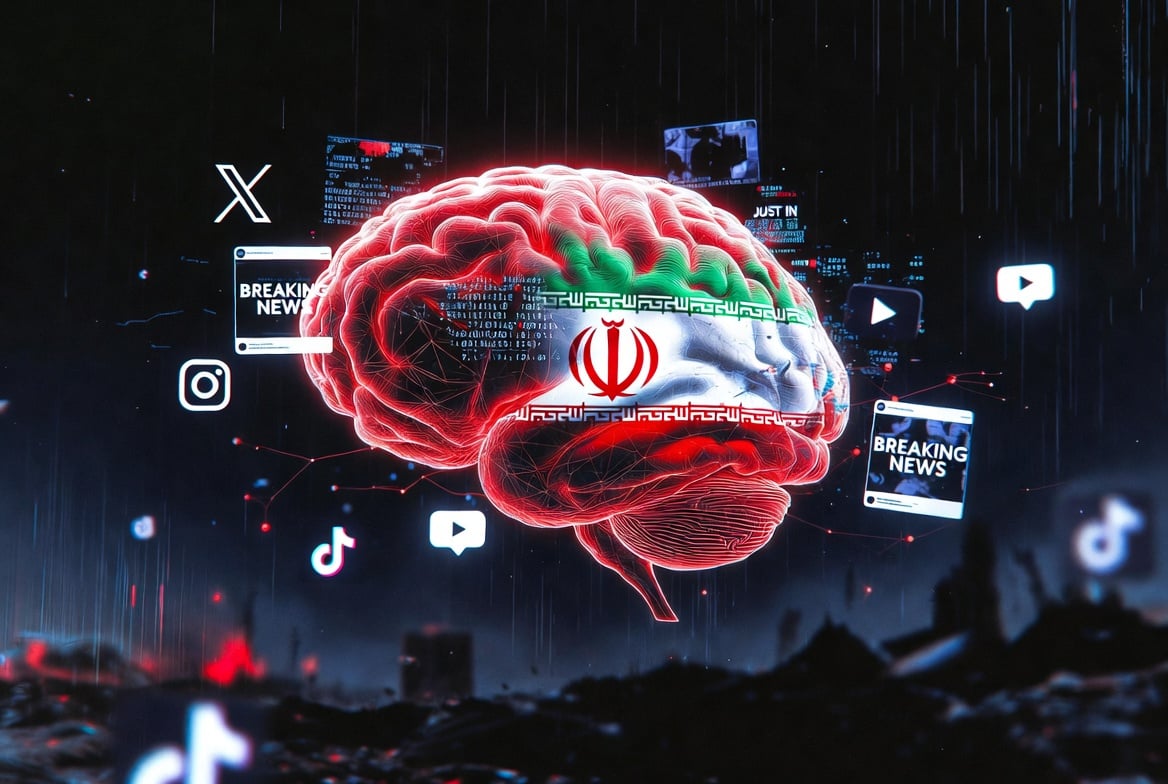
(AI)
Even as US and Iranian negotiators sit in Switzerland this week hammering out the technical details of a fragile ceasefire and sanctions relief framework, another front in the conflict shows no sign of pausing. On social media platforms across the world, Iran’s sophisticated digital propaganda apparatus continues to operate at full capacity — and in many cases, it appears to be outpacing traditional Israeli and Western information efforts.
What makes this campaign particularly effective in 2026 is its heavy reliance on artificial intelligence. Iran has moved beyond old-school troll farms and state television. It is now deploying coordinated networks of inauthentic accounts, AI-generated deepfakes, and viral meme content at a scale and speed that few anticipated.
A Shift Born of Necessity
Iran entered the 2026 conflict at a clear conventional disadvantage against the combined military power of the United States and Israel. Rather than conceding the narrative space, Tehran appears to have doubled down on asymmetric tools it had been developing for years. Social media intelligence firm Cyabra documented a sharp escalation in Iranian-linked influence operations immediately after the February 28 launch of major strikes on Iranian targets.
In one investigation covering late February to mid-March, Cyabra identified tens of thousands of inauthentic accounts distributing AI-generated videos across TikTok, X, Instagram, and Facebook. These accounts generated more than 145 million views in under two weeks. The content was not random. It followed clear narrative lines: exaggerated or entirely fabricated Iranian military successes, fake footage of Israeli cities under attack, and synthetic videos showing American casualties and grieving families.
The coordination was striking. Many videos appeared with identical captions, synchronized posting times, and clustered hashtags — strong indicators of centralized production and distribution.
From Deepfakes to “Slopaganda”
Iran’s operation combines high-end deepfakes with lower-quality but highly viral AI-generated content that researchers have begun calling “slopaganda.”
On one end of the spectrum are sophisticated deepfakes designed to look like authentic battlefield footage — explosions in Tel Aviv, successful Iranian missile strikes on US naval assets, or satellite imagery purporting to show damage to American bases. On the other end are meme-style videos, including a series of Lego-inspired animations that went viral across multiple platforms. These cartoonish but emotionally charged videos mocked US leadership and portrayed Iran as a defiant underdog standing up to Western aggression.
The Lego videos in particular proved remarkably effective at reaching younger audiences and crossing language barriers. Iranian diplomatic accounts and aligned creators leaned into meme culture rather than dry state messaging, making the content more shareable and harder to dismiss as traditional propaganda.
This dual-track approach — polished disinformation mixed with high-volume, low-effort AI slop — creates a fog of content that overwhelms fact-checkers and platform moderation systems.
The Bot Network Advantage
One of the most revealing aspects of Iran’s operation came from what happened when the accounts went silent. In mid-2025, Cyabra had already mapped an Iranian-linked bot network active in British political discourse, pushing content around Scottish independence and anti-Brexit themes. When major strikes hit Iran in 2026, those same accounts went completely dark for roughly two weeks before re-emerging with explicitly pro-Iran and anti-Israel messaging.
This pattern — pausing activity during periods of high scrutiny and then reactivating with new talking points — strongly suggests state direction rather than organic activism. The ability to maintain and redeploy large networks of fake personas gives Iran a persistent infrastructure that is difficult and expensive for democratic societies to fully dismantle.
Why This Matters Beyond Social Media Metrics
The goal of this campaign is not simply to generate likes or views. It is to erode international support for Israel and the United States, amplify domestic political divisions in Western countries, and create the perception that Iran is winning — or at least not losing — the broader conflict.
During the active phase of fighting earlier this year, Iranian information operations successfully pushed narratives that framed the conflict as an Israeli war of choice and exaggerated Iranian retaliatory capabilities. Even now, as diplomatic talks proceed, the same infrastructure continues to shape how global audiences interpret every development in the negotiations.
Public opinion data from multiple Western countries showed measurable shifts during the peak of the information campaign. When false or misleading content reaches tens of millions of people before it can be debunked, the damage to Israel’s image and diplomatic position is real — regardless of battlefield outcomes.
The Challenge for Israel and Its Allies
Traditional Israeli public diplomacy, often called hasbara, was designed for a different media environment. It struggles against an adversary that can generate and distribute synthetic content faster than humans can verify it. Israeli tech companies have developed promising AI-powered detection and counter-messaging tools — sometimes referred to as a “Digital Iron Dome” — but these efforts remain fragmented and under-resourced compared to the scale of the threat.
The uncomfortable reality is that Iran has turned a position of military weakness into an information advantage, at least in the short term. AI has dramatically lowered the cost and increased the speed of large-scale influence operations. What once required teams of human operators can now be partially automated, allowing Tehran to maintain pressure across multiple platforms simultaneously.
A Permanent Feature of Conflict
The digital battlefield is no longer an auxiliary theater. It has become central to how modern conflicts are won or lost in the court of global public opinion. Iran’s AI propaganda machine demonstrated during the 2026 escalation that it can operate effectively even while its conventional forces are under severe pressure.
As the region enters a new phase of diplomacy and fragile ceasefires, one thing is clear: Tehran has no intention of surrendering the information space. The question for Israel and its partners is whether they are prepared to treat the digital domain with the same strategic seriousness they apply to kinetic and diplomatic fronts.
Without a more coordinated, well-funded, and technologically advanced response, the advantage Iran has built in the information war will continue to grow — one deepfake and one viral meme at a time.
Related Topics
Related Posts