


Iran’s Endgame: Destroy the State of Israel and Conquer Jerusalem
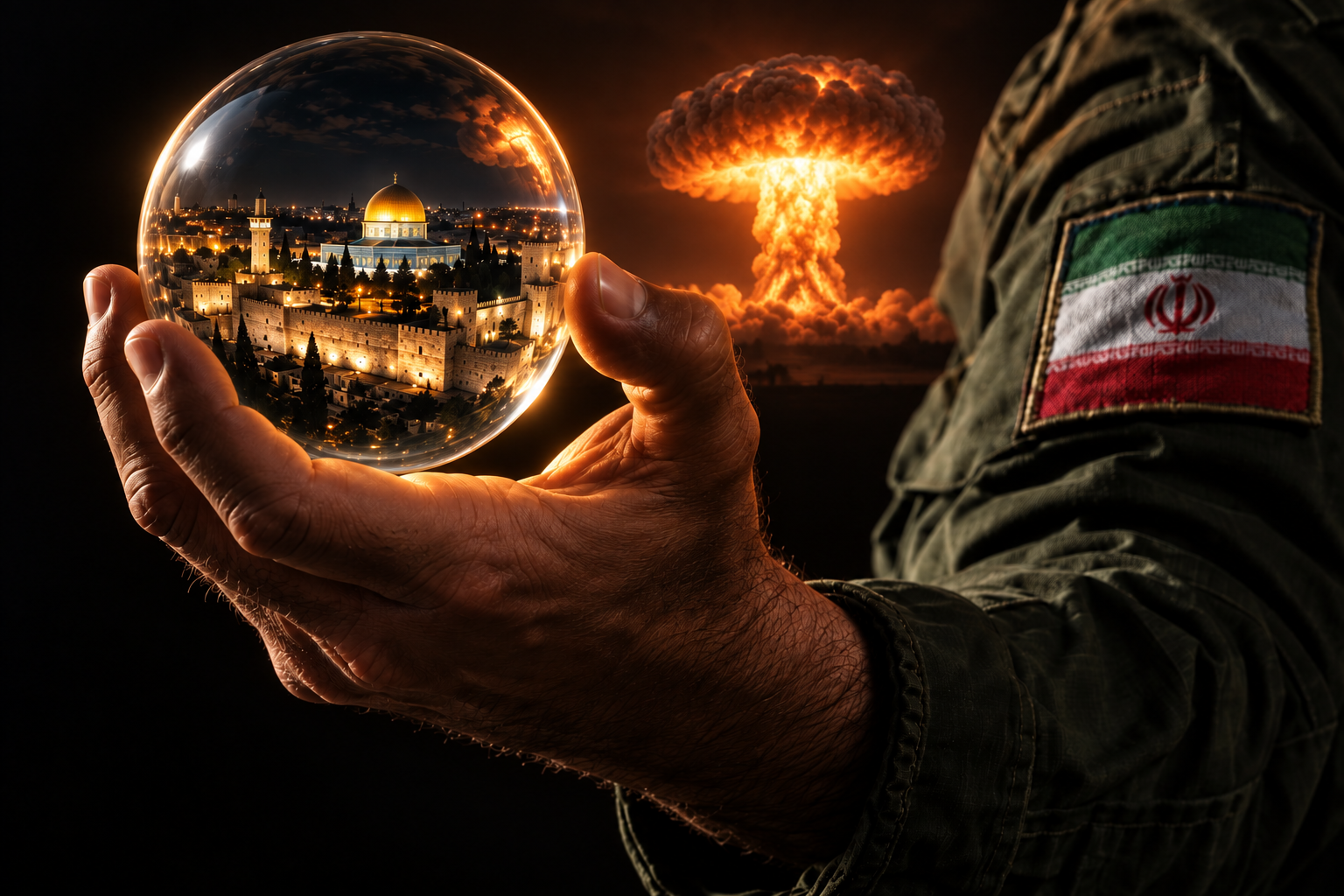
Ruhollah Khomeini did not call Israel a state. He called it the regime occupying Jerusalem, and said it had to vanish from the page of time. Mahmoud Ahmadinejad, four months into his presidency, repeated the line at the “World Without Zionism” conference in Tehran on October 26, 2005, and credited it to his imam. The New York Times rendered it as wiped off the map.
Ali Khamenei, supreme leader until he was killed in the opening strikes of February 28, called Israel a cancerous tumor. On Quds Day in 2020, the observance Khomeini fixed to the last Friday of Ramadan, he called Zionism a virus that has to be eliminated. Quds is the name for Jerusalem in Arabic and Persian.
In February 2025 Major General Ebrahim Jabbari told Basij members that Operation True Promise 3 would be executed at the right time, with precision, and on a scale sufficient to destroy Israel and raze Tel Aviv and Haifa to the ground. He was the third Revolutionary Guard commander to say it that week.
In the twelve days of June 2025 Iran fired roughly 550 ballistic missiles and 1,000 drones. Thirty-one hit populated areas or critical infrastructure. Twenty-eight people were killed, all but one civilians. Nine died in Bat Yam, four in Petah Tikva, three in Haifa, one in Bnei Brak, a woman in Tamra, and more in Beersheba on the final day. Three workers died at the Haifa oil refinery. The Soroka Medical Center in Beersheba took a direct hit.
The war that began on February 28 of this year ran forty days before the April 8 ceasefire. Around 650 missiles, sixteen of them into populated areas, twenty-four civilians killed. The worst single strike was Beit Shemesh on March 1, nine dead.
On March 4 a senior Iranian military official told the semi-official ISNA agency that Tehran’s final missiles would target the Dimona reactor and all regional energy infrastructure if Israel or the United States pursued regime change, and added that this is a scenario they have already prepared for. It was the sixth Iranian threat against the site. Seventeen days later missiles hit Dimona and Arad and wounded more than 180 people.
A fragment of an intercepted missile, probably the warhead, landed in a parking lot in the Jewish Quarter of the Old City, about 400 meters from the Western Wall and the Al-Aqsa compound. Nobody was hurt.
Roughly 1,200 missiles across two wars, some with cluster warheads that spread submunitions over a wider radius. Tel Aviv and its ring. Haifa and the refinery. Beersheba, Dimona. Beit Shemesh sits thirty kilometers from Jerusalem, and thirty kilometers is not a miss. No Israeli has been reported killed in Jerusalem.
The seat of the state was never named.
Qassem Soleimani came close to explaining why in February 2018, at a Tehran gathering marking ten years since the killing of Hezbollah commander Imad Mughniyeh. The commander of the Quds Force, the unit named for Jerusalem, said the regime would not survive and that the resistance front would expand. Launching missiles at Israel, he added, is not sufficient.
Esmail Qaani, his deputy then and still listed as commander of the Quds Force, had said it in Qom a few weeks earlier. The fighters would reach Jerusalem one day, and the promise of the Supreme Leader would come true.
Mohammad Bagher Ghalibaf, speaker of Iran’s parliament, said the same in January 2025: the path of Soleimani continues until the liberation of Al-Quds and the elimination of the Zionist regime.
No country enriches uranium to 60 percent for a power plant. The IAEA verified 440.9 kilograms of it before June 2025. By the agency’s own measure, roughly 42 kilograms is theoretically enough for one weapon once enriched to 90 percent. That is ten bombs, with material to spare.
Inspectors left in June and Tehran suspended cooperation in July. On September 2 of this year the agency reported that it still cannot confirm how much of the material remains or where it is. More than half is believed to sit at Isfahan. A mile south of Natanz, the tunnels under Pickaxe Mountain run at least a hundred meters below rock through four entrances. No inspector has ever been inside. Neither war touched it.
Two decades of sanctions bought that stockpile. Electricity does not require it.
I start from the bomb and read the rest from there.
Ten weapons on Tel Aviv, Haifa, Beersheba and the rest of the coastal plain would end Israel as a working country. Not Jerusalem. SIPRI assessed Israel at more than 80 warheads, with fissile material for up to 200, and the answer would come. Iran’s leadership and part of its forces can be underground before the first launch, in facilities dug for that purpose. Fallout crosses both countries and decays with time. It would also reach Gaza and the West Bank. Iranian forces then move on Jerusalem, which is still standing.
The arithmetic is not only ten million against ninety-two million. It includes the dead from the exchange and from the radioactive plume: Iranians, Israelis, Palestinians. The regime does not need a public spreadsheet to have run that sum. Martyrdom is already in the doctrine. If the last line is that Israel ceases to exist as a state and Jerusalem is held by Islam with Iran at the head, the deaths in Iran, Gaza and the West Bank are a price the logic of the project can absorb.
A return strike would not kill Iran’s leadership or wipe out the Revolutionary Guard. The country is 1.6 million square kilometers, and part of the command already sits in mountain rock. Pickaxe is the measure of that problem. Hundreds of meters of granite over the chambers turn the massif into a bunker. A warhead that breaks the surface can seal the tunnels and leave the rooms intact.
Missiles, launchers, armor, stores and men can sit in those halls. Iran can also park part of an army in empty ground it knows Israel will not spend a warhead on. The Israeli coast has no equivalent depth. The planners can wait out the plume underground. The cities cannot.
I cannot make the sentences of Khomeini, Qaani and Ghalibaf mean anything else.
Ten million Israelis against 92 million Iranians is the arithmetic in which Tehran survives its own plan. Unless the numbers were never what decided it. Forty years of naming the city in the calendar and in the title of the force that fights abroad. Where there is faith, the other variables weigh less.
Khomeini named the enemy before Iran had a single ballistic missile. The regime occupying Jerusalem. The phrase is the plan: kill the state, wait, then march on Jerusalem.

