The views expressed herein are solely mine.
Iran’s Mines Tighten Their Grip on Hormuz
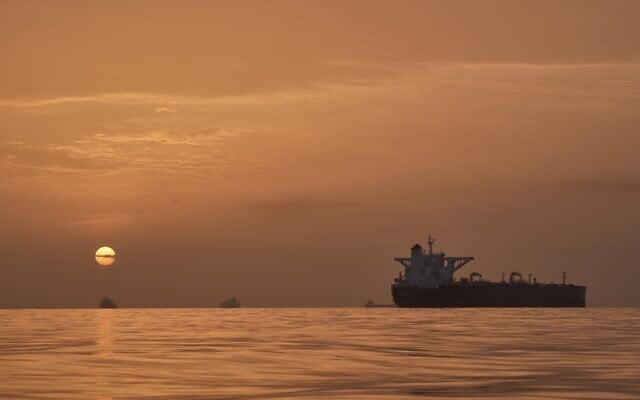
The sun rising behind tankers anchored in the Strait of Hormuz off the coast of Qeshm Island, Iran, April 18, 2026. (Asghar Besharati/AP).
During the 2026 military campaign against Iran, as American and Israeli forces struck Iranian military targets, the regime responded with one of its most potent survival tools: naval mines.
In March 2026, Iranian forces laid approximately a dozen influence mines in the Strait of Hormuz. American forces subsequently destroyed at least 16 Iranian minelaying vessels. Yet Iran still possesses hundreds to thousands of speedboats and submersibles, backed by an arsenal of 2,000 to 6,000 naval mines.
The mines currently in play represent a major evolution from the simple contact mines used during the 1980s Tanker War. The Islamic Revolutionary Guard Corps (IRGC) Navy is deploying Maham-3 anchored mines, each weighing 300 kilograms and operable in waters up to 100 meters deep. It has also laid Maham-7 bottom mines weighing 220 kilograms for shallower waters. Both types are sophisticated influence mines fitted with magnetic, acoustic, and pressure sensors.
Unlike older contact mines that required direct impact, these detonate when a target comes within range, without physical contact. This makes them far more resistant to traditional minesweeping methods.
Delivery is simple and hard to attribute. Swarms of small boats can lay two or three mines per sortie, supported by frogmen, helicopters, and pre-positioned coastal assets. The IRGC Navy has constructed its anti-access/area-denial doctrine around precisely this combination of low-cost, dispersed platforms reinforced by coastal missiles and drones.
The Strait of Hormuz remains the world’s most critical energy chokepoint. At its narrowest, it is only 21 miles wide. Yet it carries 20.9 million barrels of oil and petroleum products daily — roughly 20 percent of global petroleum liquids consumption and one-quarter of all seaborne oil trade.
Before the current conflict, more than 30,000 vessels transited the strait each year. Now, over 20,000 seafarers are stranded there. Saudi Arabia sends 37 percent of its crude and condensate exports through the passage, while China receives 37.7 percent of the total volume.
The economic impact has been immediate and severe. Brent crude prices have surged past $100 per barrel in the opening weeks. Tanker insurance rates have spiked, and commercial traffic has plummeted. A relatively small number of mines have created effects that the U.S. naval blockade is struggling to neutralize while attempting to preserve Iranian deniability.
Patently, Tehran is not trying to close the Strait completely. Instead, it has manufactured persistent uncertainty, enabling selective passage that strengthens its naval-mine blackmail and supports the toll-system strategy it hopes to institutionalize permanently.
Vessels bound for China, however, have faced fewer disruptions. Tehran continues limited oil exports of roughly 1.7 million barrels per day, many settled in Chinese yuan. This sustains the regime’s revenue while simultaneously challenging the dollar’s dominance in energy markets. Beijing has cushioned the impact through diversified suppliers and strategic reserves. Joint naval drills with Russia and China further signal the emerging alignment.
For the United States, the operational challenge is formidable. Clearing mines in contested waters under the threat of shore-based fire is slow and hazardous. Many traditional U.S. Navy minesweepers have been decommissioned in recent years, leaving the service more reliant on unmanned systems whose real-world combat effectiveness remains unproven. Although the Pentagon denies it, credible assessments suggest that complete clearance of the Strait could take up to six months.
The 2026 Hormuz mine campaign underscores a fundamental asymmetry in modern naval warfare: advanced influence mines are relatively inexpensive, yet they threaten trillions of dollars in annual global energy trade. They enable a weaker naval power to inflict disproportionate costs on stronger adversaries and the wider world economy. By mastering this capability, Iran is exposing vulnerabilities in American power projection and underscoring the enduring strategic importance of maritime chokepoints in great-power competition.
The mines remain in the water. Neutralizing them is more than a tactical counter-mine problem. It has become a critical test of American and allied resolve to secure the vital sea lanes that underpin global energy security.
Related Topics
Related Posts