Iran’s Regime Offers No Stability – Just Chaos and Death
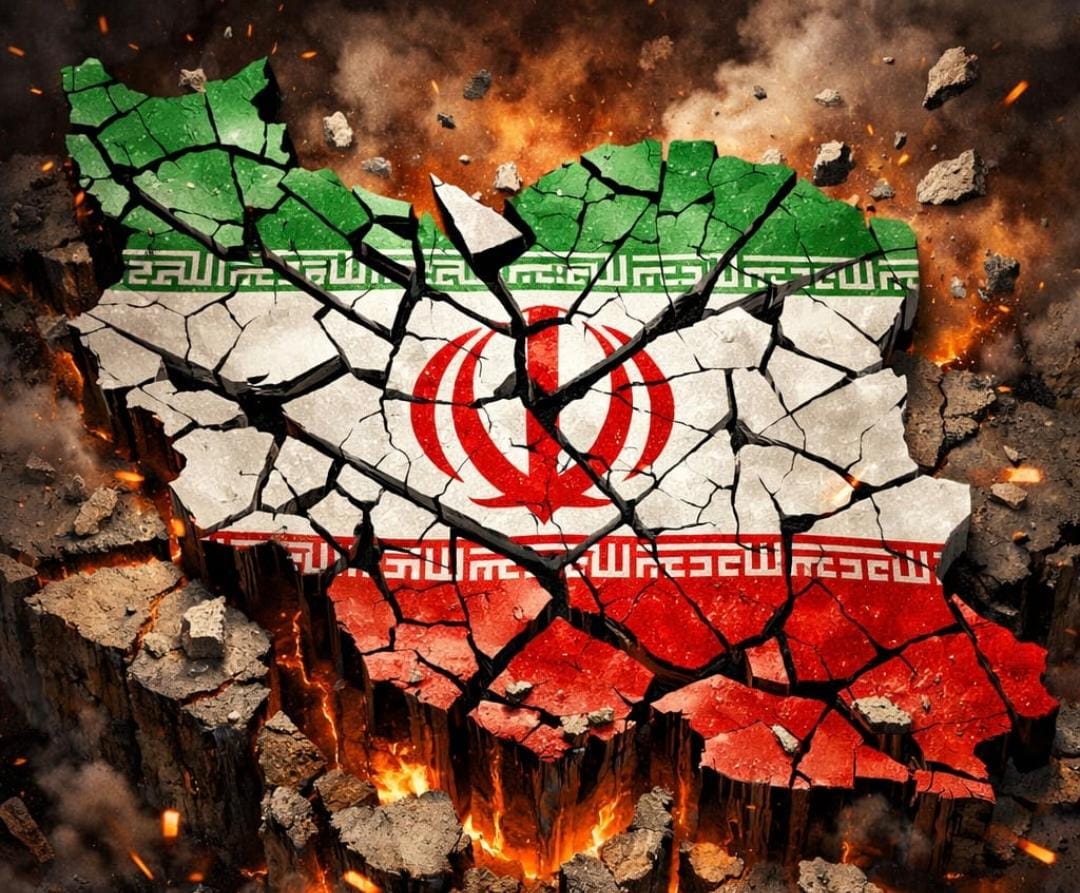
Fears of another Iraq or Libya fiasco are holding back tougher action against Iran’s Mullah regime. But appeasement won’t deliver stability, it will only prolong and exacerbate the coming collapse of the regime. Previously untranslated archival speeches of Ali Khamenei reveal what the dictator is really afraid of — and why his regime is already losing control.
To understand the downward spiral the regime is in, it is vital to consider the historical and demographic context in which it has to operate. Today’s Iran is not an ethno-state of Persians. As academics have made clear, Iran is “unrivalled in terms of cultural diversity” and the Persian language may well be “the mother tongue of less than half of its citizens”. The prevalence of mixed marriages makes it a fool’s errand to put exact percentages on Iran’s ethno-linguistic makeup, but one regime official who tried to do so in 2011 ended up estimating that roughly 40% of the current Iranian population speak Turkic languages, such as Azerbaijani, Turkmen or Qashqai. Significant numbers of Iranians also speak other distinct minority languages such as Kurdish, Lori, Achomi, Gilaki, Mazandarani, Talysh, Tati, Assyrian and Armenian.
In the early, most zealous years of the Mullah regime, the clerics believed they could plaster over these ethno-cultural diversities by creating a single Shia-Islamist identity that would supplant all else. The war with Saddam’s Sunni-dominated Iraq gave them a convenient sectarian backdrop for this project. Among those quick to embrace this new form of identity were many people from non-Persian, but religiously Shia, ethnic groups that had been cruelly repressed under the previous Pahlavi dictatorship, especially Iranian-Azerbaijanis. In the name of secular Persian nationalism, Pahlavi’s officials had sought to eradicate the Azerbaijani language, and other non-Persian tongues. Such relentless Persian chauvinism was unprecedented in historically multi-lingual Iran, and had in fact been developed in 1920s Berlin by exiled Iranian writers who were “deeply influenced by interwar Germany’s intellectual and political milieu”. Scholars have documented how these policies inadvertently “enabled the use of Shiʿism as a surrogate ideology of difference”.
As a result, Iranian-Azerbaijanis are strongly represented within the power centres of the Shia-Islamist regime today. Javad Khamenei, the father of the current tyrant Ali Khamenei, was an ethnically Azerbaijani imam who originally came from the village of Khamaneh near Lake Urmia — in the heart of Iranian Azerbaijan. Ironically, Khamenei’s strongest rival within the power structure of the regime, the now-detained reformist leader Dr. Mir-Hussein Mousavi, hails from exactly the same village, and is of course also Iranian-Azerbaijani by heritage. The regime’s puppet president, Masoud Pezeshkian, an ultra-religious medical doctor, was born to an Iranian-Azerbaijani father and an Iranian-Kurdish mother: Pezeshkian has stunned audiences with his flawless ability to recite the famous 1950s Azerbaijani language poem Heydar Babaya Salam, a dissident work written “during the heydays of Pahlavi racism” against Iranian-Azerbaijanis.
The regime’s internal coherence, and ultimately its continued existence, depends on its continued ability to impose a singular Shia-Islamist identity that supersedes real ethnic diversity. This ability, however, is in decline, and has been for decades.
There have been many waves of protest in Iran over the years. Almost all of them were brutally suppressed, with the regime doubling down on its hard-line policies instead of accommodating the public mood. There is one single exception—a protest movement that scared the regime so much it gave in to the demands of the street: the 2006 “Cartoon protests” in the regime’s heartlands in Iranian Azerbaijan.
Back then, a Persian-language newspaper in Tehran had published a crude cartoon that suggested that while human beings speak Persian, cockroaches speak Azerbaijani. Hundreds of thousands of Iranian-Azerbaijanis, including the children of regime loyalists, unleashed their violent fury about this offensive drawing on the streets. Dumbstruck, the regime arrested the cartoonist and later forced him into permanent exile abroad. The panicked regime even shut down the newspaper too. The Cartoon Crisis marked a turning point for the regime: despite a quarter of a century of Shia-Islamist rule, the regime’s vision of identity had not managed to overcome primal ethnic loyalties. In fact, theocratic rule appears to have turned people away from sincere religion.
This triggered the regime’s deepest, pre-existing anxieties. Even though he has ruled Iran more absolutely and more harshly than any dictator of the past, there is one simple achievement that has always completely eluded Ali Khamenei: to be the most accomplished son of his Iranian-Azerbaijani home village, Khameneh. This honour indisputably falls to an anti-religious writer, Mirza Fatali Akhundzadeh, the son of one of Khameneh’s mayors in the 19th century. Akhundzadeh’s importance is hard to overstate: “Many in Iran consider him the founder of Persian nationalism, while others primarily in Azerbaijan and Turkey portray him as one of the earliest Turkic nationalists.”
Akhundzadeh glorified pre-Islamic societies, including Ancient Persia. He called on Iranians to “wake up from their slumber and dethrone” Islamic rulers, a demand that still eerily resonates with protesters in Tehran today. In his time, Akhundzadeh forsook the deeply-religious Persian realm, serving the rival Russian Empire instead: He worked for the Tsars as a linguist in the Caucasus territories that they had recently conquered from the Persian Empire, where the Azerbaijani language is also spoken (among them, the areas that are now the actual, independent Republic of Azerbaijan, as distinct from Iranian Azerbaijan).
While in Caucasia, Akhundzadeh quite unexpectedly became one of the intellectual fathers of modern Turkic identity: He proposed swapping the Arabic script for Latin lettering —a reform later adopted by Atatürk in Turkey as well as leaders across the Turkic-speaking Central Asian and Caucasian regions. Akhundzadeh’s ideas have endured through time among both Persian and Turkic peoples, while Khamenei’s artificial Shia-Islamist vision is constantly teetering on the brink of collapse. More than any sanctions or protests, this is deeply humiliating to Ali Khamenei, striking at his personal honour.
“This Akhundzadeh was from Khameneh. I have heard many things about him from old Khāmeneh residents and from some of our own relatives,” Ali Khamenei lamented in a speech in the 1990s, which has never been translated to English before. A “concert”, he complained, had once been held in the village of Khameneh, in honour of the memory of Akhundzadeh. Unnamed intellectuals, Khamenei exclaimed, “glorify Mirza Fatali Akhundzadeh as if they were glorifying a prophet”. All this bizarre ranting by Khamenei only goes to show how threatened the dictator always felt, even personally, by the ethno-secular realities Akhundzadeh represented. The 2006 Cartoon Crisis was when those ancestral fears finally caught up with Khamenei – and he never recovered, mentally.
Since 2006, the ailing regime appears to have given up any hope of succeeding in its project of enforcing a unifying, supra-ethnic Shia-Islamist identity. Incapable of formulating an alternative, regime-sustaining vision of identity, Khamenei instead deployed blunt, mindless and often-counterproductive mass repression.
In 2009, a clearly panicked Khamenei had Iran’s presidential elections rigged. The reformist Green Movement protests against that electoral fraud were crushed heavy-handedly. Since then, it has been clear to Iranians that the regime’s elections have been transformed into a scam, with the “results” decided by Ali Khamenei alone.
As a result, fewer and fewer Iranians have gone to vote. Elections are crucial for the regime as a tool for demonstratively enforcing consent, simulating legitimacy and mandating participation in the dictatorship.
The regime has responded to this existential problem with an ill-advised divide-and-rule gambit. Previously suppressed ethnic differences are now weaponised to mobilise voters to take part. Every candidate in Khamenei’s sham elections is loyal to the regime’s overarching goals, but the ethnicities of these candidates do vary—and are now prominently advertised. The implication: If you do not vote in the elections, other ethnic groups will, electing ‘their guys’ instead and gaining increased control over state resources.
It started small: in 2019, the Iranian-Azerbaijani mayor of Urmia, a multi-ethnic city in north-western Iran, spoke in the Azerbaijani language at a city council meeting. When politely asked by a Kurdish city councillor to switch to Persian so that everyone in the room could understand, the mayor point-blank refused. Where such an incident might once have been swept under the carpet, it was now prominently reported in the media, and the mayor was not immediately sacked. Unsurprisingly, local Kurds, who had often ignored the regime’s elections, were suddenly motivated to take part. After more recent elections in the Urmia region, a Kurdish media outlet reported that the majority of the newly elected politicians “now represent Kurdish interests, marking a significant political shift and bringing joy to the Kurdish community.”
This is not just a local trend, but a paradigm shift. As the regime fails to deliver basic necessities such as water, electricity and food, these ethno-electoral hunger games have become highly effective. During the 2024 sham presidential election, some Iranian-Azerbaijani supporters of Masoud Pezeshkian were allowed to perform the ‘Grey Wolf’ salute at Pezeshkian’s rallies. This salute is a pan-Turanist gesture that associated with far-right circles in Turkey. Until 2024, such saluting by audience members typically resulted in events being halted and confrontations ensuing. Then, red lines were blurred to mobilise voters.
Khamenei is currently facing the largest popular uprising against his rule. The exiled “Crown Prince” Reza Pahlavi has emerged as a figurehead for these protests, inspiring protesters from afar with beautifully-crafted social media speeches. The “Crown Prince” has found an enthusiastic and impressionable audience among many younger Iranians who have no personal memory of the former regime that his father or grandfather used to lead: Those born after 1979 now account for over 60% of the population. To undercut this rebellion, Khamenei is ready to cast aside any last taboos and guardrails that previously held his regime together – and not only in terms of overt brutality.
In recent weeks, some Iranian-Azerbaijani football fans have been chanting slogans saying “Azerbaijan is honourable, Pahlavi is dishonourable”. These slogans, and the emerging national consciousness of Iranian-Azerbaijanis that they reflect, have been widely celebrated by pan-Turanist and separatist opposition voices on social media. The Mullah regime didn’t react with typical repression: Instead elements of the regime decided to elevate this ethno-political slogan from the football stands to the hallowed halls of its so-called ‘parliament’, the Majlis. On the floor of the chamber, where the Azerbaijani language is otherwise almost never spoken, regime legislator Soedif Badri repeated the slogan, while adding in “Iran is honourable” as well. The Rubicon was forever crossed, regardless of Soedif Badri’s individual intentions.
The Mullah regime’s embrace of ethnic divide-and-rule strategies has opened a Pandora’s box of bitterness, hate and separatism. In multi-ethnic Urmia, the ground zero of these strategies, their uncontrollable consequences have already become apparent. Last year, a crowd at a Shia mourning ceremony, attended by leading regime officials, suddenly started brandishing sticks and shouting inflammatory pan-Turanist, anti-Kurdish chants. Reza Rahmani, the governor-general of Urmia Province, looked on helplessly; standing on the stage in front of Khamenei’s picture, but utterly unable to control the rabid mob assembled before him. Even if it won’t happen tomorrow, it is clear where this road can lead: first ethnic balkanisation, eventually state implosion, ultimately civil war and ethnic cleansing like in the former Yugoslavia, in Nagorno-Karabakh, or in Rwanda in the 1990s—countless dead, millions displaced, and long-lasting regional conflagration.
Ali Khamenei is no longer a rational dictator or negotiating partner. Archetypal dictators like Gaddafi or Saddam tend to place a violently uncompromising emphasis on the unity of their countries. Khamenei, on the contrary, is playing a reckless game, the consequences of which he cannot grasp, but which can tear Iran to shreds.
The non-interventionists who appease Khamenei’s regime fail to understand this. By keeping the old man in Tehran in power, they are not preventing a war. Rather, they are laying the foundations for a much bigger one later.