The views expressed herein are solely mine.
Iran’s Secret Brotherhood Cash Highway
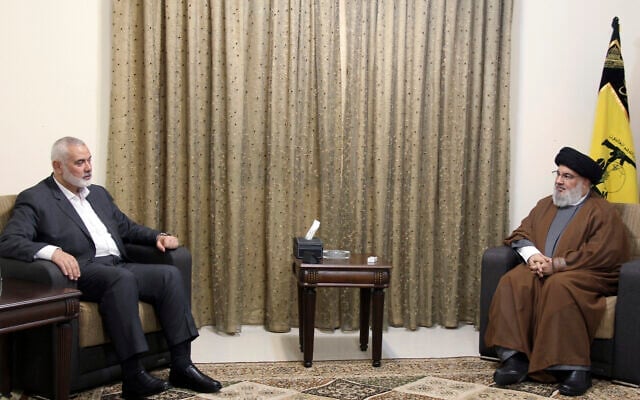
This picture released by the Hezbollah Media Relations Office, shows terror leader Sayyed Hassan Nasrallah, right, meeting with Ismail Haniyeh, the leader of the Palestinian terror group Hamas, in Beirut, Lebanon, June 29, 2021. (Hezbollah Media Relations Office, via AP )
Hamas and Hezbollah pretend to be sectarian opposites, but the truth is sharper: the Muslim Brotherhood decided that destroying Israel mattered more than Sunni purity, and Iran seized the opening—pouring money, weapons, covert networks, cyber tools, and political armor into a project the media still tiptoes around.
What almost nobody discusses is how Iran used Brotherhood-linked NGOs in Europe, Africa, and Southeast Asia as quiet financial roads to Gaza and Beirut—turning Sunni “charities” into logistical wings of a Shia revolution.
Hamas, born from the Brotherhood’s Gaza chapter, crossed the doctrinal Rubicon the moment Tehran offered rockets instead of slogans. Today the relationship is deeper: IRGC tech contractors train Hamas operatives in drone guidance, EW jamming, encrypted networks, and tunnel engineering—far from the cameras, often in Turkey, Lebanon, or the Caucasus.
Meanwhile, Iran’s cash pipeline—hundreds of millions for Hamas and roughly $700 million a year for Hezbollah—sits on top of a sanctions-dodging ecosystem that stretches from African gold smuggling to Malaysian crypto laundromats to front companies in Dubai’s free zones. The “Axis of Resistance” is not just ideological; it is a multinational financial machine.
Today, Hezbollah remains the franchise powerhouse, Hamas the Sunni storefront, and the Brotherhood the ideological distributor that sells this Shia-led enterprise to the wider Sunni world.
Brotherhood ideologues, from Doha to Istanbul, now preach that the Sunni–Shia divide is a Western invention while promoting Iran as the “authentic” vanguard against Israel. This is not theological evolution—it is psychological warfare designed to mass-market Tehran’s ambitions.
At the same time, Hamas leaders openly hail Iran as a revolutionary partner, and the IRGC brands Hamas as a pillar of its axis.
Thus, the real innovation is the Brotherhood’s role as the legitimizer: it turns Iran’s Shia militancy into a Sunni-acceptable export product.
Turkey and Qatar lock the architecture into place.
Under Erdoğan, Turkey is now Hamas’s safe logistics hub—offering residency, banking channels, intelligence access, and a springboard into Europe and the Caucasus. Ankara has also quietly allowed Hamas figures to build businesses that double as operational fronts.
Qatar, meanwhile, bankrolls the enterprise, hosts the political office, and shapes the global narrative through Brotherhood-aligned media and think tanks. Doha plays broker, mediator, financier, and spokesman all at once—while pretending neutrality.
Regionally, this axis plugs into other under-reported arenas: Iranian trainers embedded with Houthi units in Yemen; Brotherhood networks in Sudan facilitating weapons routes across the Red Sea; Hezbollah operatives advising militias in Syria and Iraq; Turkish intelligence using Gaza as leverage in Libya and the Eastern Mediterranean. These are not loose intersections—they are the outer rings of the same anti-Israel engine.
Put it all together and the pattern becomes unmistakable: Iran provides the hard power, Hezbollah the discipline, Hamas the Sunni brand, Turkey the diplomatic shield, Qatar the money and media, and the Muslim Brotherhood the ideological passport that convinces millions of Sunnis to back a Shia-led geopolitical project.
This is the Middle East’s least acknowledged reality: a Sunni Islamist movement sanctifying a Shia revolutionary state because both believe Israel must fall. Hence, the Brotherhood did not just normalize Iran—it globalized Iran.
Strip away the speeches and hashtags, and the rule is blunt: the Iran–Hamas–Hezbollah axis works because the Muslim Brotherhood made hating Israel the organizing principle of an entire geopolitical coalition.
Related Topics
Related Posts