Geopolitical Analyst: Bridging Somaliland & Israel to the world
Irro Puts Berbera on the Table and Washington Must Decide
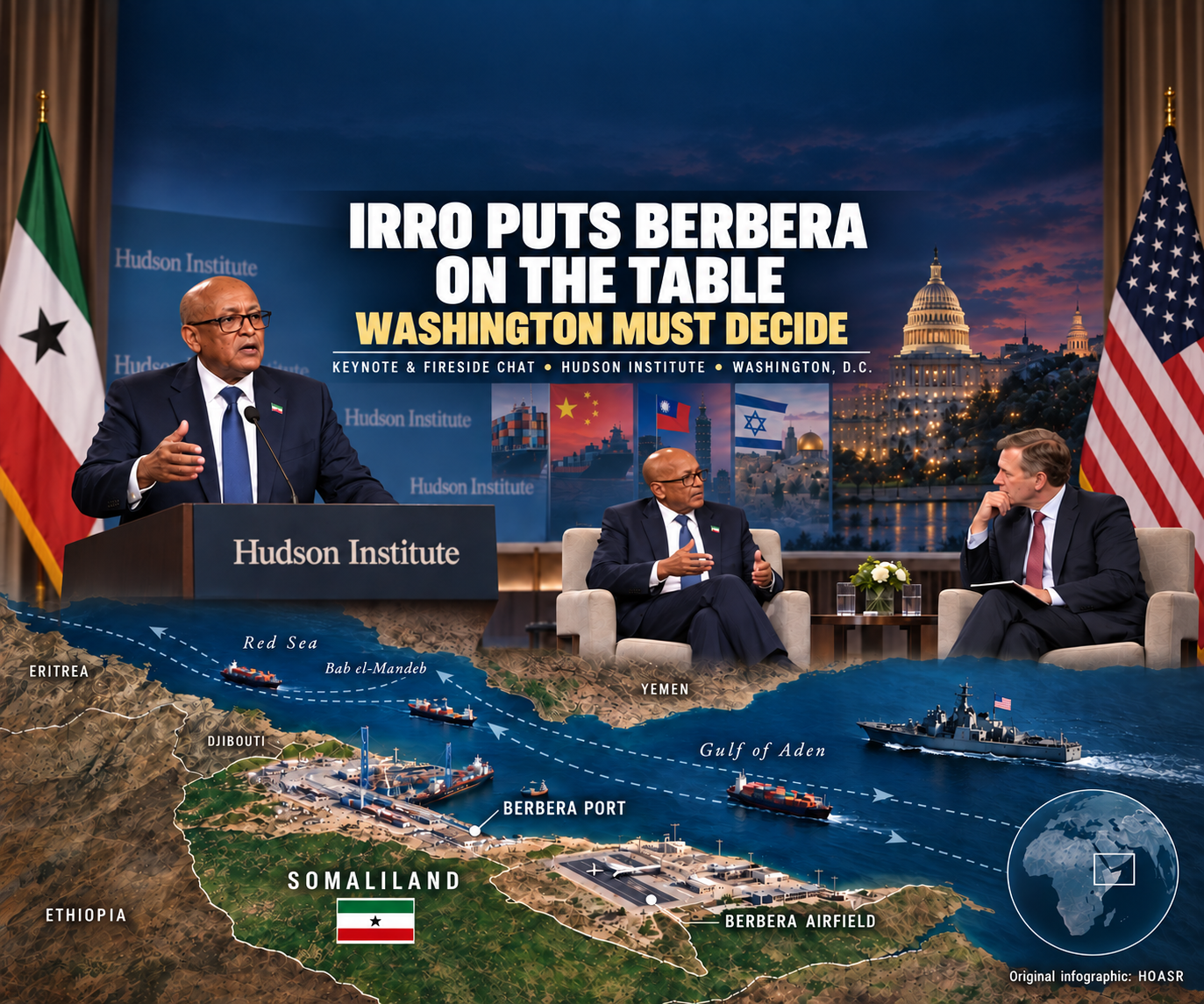
A HOASR geopolitical infographic illustrating President Abdirahman Mohamed Abdullahi Irro delivering his Hudson Institute keynote and participating in a fireside discussion in Washington. The artwork connects Berbera Port and airfield with Bab el-Mandeb, Gulf of Aden shipping lanes, maritime security and potential U.S.–Somaliland cooperation.
An Editorial Assessment of The Hudson Institute address and the strategic choices now facing Somaliland and the United States
At Hudson Institute, Somaliland’s president Abdirahman Mohamed Abdullahi Irro transformed recognition from a historical appeal into an offer of security, access and strategic partnership. The speech strengthened Somaliland’s case, but it also raised questions that Hargeisa must now answer with precision.
The keynote changed the argument
President Abdirahman Mohamed Abdullahi Irro arrived at the Hudson Institute carrying a familiar Somaliland argument: independence in 1960, an unratified union, dictatorship, genocide, restored sovereignty and 35 years of self-government.
History, however, was not the real center of his address. Irro’s central message was strategic. Somaliland is not simply asking the United States to correct a historical injustice. It is offering Washington a reliable position on one of the world’s most dangerous maritime corridors.
That change in emphasis matters. For years, Somaliland’s campaign concentrated on whether it deserved recognition. At Hudson, Irro asked what Somaliland could contribute to American security and prosperity if Washington stopped treating it as an administrative extension of Somalia.
His answer was direct: Berbera, maritime access, counterterrorism cooperation, critical resources, commercial opportunity and a dependable pro-Western partner facing Yemen across the Gulf of Aden. This was more than another recognition speech. It was an offer.
Somalia uses sovereignty to contain Somaliland
Irro began by recounting Somaliland’s independence on June 26, 1960, its voluntary union with the former Italian-administered Somalia and the destruction later inflicted by Siad Barre’s dictatorship.
He emphasized that Somaliland is not attempting to redraw Africa’s colonial borders. It is seeking to restore the borders within which it originally became independent. Somaliland’s case therefore differs from separatist movements seeking to create new states inside inherited colonial boundaries. It concerns two previously separate territories that entered a political union which never developed into an equitable or legally secure partnership.
Irro then directly challenged Washington’s One Somalia policy. The United States restored diplomatic relations with Mogadishu in 2013 and continued investing military, diplomatic and financial resources in the hope that Somalia’s central government would eventually extend authority across the country.
That project has not produced the expected result. Al-Shabaab remains entrenched. Somalia’s federal institutions remain divided. Relations between Mogadishu and several federal member states are deeply strained. National elections remain contested, indirect and repeatedly delayed.
Irro’s sharper argument was that Mogadishu does not merely fail to govern Somaliland. It uses the sovereignty granted to Somalia by the international system to obstruct Somaliland’s development. Aviation, international finance, development assistance, diplomatic agreements and access to multilateral institutions can all be restricted through Mogadishu, even though Somalia’s federal government has exercised no effective authority in Somaliland for more than three decades.
The international community rewards Somaliland’s stability rhetorically while maintaining legal arrangements that penalize it economically. It praises Somaliland’s elections while denying it the international instruments necessary to develop. Washington cannot indefinitely describe this contradiction as neutral policy.
Berbera entered the room
The strongest section of Irro’s keynote concerned geography. The Strait of Hormuz and Bab el-Mandeb are under simultaneous pressure. Houthi advances in Yemen have brought the movement closer to the southern entrance of the Red Sea. Commercial vessels continue to face attack, insurance costs have risen and maritime routes remain vulnerable to renewed disruption.
Somaliland sits directly across the Gulf of Aden. Berbera offers a modern deep-water port, a major airfield, a growing economic zone and access to an Ethiopian market exceeding 120 million people. Unlike Djibouti, Somaliland does not host competing American and Chinese military installations within a few kilometres of one another.
Irro told Washington that Berbera was available to the United States. He also described Somaliland as a democratic and pro-Western hub with no ambiguity about its strategic alignment. Those were not ceremonial statements. They amounted to a strategic proposition.
Somaliland is offering the United States an additional logistics and security option on the Gulf of Aden. It is not necessarily seeking to replace Djibouti. It is offering Washington the flexibility that dependence on one location cannot provide.
A formal American base is only one possibility. Cooperation could begin with maritime domain awareness, coast-guard training, logistics, emergency access, counterterrorism coordination, intelligence sharing or infrastructure investment. Recognition would make such cooperation easier, more accountable and more durable. Washington does not need to wait for recognition before testing many elements of the partnership.
The remark that requires clarification
During the fireside discussion, Irro said American companies had shown interest in Berbera and mining. He then suggested that a possible presence of American forces was coming nearer. That was the most potentially newsworthy statement of the event.
It may indicate that discussions have become more serious. It could also reflect general optimism, informal consultations or imprecise phrasing during an unscripted exchange. It does not prove that an agreement has been reached.
Neither the White House nor the Pentagon has announced a deployment, basing agreement or formal security arrangement with Somaliland. The Somaliland government should therefore clarify what Irro meant before opponents construct their own interpretation.
Mogadishu will present the remark as an unauthorized attempt to trade “Somali territory”. China will view an American presence near its Djibouti base through the lens of strategic competition. Turkiye, Qatar, Djibouti and other regional actors may interpret Berbera as a challenge to their influence.
Hargeisa should not retreat from security cooperation. It should define it carefully. Somaliland must decide what type of access it is prepared to offer, under what legal authority, for what duration and with what protections for its sovereignty and commercial interests. Strategic access should strengthen Somaliland’s position. It should not reduce Berbera to a bargaining chip.
Taiwan produced the strongest spontaneous answer
Irro was particularly effective when Joshua Meservey asked about Chinese pressure concerning Somaliland’s relations with Taiwan. He confirmed that Beijing had communicated its preference that Taiwan leave Hargeisa. Both the previous Somaliland administration and Irro’s government refused.
Irro then made a simple observation: China and Taiwan both maintain a diplomatic presence in Washington. There is no reason they could not similarly coexist in Hargeisa. The answer was humorous, confident and strategically intelligent.
Somaliland did not reject China because of hostility toward the Chinese people or an ideological desire for confrontation. It rejected Beijing’s demand that Hargeisa abandon an existing partner as the price of engagement.
Taiwan has supported Somaliland in health, education, agriculture, technology and institutional development. Somaliland’s refusal to exchange Taiwan for Chinese approval strengthens its claim to reliability.
Washington has spent years searching for African partners willing to withstand Chinese diplomatic and economic pressure. Somaliland has already demonstrated that willingness without receiving an American security guarantee, major development assistance or diplomatic recognition in return. That record should carry weight.
Israel changed the political psychology
Irro described Israel’s recognition as a strategic decision rather than a favor. That was the right framing. Israel did not recognize Somaliland simply because of historical sympathy. Somaliland occupies a valuable position across from Yemen, near Bab el-Mandeb and along maritime routes essential to Israeli and international trade.
Recognition also demonstrated that the diplomatic taboo surrounding Somaliland could be broken. For decades, many governments privately acknowledged Somaliland’s stability while claiming that no country wanted to move first. Israel removed that excuse.
The next government considering recognition would no longer be acting alone. It would be joining an emerging relationship between two democratic states positioned at opposite ends of the Red Sea.
Irro nevertheless gave a limited answer when asked why Israel recognized Somaliland when it did. He explained that Israel responded positively to a May 2025 appeal he sent to world leaders. Denmark was the only other country that formally answered, praising Somaliland’s achievements without offering recognition.
However, it did not fully explain the security, diplomatic and political calculations behind Israel’s timing. Somaliland should articulate that story more clearly. Israel’s decision is evidence that recognition can emerge from strategic convergence as well as legal argument.
A disciplined answer on the Houthis
Irro avoided exaggeration when discussing possible cooperation between the Houthis and Al-Shabaab. He acknowledged that Somaliland had received reports from partners suggesting connections between the two movements. He also said the allegations had not been independently proven.
Nevertheless, Somaliland should remain alert. Weapons smuggling, piracy, militant financing and the movement of personnel across the Gulf of Aden are legitimate security concerns. Hargeisa should not present every unconfirmed report as established intelligence.
Irro also clarified that Somaliland is not at war with the Houthis or the Yemeni people. It nevertheless recognizes the growing threat across the Gulf of Aden and is prepared to work with partners to protect shipping. That balance was appropriate.
Peace in the east remains a decisive test
Meservey raised one of the most difficult questions facing Somaliland: the territorial dispute in the east and Mogadishu’s attempt to present a new federal member state as an alternative authority.
Irro defended his administration’s peaceful approach. He pointed to militia demobilization, community reconciliation and dialogue with Puntland. He rejected invasion and promised to pursue political solutions.
Somaliland cannot ask Washington to recognize it as a stabilizing partner while appearing unwilling to resolve internal disputes through negotiation. Peaceful language must now be followed by an inclusive political strategy.
Recognition opponents will increasingly use Las Anod, Sool and parts of Sanaag to argue that Somaliland does not exercise uncontested authority within all its claimed borders. Hargeisa cannot answer that challenge through slogans alone. It requires local reconciliation, credible representation, humanitarian access, economic inclusion and patient negotiations with communities that feel politically marginalized.
Peace in the east is not separate from the recognition campaign. It is one of its decisive tests.
The argument needed greater precision
The prepared keynote was considerably stronger than several fireside answers. Irro characterized Arab opposition as almost entirely political because Somalia belongs to the Arab League. Politics is central, but the regional picture is more complicated.
Egypt views the Horn partly through its competition with Ethiopia. Turkiye has military, commercial and diplomatic interests in Somalia. Qatar has cultivated influence in Mogadishu. Saudi Arabia balances Red Sea security, Arab solidarity and its own regional relationships. The United Arab Emirates has developed a different position through its investment in Berbera.
These countries should not be treated as a single bloc. Somaliland’s diplomacy should identify their separate interests and create different approaches for each.
Irro also missed an opportunity when asked about Sudan. A Somaliland president is understandably cautious about offering solutions to a distant and complicated war. Nevertheless, Washington wants partners that can interpret the entire region, not only advocate for their own diplomatic objectives.
His answer concerning mineral resources was similarly light. Somaliland may possess oil, gas, lithium, gemstones and other valuable deposits. Investors require geological surveys, verified data, transparent licensing, contractual protections and enforceable regulations. Strategic optimism cannot substitute for bankable evidence.
Hudson was a platform rather than a policy decision
The Hudson event did not produce American recognition. No White House, State Department, Pentagon or AFRICOM announcement followed Irro’s appearance. That does not mean the event failed.
Hudson placed Somaliland before an influential policy audience as a potential strategic partner. The discussion connected Irro with security specialists, investors, former officials and advocates capable of carrying Somaliland’s case into Congress and the administration.
That is how Washington policy often develops. Arguments move from specialist institutions into congressional offices, government reviews, legislative proposals and eventually executive decisions.
Visibility must now become institutional follow-through. Somaliland needs identifiable American partners. It needs congressional action, technical discussions on Berbera, investment missions, security working groups and a clearer explanation of what Washington would gain from formal relations.
A successful speech can open doors. It cannot replace the work required after those doors open.
The map moved while policy remains unchanged
Irro’s achievement at Hudson was to reposition Somaliland’s case. He did not abandon history, legality or democratic legitimacy. He placed them inside a wider strategic argument.
Somaliland offers a secure coastline across from Yemen. It offers Berbera without Chinese military competition. It offers access to Ethiopia and the wider African interior. It offers cooperation with Taiwan, Israel, the United Arab Emirates and the United States. It offers a population that has maintained peace and functioning institutions despite decades of diplomatic exclusion.
Washington must now decide whether it will continue investing in a Somalia-centered policy that has repeatedly failed to produce the promised democratic state or begin building formal relations with a partner that already exists.
Somaliland should not assume that geography alone will deliver recognition. Berbera creates leverage, but that leverage must be converted into agreements, investment and political support.
The Hudson speech moved Somaliland closer to that conversation. The next stage will determine whether Washington heard an impressive argument or received an offer it is finally prepared to accept.
Selected sources
Related Topics
Related Posts