Geopolitical Analyst: Bridging Somaliland & Israel to the world
Cairo Drew the Line in El Alamein and President Irro Chose Ethiopia
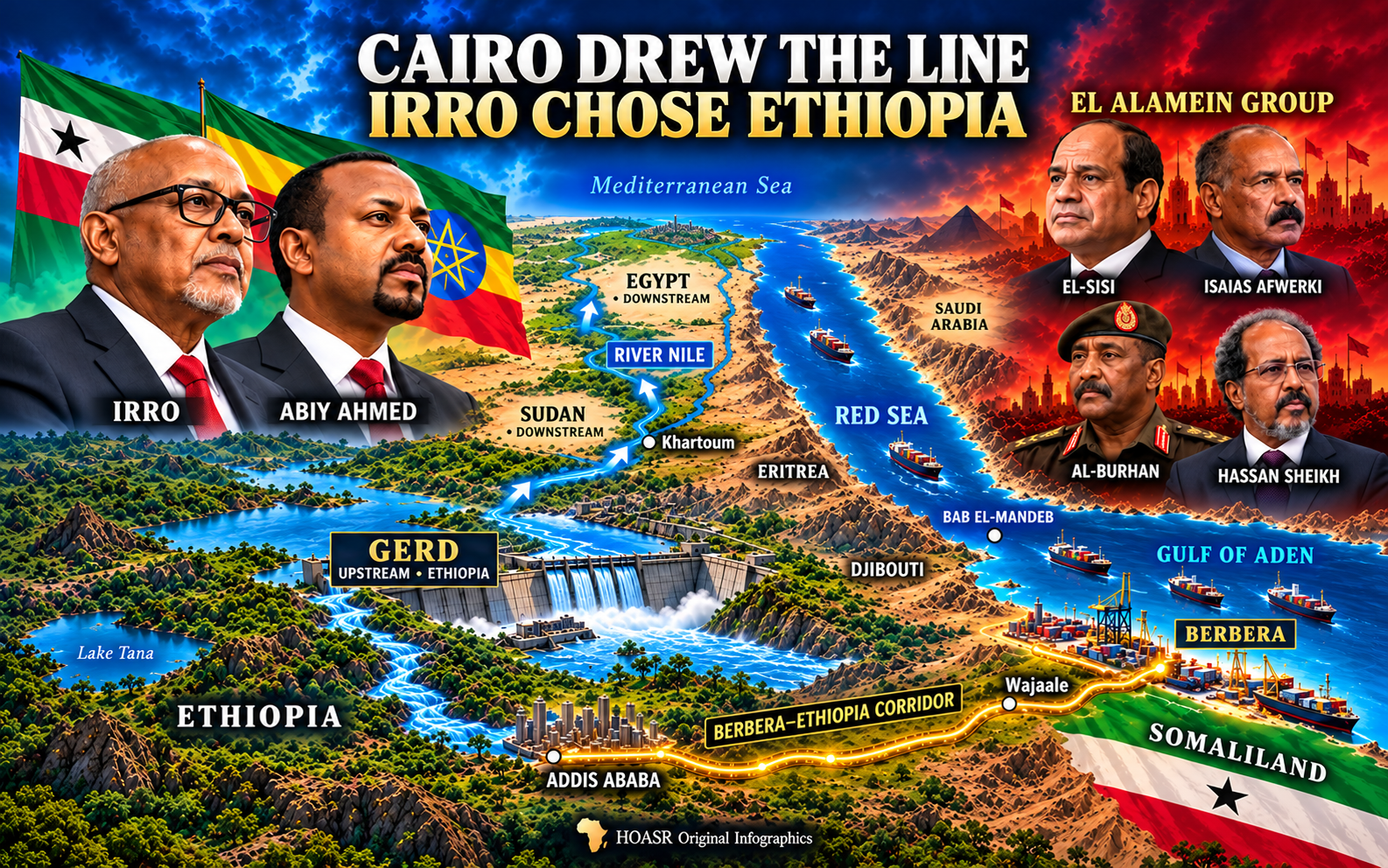
Shared regional pressure gives Somaliland–Ethiopia cooperation greater strategic weight, connecting Nile politics with maritime access through Berbera. Credit: HOASR Original Infographics.
A presidential pledge and defense talks suggest that shared pressure is drawing Somaliland and Ethiopia closer and giving the Berbera bargain new strategic weight
The El Alamein declaration may be producing the partnership its sponsors hoped to constrain. President Abdirahman Mohamed Abdullahi Irro’s defence of Ethiopia, delivered as Somaliland and Ethiopian officials maintained diplomatic and military contacts, points toward a relationship acquiring greater political purpose. Hargeisa is placing Ethiopia’s security beside its own sovereignty in the regional argument.
The two neighbors are beginning to tie their interests together more tightly, even though a new treaty remains unannounced.
The sequence is revealing. Egypt, Eritrea, Sudan and Somalia issued their declaration on 4 October; Somaliland’s army chief met Ethiopian representatives in Hargeisa in talks reported on 13–14 October; Irro publicly defended Ethiopia on 15 October. The military engagement occurred before Irro’s homecoming speech upon from an extended working visit to Washington and New York.
Read together, these developments suggest an emerging alignment across several channels, with the presidency supplying a political message in a televised address to Somalilanders and the world that the security relationship can carry into practice.
El Alamein put two disputes into one room
The official Egyptian text explicitly rejects recognition of Somaliland, reserves Red Sea governance to coastal states and supports downstream Nile interests. It establishes a mechanism for continued coordination among the four governments. The declaration does not name Ethiopia or explicitly prohibit commercial port access. Its combination of positions nevertheless puts pressure on interests central to both Addis Ababa and Hargeisa, while presenting that pressure as a defence of sovereignty.
Those provisions create an obvious incentive for the two excluded partners to consult each other. Somaliland faces an organized effort to block the international acceptance it seeks. Ethiopia faces a regional framework that gives its coastal neighbours political authority over a maritime space it considers essential to its future. By gathering these concerns into one document, the four governments have made it easier for Hargeisa and Addis Ababa to see their difficulties as connected.
There is a harder security background too. Reuters reported on 5 October, citing unnamed Egyptian officials, that the four leaders agreed to coordinate military and intelligence efforts if fighting reached Ethiopia’s borders with Eritrea, Sudan or Somalia. That is an attributed account of a contingency, not a published mutual-defence treaty. Ethiopia’s foreign ministry separately rejected pressure over the Nile and Red Sea. The environment in which Irro spoke was already becoming more confrontational.
Irro gave the security relationship a political voice
In his 15 October remarks, Irro expressed confidence in cooperation with Ethiopia and opposed interference threatening its stability and sovereignty. He also rejected the Egypt-led grouping’s actions against Somaliland’s statehood and challenged regional arrangements that exclude Hargeisa. Linking these positions in the same address massive. He was telling Addis Ababa that Somaliland understood the pressure it faced, while reminding the wider region that Hargeisa would make its own choices.
The practical channel was already visible. Somali-language coverage dated 13 October and Horn Diplomat’s 14 October report described army commander Brigadier General Nimcaan Yusuf Gaaxnuug meeting Ethiopian envoy Teshome and diplomatic and defence representatives at army headquarters.
The reported agenda covered defense cooperation, security coordination and regional developments. These were Ethiopia–Somaliland talks in Hargeisa; Somalia was a participant in the El Alamein summit. No published account of the Hargeisa meeting announced a new deployment or defence pact.
A meeting alone cannot establish how far cooperation has progressed. Longstanding neighbours have good reasons to discuss border security during a regional crisis. The stronger signal comes from the combination of military contact and a presidential statement that gives cooperation a broader political meaning.
If officials begin translating that meaning into regular consultations, clearer responsibilities and protection for cross-border trade, the coming weeks could become an important turning point.
Somalia is making Ethiopia weigh two relationships
Mogadishu’s position makes the emerging picture more consequential. According to Somalia’s own state news agency, President Hassan Sheikh Mohamud met Prime Minister Abiy Ahmed in Addis Ababa on 29 September for discussions including regional security, trade and diplomacy. Five days later, he joined the El Alamein summit. Somalia retains reasons to cooperate with Ethiopia while aligning diplomatically with governments whose positions Addis Ababa regards as threatening.
The security relationship is substantial enough to resist a simple description of two opposing camps. AUSSOM confirmed an Ethiopian troop rotation in September, with incoming personnel replacing departing forces in Beledweyne and Halgan. Political friction has therefore coexisted with operational cooperation. Addis Ababa must weigh the immediate value of that deployment against the longer-term value of a closer relationship with Somaliland.
Mogadishu increases the appeal of the Somaliland option when it asks Ethiopia for security cooperation while supporting a regional position Ethiopia reject. That does not mean an Ethiopian break up with Somalia is inevitable.
It does give Addis Ababa a reason to develop alternatives and Hargeisa a reason to demonstrate reliability. The more Ethiopia doubts the political return on accommodating Mogadishu, the stronger Somaliland’s negotiating position could become.
Berbera can give the partnership economic weight
Berbera makes this alignment more than a just a routine diplomatic response to hostile communiqués. DP World’s account of the economic zone’s opening describes a port and logistics development linked through the Berbera–Wajaale corridor to Ethiopia. The infrastructure gives the two sides something concrete around which to negotiate. A useful partnership can grow through cargo, customs and transport arrangements even while more difficult political questions remain under discussion.
Foreign Minister Abdirahman Dahir Adan Bakal reinforced that opening in an interview reported on 12 October. He said Somaliland was ready to discuss Ethiopian coastal access and greater use of Berbera, but announced neither a new agreement nor an implementation timetable. The offer matters because it gives diplomatic solidarity an economic destination. Ethiopia can pursue an additional maritime route through negotiation, while Somaliland can seek investment, revenue and a more dependable relationship.
The geography gives that offer a wider purpose. Berbera lies on the Gulf of Aden, connecting its hinterland to shipping routes approaching the Red Sea through Bab el-Mandeb.
A negotiated corridor could give Ethiopia an additional commercial outlet while giving Somaliland a greater stake in regional trade. It would also offer the surrounding governments a practical example of maritime cooperation built through consent.
That is a more productive regional response than allowing every discussion of sea access to become a contest over territory.
The negotiations would need to separate several decisions: commercial port use, transit arrangements, any proposed naval access and diplomatic recognition. Each carries different costs and expectations.
Hargeisa should seek clear reciprocal commitments, public accountability and protection for local interests, rather than assume that every commercial concession will produce a political return. Addis Ababa, in turn, needs arrangements that businesses and governments can rely upon after the immediate crisis passes.
Recognition remains the test of reciprocity
The most important evidence against assuming a completed strategic bargain appeared on 16 October. Accounts of an i24NEWS interview with Ethiopia’s ambassador to Israel, Tesfaye Yetayeh Anteneh, reported his concern that recognition could prompt Mogadishu to demand Ethiopian troop withdrawal and create opportunities for Al-Shabaab. His warning exposes a real constraint on Ethiopian decision-making. It also shows why friendly meetings cannot yet be read as a promise that recognition is imminent.
Somaliland’s ambassador to Israel, Mohamed Hagi, challenged that assessment, arguing that recognition would strengthen Ethiopia’s strategic and security position. The disagreement identifies the decision Addis Ababa has to make. Maintaining its present arrangements in Somalia may reduce immediate risks, but postponing a clearer commitment to Somaliland carries costs of its own.
Hargeisa has reason to ask how long it should demonstrate strategic loyalty before receiving a corresponding political commitment.
The record of the earlier negotiations deserves equal care. Ethiopia’s January 2024 government statement described cooperation involving commercial maritime services and naval access, together with an assessment of Somaliland’s recognition aspirations.
The December 2024 Ankara Declaration later committed Ethiopia and Somalia to pursue commercial sea access under Somalia’s sovereign authority. Neither document should be reduced to a slogan: diplomatic commitments and competing expectations still have to be reconciled before a durable arrangement can emerge.
Ethiopia’s domestic crisis adds a further constraint. Associated Press reported on 16 October that the federal government had established a six-month caretaker administration for Tigray following renewed fighting.
A government managing conflict at home can value an additional partner while lacking the resources or political room to complete an ambitious agreement quickly. Shared pressure can therefore strengthen the motive for cooperation and weaken the capacity to deliver it at the same time.
Hargeisa should negotiate around commitments that can actually be implemented.
What could lie below the visible diplomacy
The tip-of-the-iceberg argument is strongest when treated as a hypothesis about institutions and incentives. A president’s statement, military consultations and a port offer could be the visible beginnings of a wider negotiation covering trade routes, security and political reciprocity.
They do not prove that a secret package has already been signed. The deeper possibility is that separate working relationships are beginning to acquire a common strategic direction.
A workable package could emerge through connected bilateral agreements. One could set commercial transit and customs arrangements; another could define security consultations and responsibilities for protecting the corridor.
A political agreement could record reciprocal commitments, including an agreed approach to recognition. This is a possible negotiating structure, rather than a description of documents already concluded. Its advantage would be to make each side’s obligations visible and give both governments specific measures of progress.
That direction would become measurable through regular joint consultations, named negotiating teams, funded corridor projects and published arrangements governing access. A coordinated announcement of reciprocal political commitments would carry considerably more weight than another photograph.
Any involvement by outside financiers or security partners would need its own evidence. DP World’s presence supplies commercial context; it does not establish a new military agreement involving the UAE, Israel or any other country.
There is also a plausible less dramatic explanation: the two sides could deepen practical cooperation while deferring the status question again. Shared pressure can bring governments together without resolving their bargaining differences.
To turn this moment into a durable partnership, Ethiopia would have to offer commitments Somaliland can trust, and Somaliland would have to define the benefits and limits of its cooperation. Mutual concern supplies an opening; negotiated reciprocity determines whether it lasts.
The Scoop Cairo may be helping to tie the knot
The developing story is the possible convergence of political solidarity, military consultation and economic opportunity. El Alamein has made that convergence easier to understand by placing Somaliland’s recognition struggle beside disputes affecting Ethiopia’s regional position.
Irro has answered with a public defence of the neighbouring country. His message gives Hargeisa’s diplomatic and security contacts greater significance than they would have carried in a quieter week.
For Somaliland, the opportunity is to turn support into an agreement that advances its own sovereignty and development. For Ethiopia, it is to secure a dependable additional maritime partnership through consent and clear obligations.
Neither benefit from another cycle of grand announcements followed by indefinite ambiguity. A closer relationship should also leave room for dialogue with other neighbours, rather than make Somaliland a participant in wars it has no interest in joining.
Cairo and its partners have made their objections clear. They may now discover that coordinated pressure gives the governments they seek to constrain a stronger reason to coordinate in return. The knot between Ethiopia and Somaliland could be tightening. Whether it holds will depend on what Addis Ababa is prepared to commit, and what Hargeisa insists on receiving before it commits further.
Related Topics
Related Posts