
Psychologist and advocate against Anti-Semitism
Featured Post
Is it safe to be openly Jewish in Europe?
I knew I wouldn't heed the advice to hide my Star of David when traveling through Europe. Within 24 hours, I felt differently
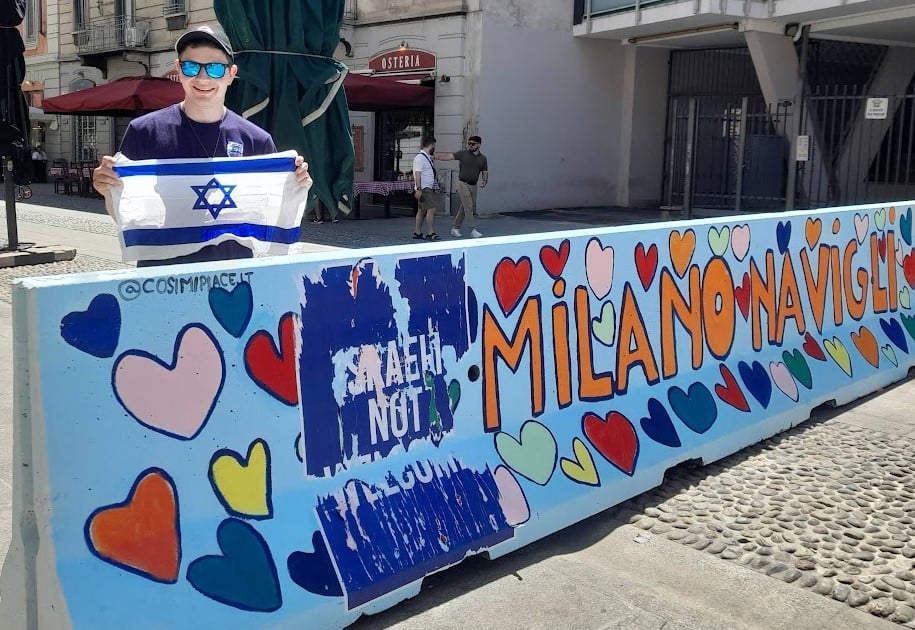
My adult son holding Israeli flag above 'Israelis Not Welcome' sign in Milan. (courtesy)
Like many Jewish people, I wear a Star of David. Living in the UK, it has rarely caused a problem, despite the much discussed rise in antisemitism here. But I have been to continental Europe several times since October 7th and during my most recent trip, for the first time, I began to question whether it is still safe to sport a Jewish symbol around my neck.
My apprehension began before I had even set foot on the plane. Heading to Barcelona, a fellow non-Jewish Catalonian passenger expressed concern on seeing my jewelry. “You might want to hide that in Barcelona,” she cautioned. I simply smiled, having no intention at that point to ever hide my Jewish identity.
‘Kill the Jews’
Within 24 hours I began to feel differently. I had been verbally abused twice, by people shouting “Free Palestine” at me, simply because I was openly Jewish. I saw stickers and graffiti far worse than what I see in the UK; “Death to the IOF” (some anti-Israel haters refer to the IDF as the Israel Offence Force) and even “Death to the Jews” were not uncommon sights. We visited the remnants of an ancient synagogue in the old Jewish Quarter or “Call” – a neighborhood that has long been Judenfrei, following centuries of persecution and the Spanish Inquisition. Yet perched above the museum, on the balcony of a private apartment, was a Palestinian flag. This was not a coincidence, as confirmed by the museum staff.
Lest you doubt that the flag was a deliberate provocation, our visit to the ruins of another synagogue, this time in Girona, revealed a similar spectacle; the flag was next door rather than on top, but the message was clear. And, if anyone was slow on the uptake with the messaging and needed it spelt out, they only had to glance through the visitor book inside the museum. Amongst the messages of support from visitors from across the globe, were various disturbing and threatening messages for the Jews – including the shocking demand to “Kill the Jews.”
Remember, this was in a place where the desire to eliminate all the Jews had actually been fully realized centuries earlier, as depicted in the museum.
‘Israelis Not Welcome’
This juxtaposition of threats to Jews today with memorials to them in the past continued elsewhere in Europe. In Milan, I visited one of the most meaningful memorials to the Holocaust I have experienced: an actual underground cattle train that transported over 600 Italian Jews to the camps of Auschwitz and to their deaths. Incidentally, this Holocaust museum was the only place I visited in Milan that was heavily guarded; I counted a total of eight armed soldiers and two army trucks. Even the famous Duomo Cathedral, one of Milan’s most popular attractions, only merited a few police officers in the vicinity. The fact that a museum to dead Jews needed such protection should have been a warning to me of what was to come later.
What was to come later was a scary encounter in the trendy Navigli canal neighborhood where a sign proclaiming “Israelis Not Welcome” had been stuck to the entrance way. Attempts had been made to erase it, but the message was still clear. This seemed to me to be the perfect place to pull out my emergency Israeli flag (doesn’t everyone carry one?!) and get a quick, defiant, snap of it above the offending sign.
As soon as we held up the flag, we started attracting attention in this otherwise peaceful, café lined street. First one, then two men began to stare and whisper to each other. We hurried in our task, then began to move away, only to be approached by one of the men gesturing towards my flag. I turned away quickly, trying to pocket the flag, but he suddenly made a lunge for it. A brief scuffle ensued but I, and the flag, won.
Our victory was brief though; feeling scared and uneasy, we abandoned our afternoon out and left. It turns out that the Milanese were quite serious when they said that Israelis (aka Jews) were not welcome.
Closing the roads for Jews in Athens
These are not the only European cities that have made me feel vulnerable being openly Jewish. Last year I enjoyed work trips as keynote speaker about one of my specialist areas, trauma, to Jewish conferences in Rome and Athens. The security detail a bunch of Jewish attendees required was unreal. As an example, in Athens, we had planned to walk as a group about five minutes down the road to our evening dinner venue. At the last minute, it was deemed far too unsafe to have a group of 100 Jews wandering so blatantly in public, so two coaches were arranged. If that weren’t crazy enough, our coaches had police vehicle escorts in front and behind, with motorcycles riding alongside us. And, if THAT weren’t crazy enough, they also closed all the roads to allow our safe passage.
At the time, we felt such security was a little excessive, but a few weeks later, it made more sense: an Israeli-owned hotel, like the one we had stayed at, was stormed by a raging anti-Israel mob. The security services of Athens knew what they were doing when they closed the roads for us.
Whilst Rome felt safer, that was because of the constant, heavily armed police presence in the Jewish ghetto. Since the tragic terror attack at the Great Synagogue in 1982 (in which a toddler was murdered and many others injured), Jewish sites are well-guarded. In fact, if you stumble across an unusual presence of armed guards in Europe, it is usually a good sign that you are at a place of Jewish interest. In Copenhagen, for example, we were able to walk under the building that housed the seat of Parliament as tourists with no checks at all, but had to endure airport-style security to access the Jewish Museum nearby.
Like the Soviet Union under the KGB
The final experience I want to share is a surreal one that I still cannot believe happened in Europe in 2025. To protect those involved, I will not name the city or country this occurred in, and in fact, I think it’s best not to even give any indication of what type of establishment I was visiting. I’ll just say that I visited somewhere (could be a hotel, restaurant, coffee shop or boutique) in Europe that I had heard was Israeli- or Jewish-owned. Keen to counter the BDS movement, I wanted to support it, so I innocently asked the employee if it was true that the place was Israeli-owned. The employee vigorously denied this but then scribbled something on a piece of paper which they then handed to me. The note said, “Yes it is.”
I immediately understood that this had to be a secret for the security of those involved, but it felt like I had stepped into 1980s USSR where refuseniks gave coded messages to other Jews or visitors to foil the KGB.
The scourge of antisemitism that I witnessed and that others too are experiencing (e.g., the Israeli ship that could not disembark in Greece because of anti-Israel protests, or the French children forced off a Vueling plane allegedly for singing Hebrew songs) is all the more disturbing when we consider that this is happening in places scarred by the Holocaust. It could be argued that we in the UK are a little more removed from the persecution of the Jews, with the last expulsion of the Jews being in the very distant past (1290), far removed from modern consciousness. But, for blatant antisemitism to occur within spitting distance of trains that took Jews to the ovens of Auschwitz makes me despair for the safety and security of Jews in Western Europe.
Despite all these experiences and my increasing concern, I never did hide my Star of David. Would you?
Related Topics