
Is Social Media Quietly Undermining the Sanctity of Marriage?
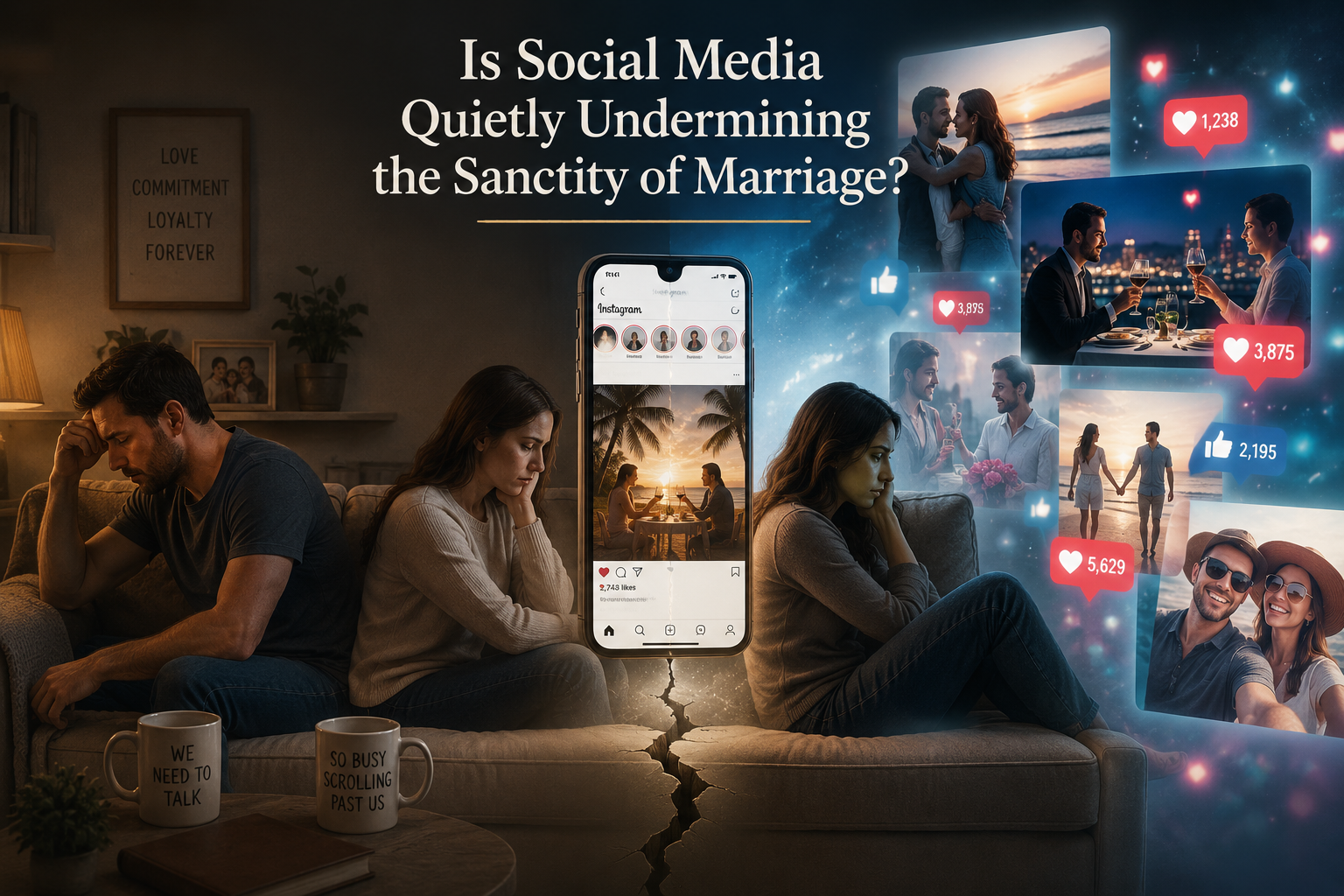
“Comparison is the thief of joy.” Theodore Roosevelt’s timeless observation may never have been more relevant than in the age of Instagram, TikTok, and Facebook.
Over the past two decades, social media has transformed every aspect of modern life. It has revolutionized communication, democratized information, connected families across continents, and given countless people a voice. Yet every technological revolution carries unintended consequences. Increasingly, researchers are asking whether the same platforms that connect us digitally may be quietly disconnecting us emotionally – particularly within marriage.
While no serious scholar would argue that social media is the sole cause of rising marital instability, it is becoming increasingly difficult to ignore the correlation between the rise of the smartphone generation and declining relationship satisfaction, increasing loneliness, and growing dissatisfaction with long-term commitment.
Perhaps nowhere is this more evident than in the subtle but relentless culture of comparison.
The Illusion of Perfect Marriages
Social media has become humanity’s greatest highlight reel. We rarely post photographs of difficult conversations, financial stress, parenting disagreements, sleepless nights, or months of emotional distance. Instead, we highlight anniversary dinners, tropical vacations, surprise gifts, romantic sunsets, and smiling family portraits.
The inevitable consequence is that millions of people unconsciously compare the unfiltered reality of their own marriage with the carefully curated version of everyone else’s.
The dangerous internal dialogue begins:
“Why doesn’t my husband look at me like that?”
“Why doesn’t my wife appreciate me like his does?”
“Everyone else seems happy. Why are we struggling?”
The irony is almost tragic. Two couples, each privately convinced that the other has discovered the secret to marital bliss, may both be quietly struggling behind closed doors.
Social comparison has always existed. Social media has simply placed it in our pockets twenty-four hours a day.
Disposable Culture Has Entered Our Relationships
Modern society has become astonishingly disposable. Phones are replaced every two years. Furniture is discarded rather than repaired. Clothing is purchased for a season. Entertainment is consumed in seconds before scrolling to something new.
Increasingly, relationships risk being viewed through the same lens. Instead of asking, “How do we repair this?” we are subtly conditioned to ask, “What else is available?”
Marriage was once understood as a covenant. Today, it is increasingly treated as a contract that can be terminated whenever expectations are no longer met. That cultural shift may be one of the most profound changes of the twenty-first century.
Unlimited Choice Can Make Commitment Harder
Psychologist Barry Schwartz famously described the “paradox of choice”: when options multiply, satisfaction often decreases rather than increases. Dating apps and social media have created the perception that there is always someone more attractive, wealthier, funnier, more attentive, or more compatible just one swipe away.
Whether those alternatives are real is beside the point. The perception itself can erode commitment.
A marriage cannot flourish if each disagreement is unconsciously measured against the fantasy that a better partner is waiting online. Commitment has always required saying “no” to countless alternatives. Endless digital choice makes that act of commitment psychologically more challenging.
Instant Gratification Meets Lifelong Commitment
Marriage is the ultimate delayed-gratification institution. Trust develops slowly. Forgiveness requires patience. Communication improves through repetition. Intimacy deepens over years.
Yet we now live in an environment where food arrives in minutes, movies stream instantly, purchases appear the next day, and validation comes in the form of immediate likes and comments.
The digital world trains the brain to expect rapid rewards. Healthy marriages often require exactly the opposite: perseverance through seasons when rewards are not immediate.
No algorithm can replace years of choosing each other.
The Cost of Unrealistic Expectations
Many marriages do not fail because two fundamentally incompatible people meet. Most fail because ordinary marital challenges are interpreted as evidence that something must be terribly wrong.
Every marriage experiences disappointment. Every spouse will occasionally feel misunderstood. Every family encounters stress.
When social media constantly whispers that everyone else has found effortless happiness, ordinary difficulties can begin to feel extraordinary. That distorted perspective may lead couples to underestimate what can be rebuilt through honest communication, humility, counseling, and sustained effort.
The countless number of insensitive idiots who have the need to post about their newfound freedom following divorce on social media or weigh in after some tone dead person announces their divorce online with the usual “you go girl” – like divorce is something to be celebrated – further cheapens the sanctity of marriage and minimizes the excruciating pain and far-reaching impact of divorce.
Divorce Is Sometimes Necessary, but it should be the exception to the rule
Clearly there are situations involving abuse, addiction, coercive control, or chronic betrayal where divorce is necessary. There are marriages that cannot – and should not – be preserved at all costs.
But having counselled many couples over the past twenty-five years, I would submit that most divorces deserve thoughtful reflection: marriages that might have been repairable had both spouses remained willing to seek help and do the challenging work of rebuilding trust and respect.
When Regret Arrives Quietly
Public discussion sadly focuses on the courage required to leave an unhappy marriage. Much less attention is given to those who later discover that freedom carries its own burdens.
A growing number of divorced individuals – primarily women – report that the relief they initially experienced eventually gave way to unexpected loneliness, fractured family traditions, reduced time with children, financial pressures, or the realization that dating in mid-life is more challenging than anticipated.
Others discover that many frustrations they believed were unique to their former spouse are, in fact, common to long-term relationships.
What divorce lawyers and pop culture seem to avoid is the harsh reality that in most cases divorce does not end pain but rather exchanges one set of challenges for another.
A Torah Perspective
Judaism has never romanticized marriage as effortless.
Our tradition recognizes that shalom bayis is among life’s greatest achievements precisely because it demands humility, sacrifice, patience, forgiveness, and constant growth.
The Mishnah teaches that one should judge others favorably. Perhaps nowhere is that teaching more relevant than when looking at another family’s carefully curated online life.
The smiling photograph tells us almost nothing. Behind every image is a real family carrying burdens invisible to the camera. The greatest antidote to social media’s distortion is to remember that no marriage is perfect.
Strong marriages are not those that never struggle. They are those in which two imperfect people repeatedly choose commitment over comparison, covenant over convenience, perseverance over instant gratification, and reality over illusion.
In an age obsessed with finding something better, the greatest act of courage is learning to build something lasting.
About the Author
Antony Gordon is a Fulbright Scholar and graduate of Harvard Law School and Harvard Business School. Antony’s TEDx Talk has surpassed one million views and was recognized as one of the decade’s most influential TED Talks. He is a USA Today and Wall Street Journal Best Selling Author and the host of the critically acclaimed podcast, The Antony Gordon Show, one of the verticals in Lighthouse-Edutainment a multi-media platform that he launched with the backing of The Yucaipa Companies after working as the Strategic Advisor for Jimmy Donaldson a/k/a MrBeast for several years.