Journalist | Documentary Filmmaker | Holocaust Educator
Is Social Media Shadow-Banning Holocaust Survivors?
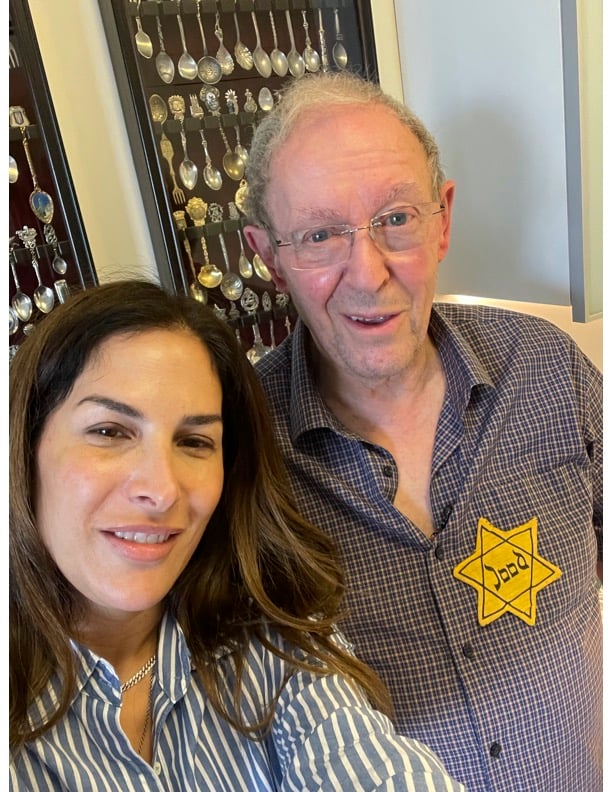
With Holocaust survivor Joseph Obsfeld in Israel in 2022, on the day I recorded his testimony.
Something has been bothering me for a while about the way Holocaust testimony travels on social media.
I will post a short Story of Lola, one of the survivors I have interviewed, telling what happened to her in her own words. Nothing graphic. Nothing recreated or sensationalized. Just her face, her voice and her testimony.
I check the views: perhaps 150.
Then I post something completely ordinary, my children on vacation, a beach, a moment from everyday life.
More than 1,000 views.
And I want to be very clear about the distinction: I am not talking about likes. I am talking about views.
Whether people liked one Story more than another is irrelevant. I am talking about whether they were given the opportunity to see it in the first place.
It happens with Joseph. With Hedy. With other survivors whose testimonies I share.
Sometimes the difference in reach is so striking that it is difficult not to wonder what happened between one Story and the next.
Was it a word the survivor used? An image? A reference to Auschwitz, a death march or a gas chamber? Did an automated system classify the testimony as violent, disturbing or “sensitive”?
I don’t know. And that is precisely what troubles me.
I have seen this pattern often enough that I have started testing it myself. A piece of testimony from Lola, Joseph or Hedy will barely move. The next Story, family, travel, ordinary life, suddenly reaches many times more people.
Maybe there is an innocent explanation for every instance. I cannot see inside an algorithm, and I cannot prove why one particular Story reached 150 people while another reached more than 1,000. But I know what I see.
And it raises a much larger question about what happens when algorithms become the invisible gatekeepers of historical memory.
Most people understand content moderation. A post violates a platform’s rules and is removed. Sometimes you receive a warning. Sometimes you can appeal.
But there is another phenomenon that many people may not know about, commonly called shadow banning. It is far more difficult to detect.
Your content remains online. You have not officially been banned. You may receive no notification, no warning and no explanation.You can still see your post. Almost nobody else does. That is what makes it so different from traditional moderation.
When something is removed, you know it has been removed. When its distribution is quietly reduced, you may never know that anything happened at all. And this is where Holocaust testimony collides with the logic of social media.
History is full of words algorithms may not like.
When I interview survivors, they don’t speak in sanitized language. They speak about ghettos. Deportations. Camps. Death marches. Gas chambers. Starvation. Murder. Children being separated from their parents.
These aren’t violent fantasies. They aren’t hate speech. They aren’t glorifying atrocities. They are eyewitness accounts of what hatred did. And yet anyone who spends enough time creating historical content for social media learns a bizarre new vocabulary.
You see letters replaced by asterisks. Numbers substituted for letters. Words deliberately misspelled. Certain terms avoided altogether. Creators do it because they fear that saying the wrong word will trigger an automated system and make their content disappear, or simply make it much less visible.
Think about the absurdity of that. A survivor has spent decades finding the strength to say exactly what happened. And now I am supposed to wonder whether I should change her words so an algorithm will allow people to hear them.
Sometimes platforms warn users that content “may be sensitive.”Of course it is sensitive. Joseph’s childhood under Nazi occupation was sensitive. Lola’s story is sensitive. Hedy’s memories are sensitive. History is sensitive.
The question is whether “sensitive” should mean “less visible.”
I understand the problem technology companies are trying to solve. Social media contains horrifying amounts of genuine hate, antisemitism, violent imagery, conspiracy theories and historical denial. I want platforms to fight it.
But here is the paradox.
In January 2025, the Claims Conference released its first eight-country Holocaust Knowledge and Awareness Index. One-third of American adults surveyed said they had encountered Holocaust denial or distortion on social media. Nearly half of Americans surveyed also said Holocaust distortion was common in the United States.
And this is not simply a matter of perception.
In 2022, UNESCO and the United Nations, working with the World Jewish Congress, published a study in which researchers examined nearly 4,000 pieces of Holocaust-related content across five major social media platforms. They found that 16.2 percent denied or distorted fundamental facts about the Holocaust. On Telegram, nearly half of the relevant public content examined contained denial or distortion.
So misinformation and distortion are finding audiences online at the very moment those of us sharing firsthand testimony are learning to spell certain words incorrectly in the hope that the truth will make it through an algorithm.
And now there is another problem.
In 2024, UNESCO warned that generative AI could not only spread false information about the Holocaust but fabricate testimony, alter historical records and produce convincing deepfake images and audio, material that young people may encounter on social media.
Think about the irony.
We are entering a world in which technology can manufacture a witness who never existed, while the voices of witnesses who actually lived this history may struggle simply to be seen.
Something is upside down. The answer is not less moderation. It is smarter moderation.
There is a difference between showing violence and documenting where violence led. There is a difference between promoting antisemitism and teaching its consequences. There is a difference between someone spreading historical denial and an elderly witness saying, simply: I was there.
Context is everything. And algorithms are notoriously bad at context.
This matters because social media is no longer just entertainment. For many young people, it is where they first encounter history. They may never open the memoir I wrote. They may never visit Auschwitz. They may never walk into a museum or memorial. But they will scroll.
And somewhere between a friend’s vacation, a beauty tutorial and a football clip, we have an opportunity to put Joseph in front of them. To let Lola speak. To let Hedy tell them what she remembers. That opportunity is too important to surrender.
Platforms should work more closely with historians, museums, and educational organizations to identify verified historical testimony. Give difficult material context. Use age-appropriate warnings when necessary. Link to authoritative information.Develop systems that can distinguish between atrocity documentation and atrocity promotion.
But please don’t quietly make history disappear. We spent decades racing against time to record the last witnesses. Now those witnesses are disappearing. Their voices increasingly have to travel without them, and much of that journey will happen through screens controlled by recommendation systems none of us can see.
The survivors already did the difficult part. They survived. They remembered. They spoke. They trusted us with what happened. We should not now have to disguise their words to make them acceptable to an algorithm.
And their testimony should not have to compete with my children’s vacation pictures simply for the right to be seen.
Related Topics
Related Posts