
Iran Analyst | Human Rights | Middle East Politics
Isaiah 14 and the Fear of Being Forgotten
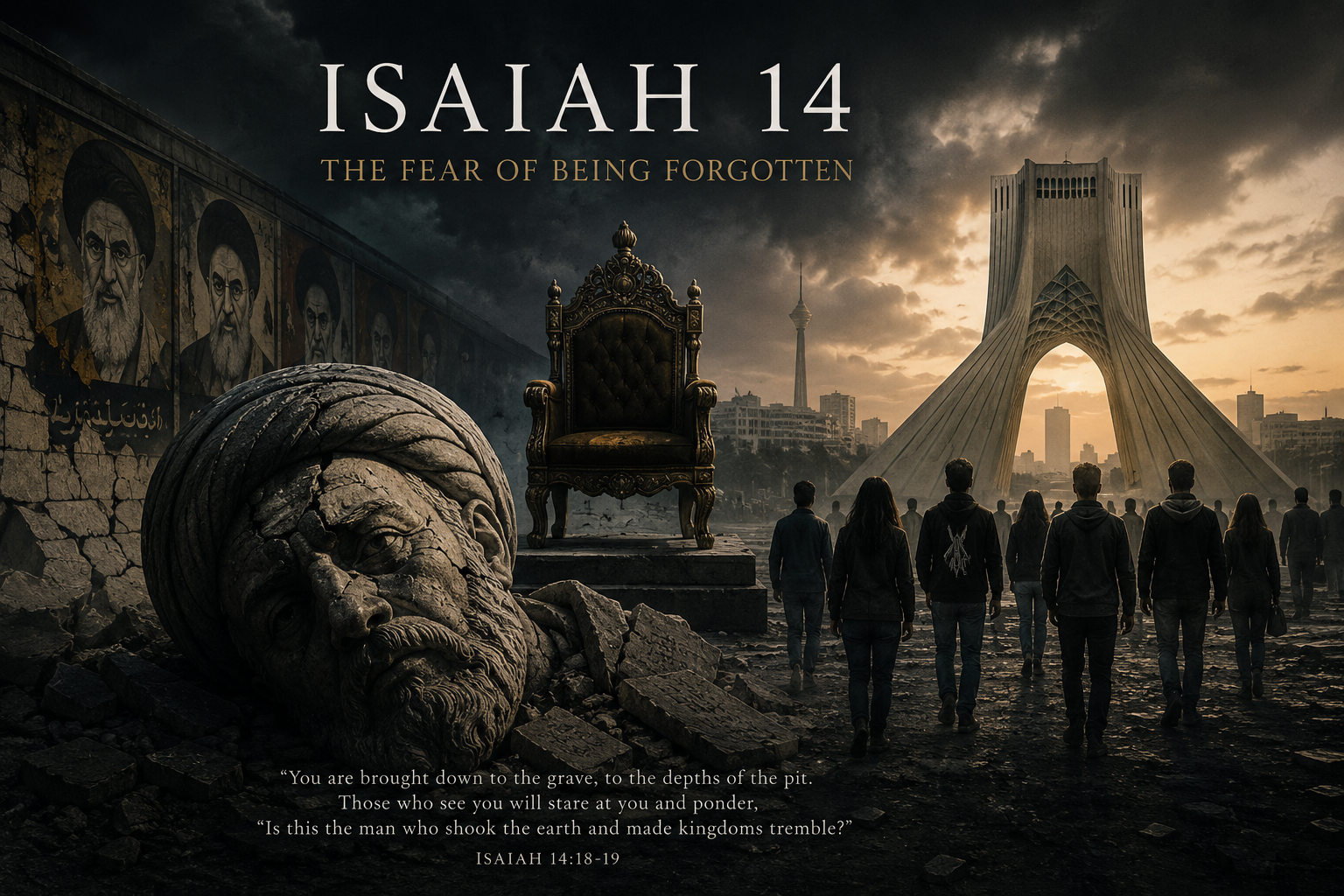
An AI-generated illustration inspired by Isaiah 14 and the tension between political permanence, memory, and historical change.
The Politics of Humiliation and Memory
Few passages in the Hebrew Bible describe political downfall with the same intensity as Isaiah 14. The chapter is remembered primarily for its imagery of collapse: a ruler once feared by nations is brought low, stripped not only of power but of dignity. Yet the most unsettling part of the text may not be the fall itself. It is what comes after.
Beginning in verse 18, the tone shifts from triumph to something colder and more enduring. Other kings, the text says, rest in honor within their tombs. But the fallen ruler is denied even that final recognition. He is cast away, abandoned in death, separated from memory and legitimacy alike. The humiliation is not merely political—it is historical.
The passage goes further still. In verses 20 and 21, the anxiety of the text extends beyond the ruler himself to the survival of his legacy. The destruction of power is presented as incomplete so long as the ruler’s name or ideological inheritance remains capable of returning. The fear is not only tyranny in the present, but its resurrection in the future.
Read today, Isaiah 14 feels unsettlingly modern.
Its language reflects a political truth that has outlived empires: authoritarian systems are rarely satisfied with control alone. They seek permanence. More than obedience, they desire continuity — the assurance that their worldview will survive them and that future generations will continue speaking in their name.
For this reason, authoritarian leaders become deeply preoccupied with legacy. Monuments, carefully managed narratives, orchestrated public mourning, and the symbolic language of resistance all serve the same purpose: to defeat time itself.
This is what gives Isaiah 14 its enduring force. The passage is not simply about one ancient ruler. It is about the psychology of power confronting mortality.
And throughout history, few things have frightened rulers more than the possibility of being forgotten.
Revolutionary Power and the Fear of Irrelevance
Throughout modern history, revolutionary regimes have shown a particular concern with permanence. Unlike traditional monarchies, which often rely on inherited legitimacy, ideological states depend on the continuous reproduction of belief.
This is why political mythology becomes central to such systems. Leaders are transformed into symbols. Their biographies become sacred narratives. Their speeches are repeated long after the political conditions that produced them have changed.
Since 1979, the Islamic Republic of Iran has increasingly defined itself through the language of revolution, martyrdom, resistance, and historical destiny. Political authority has repeatedly been framed not merely as governance, but as participation in a larger moral struggle.
Within such systems, leadership acquires symbolic weight far beyond ordinary politics. The leader becomes not simply an administrator of the state, but the guardian of ideological continuity.
This is where Isaiah 14 begins to feel uncomfortably relevant.
The passage understands something fundamental about ideological power: its deepest fear is not military defeat. It is historical irrelevance.
A regime can survive sanctions, isolation, and even war while still believing itself victorious if its narrative remains intact. But once belief begins to fracture — once slogans lose emotional force, once ritual becomes performance rather than conviction — the crisis becomes existential.
This anxiety becomes visible in the extraordinary effort authoritarian systems invest in controlling historical memory. School curricula, public ceremonies, religious symbolism, and carefully staged commemorations all become instruments in a struggle over permanence.
Yet history repeatedly demonstrates the fragility of these efforts.
The Soviet Union projected permanence. So did countless revolutionary movements that believed themselves destined to shape history indefinitely. But political mythology often ages faster than power expects.
The ruler in Isaiah 14 is not destroyed only physically. He is stripped of continuity. His fall becomes complete when the future no longer belongs to him.
The Architecture of Immortality
Authoritarian systems rarely rely on coercion alone. Fear may preserve power temporarily, but no state can govern indefinitely through force without eventually exhausting itself. For that reason, enduring ideological systems attempt something more ambitious: they seek to shape emotional reality.
This is why such states invest so heavily in symbolism.
Flags, murals, slogans, funerals, anniversaries, and public rituals are not secondary features of ideological power — they are central to it. They create an atmosphere in which the state attempts to present itself as inevitable, historical, even sacred.
In such environments, political leaders are gradually elevated beyond administrative authority. Their words are treated not merely as policy positions, but as moral guidance. Their images become permanent fixtures of public space.
The goal is not simply obedience.
It is emotional continuity.
The Islamic Republic has spent decades constructing precisely this kind of symbolic architecture. The language of martyrdom, sacrifice, and resistance permeates official discourse, particularly during periods of instability.
When economic crises deepen, public trust declines, or generational divisions intensify, ideological systems often respond not by reducing symbolic rhetoric, but by increasing it. Public ceremonies become more elaborate. Historical memory becomes more aggressively managed.
Because beneath the language of certainty lies a persistent fear: that belief itself may no longer be secure.
Isaiah 14 captures this anxiety with remarkable precision.
The ruler in the passage fears more than death. He fears removal from history. He fears becoming disconnected from continuity and from the illusion of permanence that power attempts to construct around itself.
In this sense, the humiliation described in the text is not merely personal. It is symbolic collapse.
Modern authoritarianism often depends on the assumption that political mythology can outlive political reality. But history suggests otherwise.
Sooner or later, every ideological system encounters the same problem: the generation that remembers the revolution is eventually replaced by one that only inherits its slogans.
And inherited slogans rarely carry the same emotional force as lived experience.
Iran’s Generational Divide and the Crisis of Belief
One of the most revealing features of modern Iran is the widening distance between official ideology and generational experience.
The generation that lived through the 1979 Revolution experienced the Islamic Republic as a historical rupture. For many, the revolution was tied to genuine political emotion: anti-monarchical sentiment, anti-imperial identity, religious idealism, or the belief that an entirely different political order was possible.
But younger generations inherited a very different reality.
They did not inherit the emotional momentum of revolution. They inherited its institutions.
Political systems rooted in revolutionary legitimacy often struggle once historical memory becomes secondhand. The slogans that once mobilized millions gradually lose emotional immediacy when repeated across decades without the historical conditions that originally gave them force.
What was once experienced as sacrifice can begin to feel like ritual.
What was once experienced as resistance can begin to feel performative.
And what was once presented as historical destiny can begin to resemble stagnation.
This transformation helps explain why ideological states invest so intensely in symbolic repetition. Public memory must constantly be reproduced because belief can no longer be assumed.
In Iran, this tension is increasingly visible.
The state continues to present itself through the language of existential struggle and revolutionary continuity, while many younger Iranians experience daily life through very different concerns: economic pressure, corruption, social restriction, isolation, and exhaustion with ideological absolutism.
This does not mean Iranian society is politically uniform. It is not. Nor does it mean that all forms of belief have disappeared. But it does suggest a growing fragmentation between official narrative and lived experience.
And this fragmentation creates a deeper form of political anxiety.
Authoritarian systems can often survive external pressure and even periods of unrest. What becomes far more difficult to survive is the gradual erosion of emotional legitimacy — the moment when the population no longer experiences the state’s symbolic language as convincing.
Isaiah 14 speaks directly to this fear.
The passage portrays something psychologically devastating: the ruler becoming historically disconnected from the future.
His authority no longer reproduces itself.
His legacy no longer inspires continuity.
His symbolic permanence begins to fail.
For ideological systems, this may be the ultimate crisis.
Because power can survive opposition more easily than it can survive indifference.
And perhaps this is why authoritarian regimes so often fear cultural change more than political dissent. Protest can sometimes be suppressed. But generational exhaustion is much harder to control.
Once belief becomes inherited rather than lived, the architecture of permanence begins to weaken from within.
The Fear of Being Forgotten
In the end, Isaiah 14 is not simply a meditation on power. It is a meditation on impermanence.
What makes the passage so unsettling is that the ruler’s downfall is portrayed not merely as political defeat, but as historical erasure. The humiliation described in the text is total because it extends beyond death itself. The king is denied continuity. His memory becomes fractured, his legacy unstable, his future uncertain.
This fear has accompanied political power across centuries.
Empires build monuments because they fear disappearance. Revolutionary systems produce mythology because they fear irrelevance. Authoritarian leaders surround themselves with symbols of permanence because political authority alone is never enough to overcome mortality.
The deeper the ideological certainty, the more intense the anxiety often becomes.
This is why regimes that present themselves as eternal frequently react so strongly to cultural fatigue, satire, generational detachment, or the gradual decline of emotional belief. Such developments threaten something more profound than political control: they threaten historical continuity.
Modern Iran reflects many of these tensions. The Islamic Republic continues to present itself through the language of resistance, sacrifice, and historical destiny. Yet beneath this official narrative lies an unresolved uncertainty about the future — about succession, legitimacy, and whether revolutionary identity can indefinitely survive generational transformation.
This uncertainty does not mean collapse is inevitable. History is never that simple.
But Isaiah 14 reminds us that political systems are often far more fragile than they appear at moments of maximum symbolic confidence. The rulers most obsessed with permanence are frequently those most conscious of how temporary power ultimately is.
Its warning is not theological alone. It is political, psychological, and deeply human.
Power seeks immortality.
History rarely grants it.
And perhaps that is the final humiliation Isaiah understood so well: not that power dies, but that eventually it speaks a language no one believes anymore.
Related Topics
Related Posts