Islam Needs Reform
Islam Needs Reform, and Muslims Must Be Brave Enough to Say It
I am not calling for the destruction of Islam. I am calling for its rescue from those who have turned faith into political ideology, coercion and, at its darkest extremes, a justification for violence.
I am a Muslim.
That is precisely why I believe Muslims must be willing to say something that has become dangerously difficult to say in parts of our community:
Islam needs reform.
Not because Islam should disappear. Not because Muslims should abandon their faith. And certainly not because Muslims are somehow incapable of living peacefully in the modern world.
Quite the opposite.
Islam needs a serious intellectual and institutional reform movement because the Muslim world cannot continue allowing Islamists, authoritarian governments and self-appointed guardians of religion to decide what Islam must mean for nearly two billion people.
For too long, we have confused questioning an interpretation with questioning God.
They are not the same thing.
The Qur’an is one thing. Hadith literature is another. Medieval jurisprudence is another. Local customs are another. And the political ideology we now call Islamism is yet another.
Yet these categories are routinely collapsed into one supposedly untouchable package.
That is intellectually dishonest and increasingly dangerous.
The Hadith question cannot be forbidden
Consider Hadith.
Prophet Muhammad died in 632 CE. The major canonical Sunni Hadith collections associated with scholars such as al-Bukhari and Muslim were compiled roughly two centuries later, although they drew upon earlier oral and written traditions.
That does not mean every Hadith should simply be discarded.
It means Muslims should be allowed to ask questions.
How reliable is a particular narration? What was its historical context? Does it conflict with another narration? How did early political struggles influence religious interpretation? Should every rule developed in a medieval society automatically govern human beings living more than a thousand years later?
These should not be dangerous questions.
They should be Muslim questions.
Islam developed extraordinary traditions of scholarship, debate, jurisprudence and philosophy. Yet today, in some communities, merely asking whether a centuries-old interpretation remains appropriate can invite accusations of apostasy.
That is not intellectual strength.
It is intellectual insecurity.
Islamists thrive where reformers remain silent
And there is a price for that silence.
While ordinary Muslims are told not to question, Islamists are very comfortable providing answers.
They weaponize scripture.
They turn political grievances into religious wars.
They teach young Muslims that Jews are enemies rather than human beings and potential partners.
They treat women as repositories of family honor instead of autonomous human beings.
They persecute religious minorities.
They glorify martyrdom.
At the extreme end of this ideology, they have justified terrorism, slavery, sexual violence and murder while shouting the name of God.
ISIS did not invent its religious vocabulary from nothing.
Neither did al-Qaeda.
Neither did the Taliban.
Neither did the countless Islamist movements that insist their political ambitions carry divine authorization.
It is far too convenient for Muslims simply to declare, “That has nothing to do with Islam,” and end the conversation.
If extremists repeatedly cite Islamic texts and traditions, then Muslim scholars and reformers have an obligation to confront those interpretations directly.
We cannot defeat an ideology by pretending its theological arguments do not exist.
And we cannot surrender the battlefield of interpretation to the extremists.
Muslims and Jews should not be enemies
Nowhere is reform more urgently needed than in our relationship with Jews.
Antisemitism has infected parts of contemporary Muslim political discourse to an alarming degree.
Criticism of an Israeli government is legitimate. Advocacy for Palestinian dignity is legitimate.
Hatred of Jews is not.
Calling for their destruction is not.
Teaching children that Jews are inherently treacherous is not.
Turning a territorial and political conflict into an eternal religious war between Muslims and Jews is catastrophic.
As a Muslim who believes deeply in Muslim-Jewish reconciliation, I reject the idea that my faith requires me to hate a Jewish child in Tel Aviv, Jerusalem, New York or anywhere else.
It does not.
Muslims and Jews have enough graves.
We need bridges.
Where is the institution capable of answering today’s questions?
Islam also faces an institutional problem.
Catholicism has the Vatican and a centralized hierarchy. Islam, particularly Sunni Islam, has no equivalent universal authority. That decentralization has advantages, but in the internet age it has also created a dangerous vacuum.
A young Muslim can now receive religious instruction from an anonymous extremist thousands of miles away within seconds.
So perhaps we need something new.
I propose the creation of an International Muslim Reform Council.
Not a Muslim pope.
Not another religious ministry controlled by a monarchy, dictatorship or political party.
An independent international institution bringing together respected Islamic scholars, women, jurists, historians, scientists, educators, human-rights advocates and reformers representing different schools of Muslim thought.
Its purpose would not be to dictate every Muslim’s beliefs.
Its purpose would be to confront the questions our societies keep avoiding.
Can someone born Muslim freely leave Islam without punishment?
Can a Muslim woman have precisely the same civic rights as a Muslim man?
What protections must Christians, Jews, Hindus, Baháʼís, atheists and other minorities receive in Muslim-majority societies?
What does Islamic ethics mean for artificial intelligence, genetic engineering and modern medicine?
How should Muslims understand jihad in a world of nation-states and international law?
How do we confront antisemitism within Muslim communities?
Where does legitimate religious observance end and political Islamism begin?
And when a medieval ruling conflicts with fundamental human dignity, what takes precedence?
These are not attacks on Islam.
These are questions Islam must be strong enough to answer.
We cannot govern the 21st century from the 8th century
The world in which classical Islamic jurisprudence developed no longer exists.
We live with artificial intelligence, nuclear weapons, organ transplantation, genetic engineering, instantaneous global communication, modern constitutional government and international human-rights law.
Our scholars cannot simply reach backward for every answer.
There is wisdom in tradition.
But tradition should be a foundation for thought, not a prison for thought.
Islam once produced extraordinary advances in mathematics, medicine, astronomy, philosophy, architecture and literature. Muslim civilization was not built by people terrified of knowledge.
So why should Muslims today fear intellectual inquiry?
My faith does not belong to the Islamists
There must ultimately be one principle upon which reform refuses to compromise:
No interpretation of religion gives anyone the right to murder, enslave, persecute or strip another human being of fundamental dignity.
Not a Jew.
Not a Christian.
Not a Muslim.
Not an atheist.
Not a woman who refuses to cover her hair.
Not a gay person.
Not someone who changes religions.
Not someone who has no religion at all.
Human dignity cannot depend upon whether a cleric approves of your beliefs.
I know some Muslims will disagree with me.
Others may call these ideas Western, secular or even heretical.
So be it.
The easiest thing would be silence.
But silence has consequences.
Every generation of Muslims must decide whether faith is something merely inherited or something understood, examined and lived.
I refuse to surrender Islam to Islamists.
I refuse to accept the proposition that Muslims must choose between abandoning our religion and accepting authoritarian interpretations frozen in another century.
And I refuse to believe Muslims and Jews are condemned to eternal hatred.
There is another path.
Reform without abandoning faith.
Reason without abandoning spirituality.
Human rights without apology.
Muslim-Jewish reconciliation instead of another generation of graves.
The 21st century is already here.
The question is not whether Islam will encounter modernity. It already has.
The question is whether Muslims will allow extremists to dictate that encounter, or whether reformers will finally find the courage to lead it.
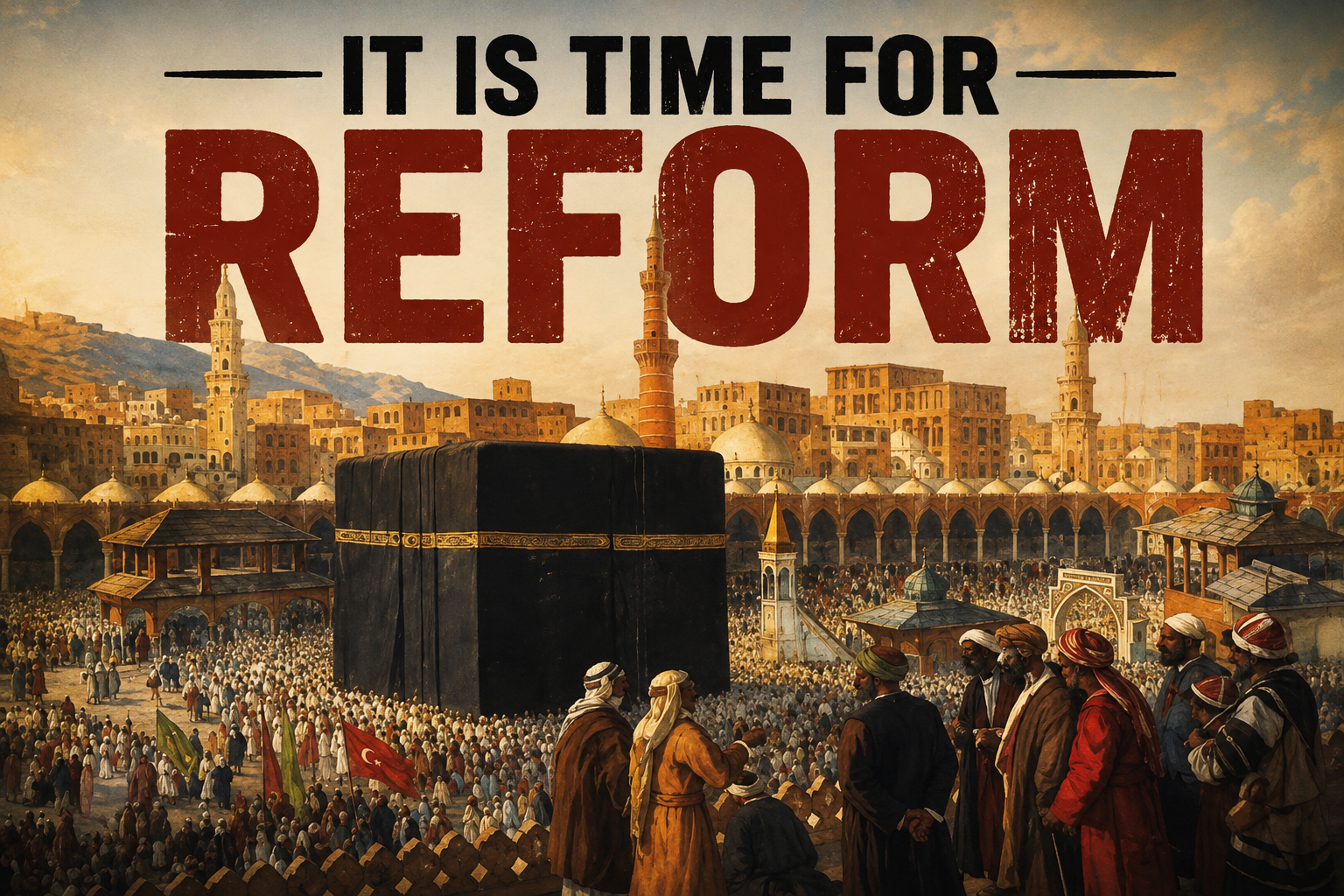
It is time for reform.