Islamism ’79: A Costly, Lose-Lose Bargain for West
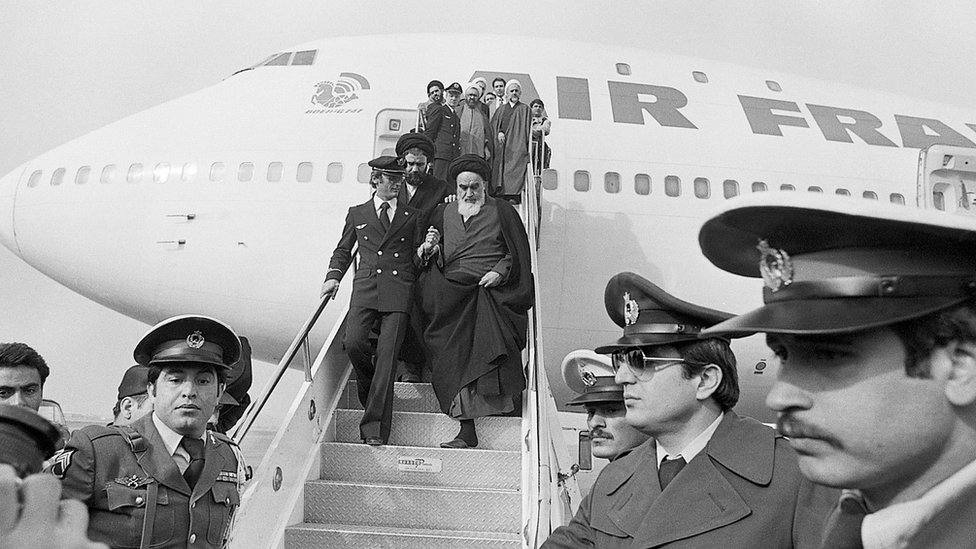
In 1979, when the Islamists prevailed in Iran, the West found itself trapped in a dead end where it sacrificed its long-term strategic interests for short-term calculations. Western governments believed they had no third option; they accepted and recognized the Islamist attackers in Iran as de facto occupiers. In the streets of Tehran, the two dominant forces — the radical Islamists and the Marxist left, from the Fedayeen to the Tudeh Party — joined together under the banner of anti-Americanism and anti-imperialism and pledged allegiance to Khomeini.
The very Western countries that had paved the way for Khomeini and his comrades, rolling out the red carpet for them, ended up as facilitators of the Islamist onslaught. They even appeared in the front rows of the regime’s mass prayer spectacles, performances meant to display the “legitimacy” of the new Islamist occupation in Tehran. But soon after this kneeling, calamities followed. The seizure of the U.S. Embassy and the hostage-taking of American diplomats was the first gift of Khomeinist anti-Westernism to the Western powers that had assisted this destructive movement.
This bizarre outcome was not an accident. It was, in effect, a “Cold War bargain.” In that bargain, Western policymakers viewed the Islamists as a useful lever against the Soviet Union, even though they were well aware that Moscow-aligned anti-Western leftists were also beating their chests under Khomeini’s banner.
It did not take long for the failure of this Western strategy of supporting and legitimizing the Khomeini disaster to reveal itself on multiple fronts. They had lost everything: political leverage, economic interests, and, more importantly, the core values of the West, all sacrificed to a fire they themselves helped ignite, one that quickly turned back toward them. All eyes were fixed on Iran, and attempts were made to contain the catastrophe, such as the U.S. “Operation Eagle Claw” to rescue the hostages. But that mission failed. It was too late. The Islamists were already deep into mass killings. Only one statesman, Mohammad Reza Shah Pahlav,i had foreseen the disaster and warned, in the court of history, that the fall of Iran could eventually sweep away its friends and allies as well.
Now, 47 years later, echoes of that same old logic persist in some Western think tanks: If this regime collapses, who will contain Russian and Chinese influence? They raise theories of a power vacuum and chaos or ask what the regional landscape might look like without the Islamic Republic. Yet these are the same questions that Western policymakers never asked when they were harboring and supporting Khomeinist terrorism. And now that they fully understand the depth of Iranian society’s desire for change, they choose to amplify these baseless anxieties.
A justified criticism toward Europe today is this: after the activation of the “snapback mechanism” and the return of international sanctions, neither the United Nations nor the European Union has shown any real will to enforce them. The provisions remain ink on paper. Meanwhile, the Islamic Republic continues aiding Putin’s crimes in Ukraine, engaging in maritime piracy, and persisting in hostage-taking while European governments resort to deals and ransom payments in response.
Today’s Iran is nothing like Iran in 1979. The generation that has repeatedly taken control of the streets, paying the price for political and social freedom, desires neither an Islamic caliphate nor twentieth-century socialism. They simply want to live like the rest of the world and join the free global community: free internet, valid passports, universities without forced hijab, an economy without sanctions, security without morality police, and individual rights. These are the minimum aspirations a nation can have after half a century of repression and decline what Iranians call the “Victory Generation.”
A glance at Iran’s neighbors is telling: less than five decades ago, the UAE, Qatar, and even Saudi Arabia were clusters of small towns with a few hundred thousand residents. Today, Dubai pierces the sky, Qatar has hosted the World Cup, and Riyadh is becoming the region’s financial hub. None of them reached this stage with nuclear weapons or ballistic missiles. They did it through political stability, foreign investment, openness to the world, and respect for basic civil rights.
Iran, meanwhile, has gone from being a country with the largest refinery in the Middle East (Abadan), a university (Pahlavi University) that competed with MIT, and women who freely studied and worked, to a place where young people line up for Schengen visas, fill their tanks by the liter, and girls are imprisoned for a headscarf. This regression is no accident: it is the direct result of the 1979 bargain the West struck with the Islamists and continues to maintain out of fear that “things could get worse.”
But there is nothing worse than an Islamist regime. A regime that has survived for 46 years through hostage-taking, terror, repression, and exporting crises has no legitimacy left, even among its former supporters. A government whose Foreign Ministry still bears the slogan “Neither East nor West” is today the largest regional trading partner of Beijing and Moscow. Its “nuclear program,” supposedly an “instrument of negotiation” for peaceful energy, is now closer than ever to a bomb. The clerical regime’s ballistic missiles are not for deterrence; they are meant to be launched at Europe, just as they are now raining down on Ukraine.
Yet some Western politicians still say, “We must negotiate with this regime because there is no alternative.” This is the same logic that once called Saddam Hussein a “guarantor of stability,” only to overthrow him in 2003 over alleged weapons of mass destruction, plunging the region into flames. The difference is that, unlike Iraq in 2003, Iranians themselves have already built the alternative. Iran is neither Afghanistan nor Iraq, but the Islamic Republic is indeed the Taliban, except that the Taliban, unlike Tehran’s clerics, have not yet been granted international political legitimacy.
From Prince Reza Pahlavi, who keeps Iran’s historic national flag raised, to civil activists, independent journalists, workers, teachers, students, and especially the pioneering women, everyone speaks with one voice: We are ready. We know the character of our future government: secular, democratic, decentralized, and accountable, guaranteeing the rights of all citizens regardless of ethnicity, religion, gender, or orientation. We do not need foreign military intervention. All we need is for the West to stop supporting the mullah-pasdaran regime and to support the will of the Iranian people.
A free Iran is not a threat; it would be the greatest guarantee of stability in the Middle East. A nation of nearly 90 million, largely educated, with vast energy reserves, a unique geopolitical position, and a population exhausted by ideology, could play the same role Germany played after 1945 or South Korea after 1988: rising from the ashes of dictatorship and conflict to become an economic and political power that benefits all.
China and Russia have influence in Iran today only because sanctions and enforced isolation have left no other path. If Iran reopens to the world, neither Beijing nor Moscow can offer even a fraction of what America, Europe, or Japan can. Today’s Iranian youth prefer iPhones to Chinese goods; Harvard and the Sorbonne to Moscow or Beijing; Paris and New York to Sochi and Shanghai and Europe’s industries would capture the vast Iranian market.
The West must no longer be afraid. It must stop hiding behind the excuses of “power vacuum” or “chaos” to avoid change in Iran. The fall of the Berlin Wall, the Czechoslovak Velvet Revolution, the reunification of Germany, and South Korea’s democratization all show that when a nation decides to change, no power can stop it except through bloody repression, the cost of which is far higher for everyone.
It is time for Western leaders to show the same courage that Ronald Reagan displayed in 1987 before the Berlin Wall. Just as he said to Gorbachev, “Tear down this wall,” today they must say to Khamenei and his clique, “Enough! Your time is up.”
Iran and its people deserve to reclaim their rightful historical place not as a threat, not as a “problem,” but as a friend, a partner, and a modern, prosperous, peaceful power that restores real balance to the Middle East and the world. Supporting Iran’s freedom movement can transform the West’s 47-year lose-lose bargain into a win-win for both sides.