
Israel Advocacy 2.0
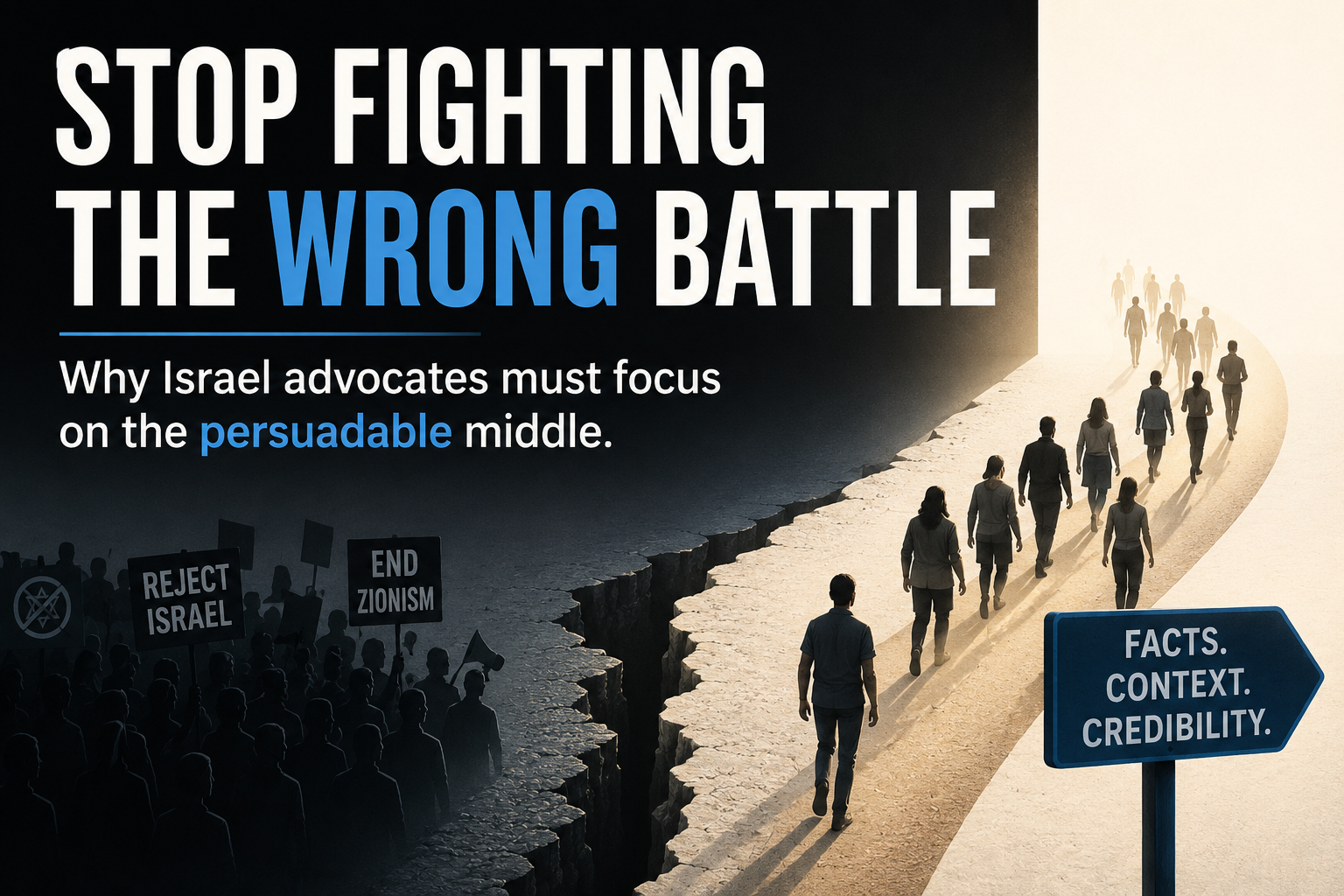
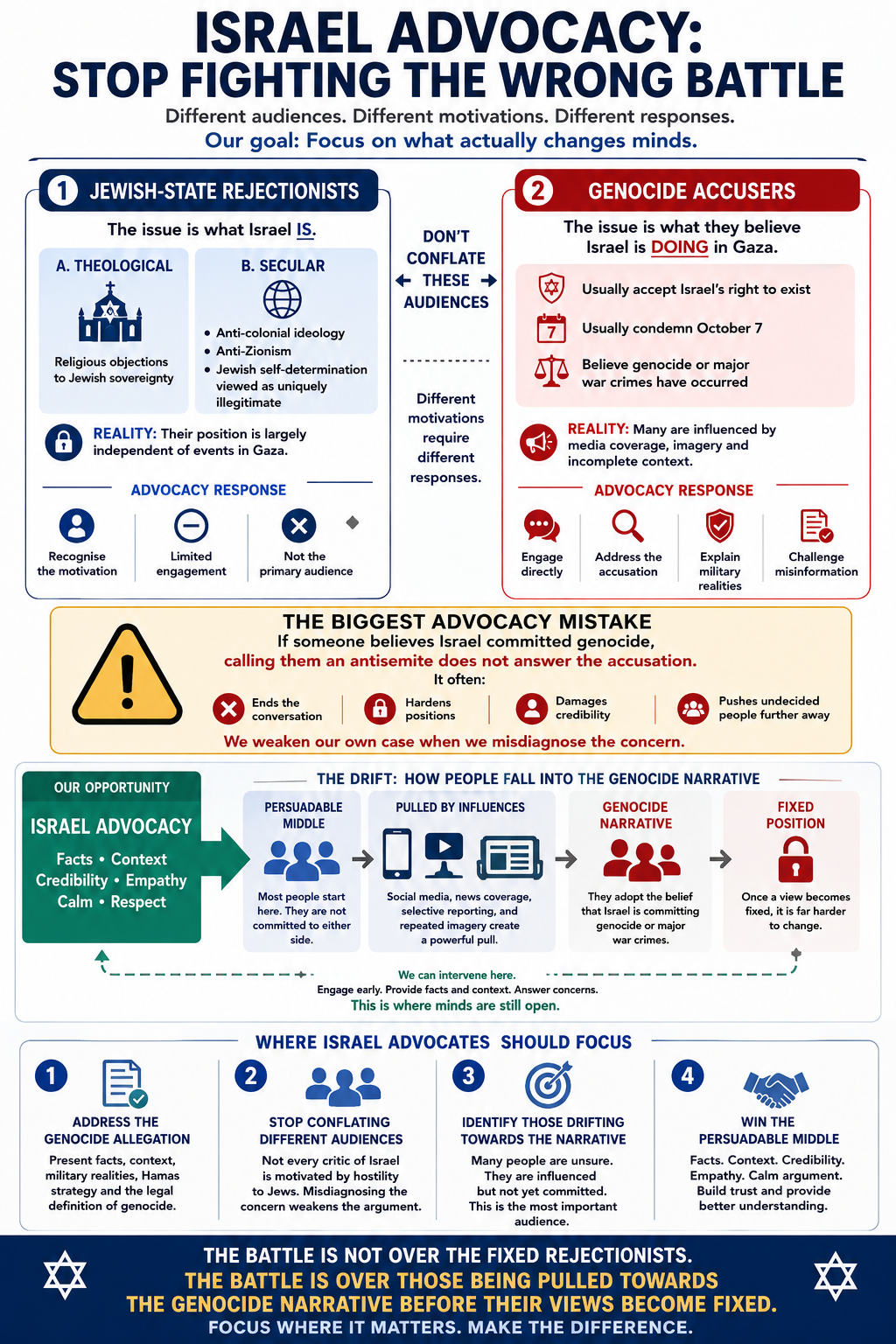
As an advocate for Israel, I believe I have to change how I think about Israel’s opponents. I have set this out in an infographic below.
Over the past year and a half, I have had hundreds of on-line conversations about Israel.
Some have been with committed supporters. Some with critics. Some with people who are simply confused by the endless stream of images, claims and counterclaims that now dominate social media and news coverage.
Those conversations have led me to a conclusion that has changed how I think about Israel advocacy.
I often talk about “the anti-Israel movement” as though it is one thing.
It is not.
The people marching together, posting together and repeating similar slogans are often motivated by very different beliefs. Yet we frequently respond to them as though they are all part of the same phenomenon.
I increasingly believe that this is a mistake.
At a broad level, there appear to be two very different groups.
The first opposes Israel because it rejects the legitimacy of a Jewish state. The reasoning varies. Sometimes it is religious. Sometimes it is ideological. Sometimes it is framed through anti-colonial language. But the conclusion is essentially the same: Israel itself is viewed as illegitimate.
For this group, the issue is what Israel is.
The second group is different.
Many within it accept Israel’s right to exist. Many condemned the atrocities of October 7. Yet they have become convinced that Israel’s conduct in Gaza constitutes genocide, war crimes, or both.
For them, the issue is what they believe Israel is doing.
These two groups often appear together. They may attend the same demonstrations and share the same social media content. But they are not motivated by the same concerns.
That distinction matters because it should fundamentally change how we engage.
Too often, when someone accuses Israel of genocide, the response from Israel’s supporters is to accuse them of antisemitism.
Sometimes that accusation is justified.
Sometimes it is not.
More importantly, it often fails to address the argument being made.
If someone genuinely believes Israel has committed genocide, responding by calling them an antisemite does not answer their concern. In many cases, it simply reinforces their conviction that supporters of Israel cannot defend the facts.
It also creates another problem.
There are millions of people around the world who have not yet reached a firm conclusion. They are neither committed opponents nor committed supporters. They are watching events unfold through a mixture of news reports, social media posts, photographs and video clips.
Some previously held positive views of Israel. Some remain sympathetic to the trauma of October 7. Many are simply trying to make sense of a conflict that is emotionally and politically overwhelming.
These people matter.
In fact, they may be the most important audience of all.
Every time we respond to a genocide accusation with an accusation of antisemitism, we risk losing part of that audience. Not because they are hostile to Israel, but because they see a question being asked and not being answered.
I do not believe Israel has committed genocide. I believe the facts, the legal definition of genocide, and the realities of the battlefield support that conclusion.
But if that is our position, then surely our responsibility is to make the case.
We should explain the complexities of urban warfare against an enemy embedded within civilian populations. We should discuss Hamas’s strategy, the use of human shields, the hostages, and the impossible choices that arise in such conflicts. We should present evidence and context.
We should not assume that everyone who disagrees with us is motivated by hostility towards Jews.
Some are.
Many are not.
The distinction is not merely academic. It is strategic.
The first group may be difficult or impossible to persuade. Their objection is rooted in Israel’s existence itself.
The second group is different. Their conclusions may be mistaken, but they are based on claims that can be challenged, evidence that can be examined, and arguments that can be debated.
And beyond both groups lies a much larger audience of people whose views are still forming.
That is where the real battle for public opinion is taking place.
As Israel advocates, we need to stop fighting the wrong battle.
Different audiences require different responses.
If our goal is persuasion rather than self-validation, then understanding that distinction is not optional. It is essential.