The views expressed herein are solely mine.
Israel and Somaliland: Red Sea Lines of Fire
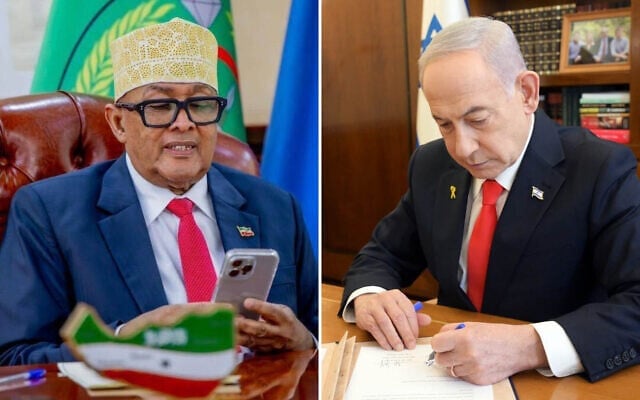
Composite picture. Left - Somaliland's President Abdirahman Mohamed Abdullahi speaks to Prime Minister Benjamin Netanyahu in a photo released on December 26, 2025, by the Israel Government Press Office; Right Prime Minister Benjamin Netanyahu signs Israel's declaration to recognize the Republic of Somaliland as an independent state, December 26, 2025. (Amos Ben Gershom/GPO)
Strategically, Israel’s recognition of Somaliland is not symbolic; it is a move timed to a war map—and to an emerging realignment.
Historically, Somaliland broke away from Somalia in 1991 as the Somali state collapsed into militia rule and institutional decay.
Institutionally, while Mogadishu dissolved, Somaliland undertook the unglamorous work of statehood: holding competitive elections (2003, 2010, 2017), maintaining a standing security force, controlling borders, and operating functional ports. For more than three decades, the international system treated Somaliland as an inconvenience while Israel treated it as a reality.
Precedent matters. This is not the first time Jerusalem has acted this way. In 1960, when British Somaliland briefly became independent before entering a failed union with Italian Somalia, Israel recognized Somaliland within days—during its six-day window of sovereignty. That recognition disappeared when Somaliland was absorbed into a state that later disintegrated.
Accordingly, Israel’s current move is not unprecedented; it is corrective. Certainly, a historical loop has closed.
Temporally, however, timing is decisive.
After October 7, 2023, the Yemenite Houthis transformed the Bab el-Mandeb Strait into a pressure valve for global trade. Missile and drone attacks forced shipping to reroute around Africa, driving up transit times, insurance premiums, and energy costs. Oil flows through the corridor dropped sharply. Supply chains felt it immediately. Geography reasserted itself as power.
Structurally, amid this recurring pattern of maritime coercion, Somaliland became pivotal.
Geographically, from Somaliland’s Gulf of Aden coastline, Yemen is not abstract. It is visible, measurable, and monitorable. Proximity enables early warning, maritime awareness, and operational depth. This is not cinematic “spy bases.” It is the unromantic math of intelligence: observe early, react less.
Doctrinally, this logic fits Israel’s long-standing periphery strategy—dating back to the Ben-Gurion era—of partnering with non-Arab or non-hostile actors to break strategic encirclement. In the 1950s and 1960s, that meant Africa and Iran. In the 2020s, it means the Red Sea and the Horn. Same doctrine. New battlefield.
Practically, the infrastructure already exists. Berbera Port, developed through a $442 million DP World agreement in 2016, transformed Somaliland into a logistics node tied to Gulf capital and Ethiopian trade corridors.
Under this new framework, Israel is not entering a vacuum; it is stepping onto hardened commercial geography that can be leveraged quietly and incrementally.
Conceptually, talk of Somaliland “joining” the Abraham Accords misunderstands the mechanism. The Accords are not a membership club; they are a U.S.-anchored alignment architecture. Somaliland’s value is not symbolic—it is functional normalization near a threatened artery.
Politically, the noise surrounding Gaza relocation schemes should be read accordingly. Reports described exploratory contacts; Somaliland publicly denied receiving proposals. As policy, mass relocation collapses on contact with law, consent, logistics, and regional blowback. Somaliland seeks recognition, investment, and legitimacy—not a demographic time bomb that would invite retaliation and destabilize its hard-won order.
Analytically, a serious discussion of Mossad activity must resist fantasy. There is no public evidence of covert deployments tied to recognition. What does exist is pattern recognition: Israel blends diplomacy, commerce, and intelligence wherever its strategic arteries are threatened. The Red Sea is now one of them.
Forward-looking, Israel’s recognition alters the permission structure. Once a Western-aligned democracy treats Somaliland as sovereign, the cost of others doing so drops—especially for the United States.
Institutionally, Washington has already debated Somaliland recognition in Congress, weighed it against China’s military presence in Djibouti, and examined Somaliland’s value as a stable partner in the Horn.
Ergo, Israel’s move provides political cover: it reframes recognition not as separatism, but as regional stabilization. Thence, if the U.S. follows—even partially through upgraded diplomatic status, security cooperation, or trade frameworks—the Horn of Africa’s balance of power would shift irreversibly.
Strategically, that shift would expose Iran’s Red Sea proxy network, dilute Chinese leverage anchored in Djibouti, reduce Houthi opacity across the Gulf of Aden, and convert Somaliland’s de facto statehood into de jure momentum. This explains the immediacy and volume of backlash. Egypt, Turkey, Somalia, and Djibouti understand that recognition is contagious—and that once Washington moves, the argument ends.
Stripped of ceremony and panic, the reality is stark: Israel has placed a legal flag on geography that matters at a moment when geography is killing assumptions. Somaliland gains legitimacy. Israel gains depth. The Red Sea becomes harder to weaponize.
Ultimately, this is not idealism. It is a forward deployment by diplomatic means.
Related Topics
Related Posts