A Moroccan Journalist
Jacky Kadoch: ‘Morocco can show Israel how to live in harmony’
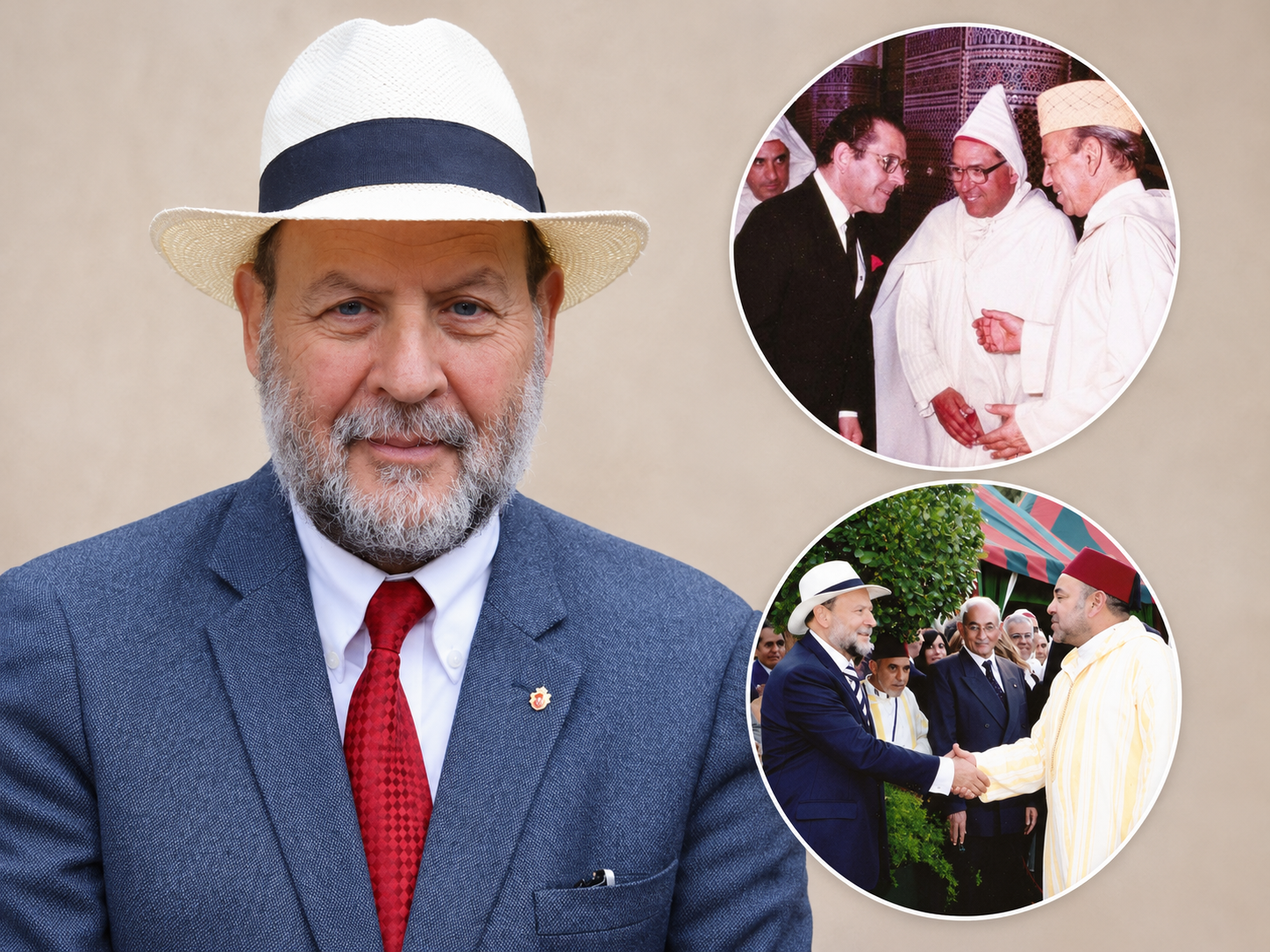
Jacky Kadoch, president of Marrakech’s Jewish community, pictured alongside King Hassan II and shaking hands with King Mohammed VI.
In Marrakech, a city where Jewish life once filled the narrow streets of the Mellah, the question of what remains of that past has become inseparable from the question of what can still be preserved for the future. The old Jewish quarter, its synagogues, cemeteries, and traditional houses are reminders of a community that helped shape the city’s identity over centuries. Yet for Jacky Kadoch, who was born and raised among those streets and has spent more than two decades leading the Jewish community of Marrakech, that history is far more personal than an architectural inheritance. It lives in the memories of neighbors, religious celebrations, family relationships, and a distinctively Moroccan sense of belonging that has survived even as the community itself has grown dramatically smaller.
The Jewish presence in Marrakech reaches back to the city’s early history, although its fortunes varied considerably under successive Moroccan dynasties. The Mellah, established in 1558 during the reign of the Saadian Sultan Moulay Abdallah al-Ghalib, became the principal center of Jewish communal life, bringing together generations of residents whose traditions reflected the diverse origins of Moroccan Jewry, including communities from the Atlas Mountains and descendants of Jews expelled from the Iberian Peninsula. Its history encompassed periods of coexistence and cultural exchange, but also segregation, economic hardship, and restrictions. According to historical research published by the Fondation Jardin Majorelle, Marrakech was home to approximately 16,700 Jews in 1951, only a year before Kadoch was born. The great waves of Jewish emigration that followed, particularly to Israel, France, and Canada, profoundly altered the community’s future. Today, the remaining Jewish population of Morocco numbers only a few thousand at most, with Casablanca accounting for the largest concentration. Marrakech’s once-thriving community survives on a much smaller scale, while many descendants of its former residents continue to preserve their Moroccan identity abroad.
Born in 1952 into a longstanding Marrakchi Jewish family, Kadoch inherited a close connection to the community’s institutions. His father, Henri Kadoch, was himself a former communal president, and Jacky has served as president of the Jewish community of Marrakech and Essaouira, today generally identified with the Marrakech-Safi region, since 2003. His responsibilities have extended beyond safeguarding places of worship to maintaining communal services, supporting vulnerable members, welcoming visitors, and sustaining relationships with Jewish communities abroad. He has also been active in promoting Jewish-Muslim dialogue. In May 2019, for example, he organized an interfaith Ramadan gathering at Marrakech’s Beth El Synagogue, bringing Jewish and Muslim participants together, with the traditional red Moroccan tarboush and Jewish kippah worn side by side, alongside local officials and civil society representatives. The gathering offered a visible expression of the relationships he has long sought to preserve, at a time when demographic decline has made the survival of ordinary communal life increasingly difficult.
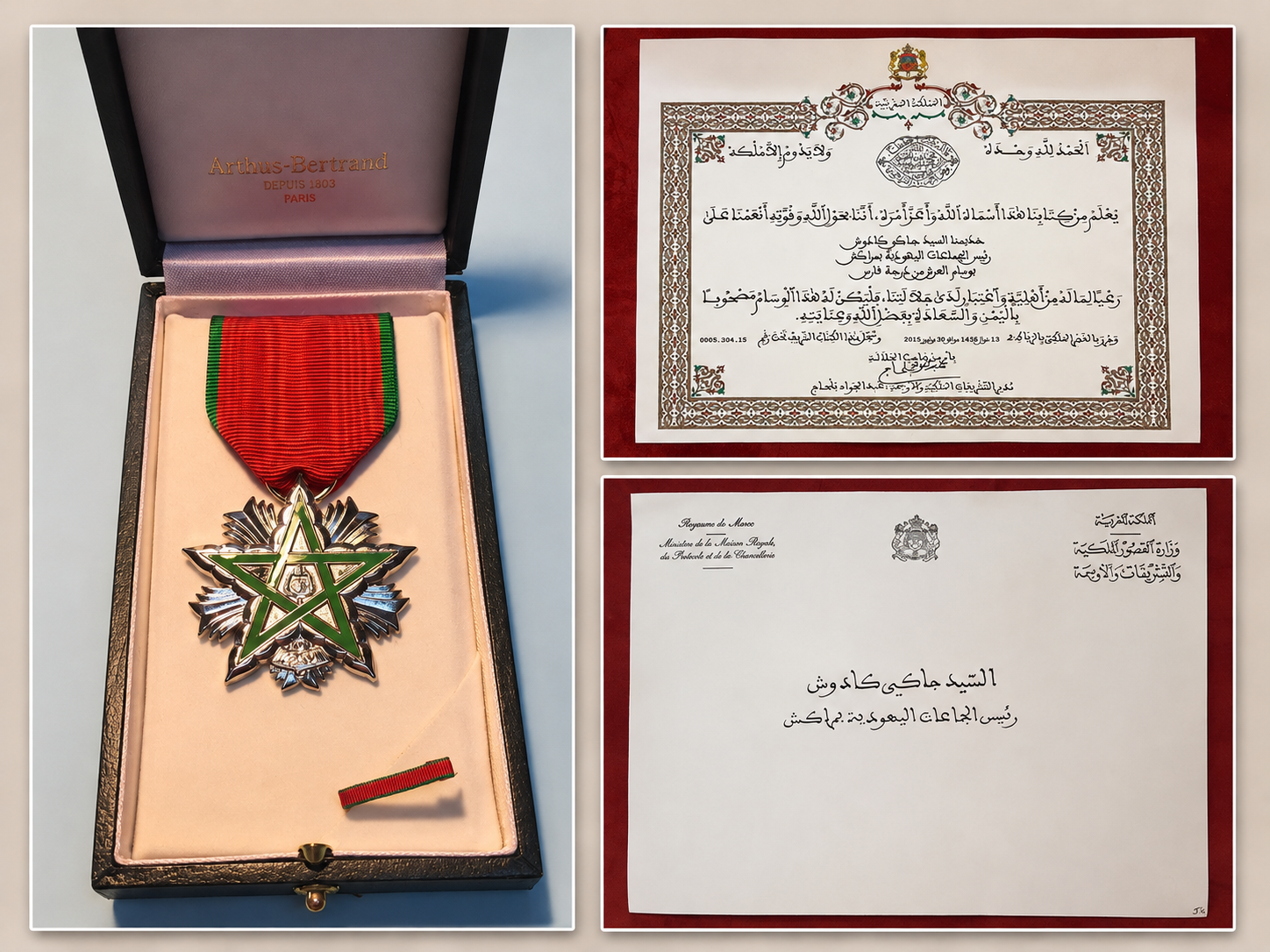
Morocco’s response to the disappearance of much of its historic Jewish population has involved an extensive effort to preserve the country’s Jewish heritage as part of its national identity. The 2011 Constitution explicitly recognizes the Hebrew component among the cultural influences that have enriched Moroccan identity, placing it alongside the country’s African, Andalusian, and Mediterranean heritage. King Mohammed VI has repeatedly reinforced that recognition. In a 2013 message marking the restoration of the Slat al-Fassiyine Synagogue in Fez, he called for the restoration of synagogues across Morocco, envisioning them not only as places of worship but also as spaces for cultural dialogue. In Marrakech, a royal-backed rehabilitation program launched in 2014 helped restore parts of the historic Mellah, whose original name was subsequently reinstated. Sites such as the Slat Al Azama Synagogue and the Miâara Jewish Cemetery continue to connect the city with its Jewish past. In November 2026, Serge Berdugo, secretary-general of the Council of Jewish Communities of Morocco, disclosed plans for another heritage-preservation campaign, following earlier work covering more than 170 Jewish cemeteries and approximately 20 sanctuaries.
Yet the survival of a historic building and the survival of the community that gave it meaning are not necessarily the same achievement. A restored synagogue may attract visitors from around the world without having enough local worshippers for regular services. A cemetery may draw descendants searching for family graves even when few relatives remain in the city itself. These are among the practical realities confronting Kadoch, whose responsibilities increasingly involve connecting the shrinking resident community with the much larger Moroccan Jewish diaspora. His concerns have also taken a more public form. In July 2025, speaking at a seminar organized by the Lahcen Lyoussi Academy, he advocated official recognition of Rosh Hashanah, the Jewish New Year, as a Moroccan national holiday. The proposal reflected his conviction that recognition of Jewish heritage should extend beyond the preservation of historical monuments to the religious and civic life of Jewish Moroccans today.
These questions have acquired additional significance since Morocco and Israel renewed official diplomatic relations in December 2020, opening new opportunities for travel, cooperation, and connections between Moroccan Jews and the land of their ancestors. But the war in Gaza following October 7, 2023, has also brought renewed political sensitivities, particularly in a country where solidarity with the Palestinians remains deeply rooted in public life. The distinction between Morocco’s Jewish citizens, Jewish visitors, and the policies of the Israeli government has consequently become an important part of the national conversation. Kadoch himself addressed such concerns in April 2026 after footage of Orthodox Jewish pilgrims praying near Marrakech’s Bab Doukkala prompted controversy on Moroccan social media. He explained that the visitors were members of the New York-based Satmar Hasidic community, rather than Israeli worshippers, and described their prayers as an ordinary religious practice. The episode illustrated how questions of Jewish identity and religious freedom can become entangled with the politics of the wider Middle East.
For Kadoch, however, the future of Moroccan Jewish life ultimately rests on something more enduring than diplomatic agreements or political controversies. In an interview published in 2018, he spoke of his ambition to establish a synagogue and community center near a mosque and church in Marrakech, imagining the three religious institutions standing beside one another. Nearly a decade later, that ambition remains close to his heart. It is a vision that brings together the central themes of his life’s work: the preservation of memory, the continuation of Jewish religious life, and the possibility of transmitting a shared Moroccan identity to generations who may never have experienced the Marrakech of his childhood. In the following written interview with The Times of Israel Blogs, Kadoch reflects on those formative memories, the challenges of leading a shrinking community, the attachment of Moroccan Jews in Israel and elsewhere to their ancestral homeland, the effects of the Gaza war on intercommunal relations, and his hopes for a future in which Morocco’s Jewish heritage remains not merely remembered, but lived.
Adil Faouzi: 1. You were born and raised in Marrakech at a time when the city’s Jewish community was considerably larger than it is today. When you think back to your childhood in the Mellah, what memories best capture the relationship between Jewish and Muslim Moroccans? Is there a particular personal experience that has remained with you throughout your life?
Jacky Kadoch:
I grew up in the Mellah of Marrakech, at a time when our community was still vibrant, numerous, and deeply rooted in the city. What I remember most vividly is this natural closeness, this everyday blending between Jewish and Muslim neighbors. We would cross paths at the market, share the same joys, the same sorrows, the same celebrations. Children played together, women exchanged words at the fountains, merchants collaborated without distinction of religion. This coexistence was not merely tolerated: it was normal, natural, woven into the very fabric of the city.
One particular memory has stayed with me throughout my entire life. As a child, a Muslim neighbor gave me a gift during our Purim celebration — not out of obligation, but simply as an act of human kindness. That moment of pure humanity, free from any political or religious consideration, taught me that fraternity truly existed, that it was possible, and that it was an integral part of our Moroccan identity. This memory has accompanied me all my life, and it still guides me today in my commitment to dialogue and tolerance.
Adil Faouzi: 2. You have been leading Marrakech’s Jewish community for more than two decades, witnessing profound demographic and social changes. What has been the most difficult part of preserving Jewish communal life as the number of Jewish residents has declined? Do you worry about the future of an active Jewish presence in Marrakech?
Jacky Kadoch:
The most difficult aspect has undoubtedly been maintaining the sense of belonging and communal vitality as the number of worshippers dwindled. Preserving regular worship, ensuring education for the young, maintaining holy sites, organizing ceremonies — all of this becomes more challenging when the community shrinks. One must find resources, mobilize volunteers, and keep hope and energy alive.
However, I am not worried about the future of the Jewish presence in Marrakech. The community, though reduced in size, remains alive, resilient, and proud of its roots. It continues to celebrate, to study, to gather. Moreover, Morocco has become aware of the importance of its Jewish heritage and is investing in its preservation. The Kingdom also encourages Diaspora communities to return, to visit, to contribute.
This creates a bridge between dispersed communities and those who remain on Moroccan soil. I firmly believe that as long as there are families, as long as there is a Beth Hamikdash, as long as there are children learning their history, the community will endure and thrive.
Adil Faouzi: 3. Morocco has invested in restoring synagogues, Jewish cemeteries, and historic neighborhoods, including Marrakech’s Mellah. But preserving buildings is not necessarily the same as preserving a living community. In your view, what more needs to be done to ensure that Morocco’s Jewish heritage remains a living part of its national identity rather than simply a memory of the past?
Jacky Kadoch:
You are right: restoring buildings is not enough. A holy site can be renovated, but if no one remains to pray, to celebrate, to give it life, it becomes a museum rather than a place of worship. For Morocco’s Jewish heritage to remain living, several things must be pursued simultaneously.
First, we must continue to support the resident community: providing educational structures, cultural activities, and spiritual guidance. Second, it is essential to highlight Jewish Moroccan history within the national narrative, in school curricula, and in collective memory. Jewish heritage must be perceived as an inseparable component of Moroccan identity, not as an isolated chapter of the past.
Third, Jewish cultural tourism can play an important role: attracting visitors, generating revenue, creating jobs, but always with respect and authenticity. Finally, we must encourage intercommunal dialogue, strengthen bonds between Moroccan Jews and Moroccan Muslims, because it is within this living relationship that the true longevity of the heritage resides. Morocco has already made significant strides under the leadership of His Majesty King Mohammed VI, who has always defended coexistence and tolerance. But there is still ground to cover. The goal is not merely to preserve stones, but to preserve souls, memories, a living culture that continues to contribute to the extraordinary richness of Morocco.
Adil Faouzi: 4. Hundreds of thousands of Israelis trace their family origins to Morocco, and many continue to visit the kingdom for religious pilgrimages, family reunions, and cultural experiences. Through your encounters with these visitors, what have you learned about their attachment to Morocco? Have you witnessed any particularly moving reunions or encounters that illustrate how deeply this connection survives across generations?
Jacky Kadoch:
Through my encounters with these visitors, I have learned that their attachment to Morocco is profound, visceral, almost instinctive. For many, it is a quest for identity, a return to their roots. They come searching for traces of their grandparents, their great-grandparents, places where their families lived, prayed, suffered, and hoped.
I have been deeply moved by several reunions. Some families had not seen each other in decades, even centuries, and during community visits, bonds were rekindled. I have seen people weeping as they discovered their ancestors’ graves in our cemeteries, touching the tombstones as if finally able to say goodbye after so many years. Others have confided that they discovered here traditions, songs, and dishes that had disappeared in their countries of adoption but which still lived on in Morocco. This living transmission, this memory that resists time and distance, fills me with profound emotion and reinforces my belief that the bond between the Diaspora and Morocco is indestructible.
Adil Faouzi: 5. Since October 2023, the war in Gaza and Morocco’s public debate over relations with Israel have introduced additional sensitivities. From your personal experience, how have these developments affected everyday relations between Jewish and Muslim Moroccans? Do you feel that Moroccan society generally distinguishes between its Jewish citizens and the policies of the Israeli government?
Jacky Kadoch:
Since October 2023, it is true that the climate has somewhat tightened at the media and political levels. However, in everyday life, relations between Jewish and Muslim Moroccans have remained remarkably stable. Our neighbors, colleagues, and Muslim friends continue to welcome us with respect and kindness. Moroccan society generally makes a clear distinction between the policies of the Israeli government and the Moroccan Jewish community.
Moroccans have always known how to differentiate between their own Jewish citizens, who are integrated and proud of their Moroccan identity, and decisions made in Jerusalem. Of course, there are public debates, strong emotions, and sometimes legitimate frustrations regarding the humanitarian situation in Gaza. But this has not translated into hostility toward our communities. On the contrary, many Moroccans have comforted us, assuring us that our place within the nation remains intact. I am proud to see that Moroccan social fabric, founded on mutual respect and tolerance, withstands these external tensions.
Adil Faouzi: 6. You have previously advocated official recognition of Rosh Hashanah, the Jewish New Year, as a national holiday in Morocco. Why is this recognition important to you? Beyond its symbolic significance, what would it mean for Moroccan Jews and for the wider understanding of Moroccan national identity?
Jacky Kadoch:
Official recognition of Rosh Hashanah as a national holiday is, in my view, a matter of justice and acknowledgment. Moroccan Jews are an integral part of the nation for millennia. It is only natural that they should be able to celebrate their New Year without having to request leave or justify their religious practice.
Beyond its symbolic significance, this recognition would have concrete consequences. It would allow members of our community to fully observe their holidays without professional or administrative constraints. It would send a strong message to all Moroccan society: religious diversity is not a threat; it is a richness. Morocco has always been a country of coexistence, and officially recognizing Rosh Hashanah would strengthen this image, this reality.
For young Moroccan Jewish generations, it would mean that their identity is recognized, valued, and legitimate. For society as a whole, it would remind everyone that Jewish history is part of Morocco’s history, that our holidays are also the country’s holidays. It is a step toward full inclusion, toward a nation that embraces all its components without exception.
Adil Faouzi: 7. Looking beyond the diplomatic relationship established in 2020, what do you believe Morocco and Israel can genuinely learn from one another through their shared human history? And, personally, after so many years devoted to your community, what legacy would you most like to leave for future generations of Moroccan Jews and Muslims?
Jacky Kadoch:
Beyond the diplomatic relations established in 2020, Morocco and Israel can genuinely learn much from one another through their shared human history. Morocco can show Israel how to live in harmony with its diversity, how to preserve the heritage of all communities on its soil. Israel, in turn, can learn from Morocco the art of peaceful coexistence, the ability to maintain calm relations despite regional conflicts. The two peoples share common roots, similar values, and overlapping traditions. This cultural and spiritual proximity deserves to be cultivated, studied, and transmitted.
Personally, after so many years devoted to my community, I would like to leave three main legacies for future generations. First, that future generations of Moroccan Jews proudly maintain their identity, their language, and their traditions, while remaining deeply rooted in Morocco. Second, that relations between Moroccan Jews and Moroccan Muslims remain strong, based on mutual respect, fraternity, and collaboration. Finally, that the world understands that Morocco is a model of tolerance, an example of what harmonious coexistence between peoples and religions can look like.
I would like to leave future generations with the certainty that their presence in Morocco is legitimate, necessary, and precious. Whether Jewish or Muslim, they are all part of this beautiful nation called Morocco, and it is together, through dialogue and love for the country, that they will build the future.
Finally, allow me to share with you my very cherished dream, that I hope will one day become reality: to see a large and beautiful Synagogue built in the Guéliz district, right beside the Mosque and the unique Marrakech’s Catholic church.
For me, this would be much more than the construction of a place of worship. It would be a living symbol of Morocco’s rich religious and cultural heritage, and a testament to the presence of Jewish, Muslim, and Christian communities in our country. Placing these three houses of worship side by side would send a powerful message: that people of different faiths can live together, respect one another, and share a common sense of belonging.
This synagogue would serve not only the Jewish community of Marrakech, but also visitors from across Morocco and all around the world who come to reconnect with their roots and heritage. It could become a place of prayer, learning, dialogue, and cultural exchange—a bridge between generations and communities.
I believe that such a project would give tangible expression to the spirit of coexistence that has long been part of Morocco’s history and identity. It would stand as a message of hope for future generations: that our differences need not divide us, and that mutual respect, friendship, and love for our country can bring us together.
Related Topics
Related Posts